Log in to make the most of Hymnary.org collections.
And can it be that I should gainAuthor: Charles Wesley (1738)Tune: SAGINA Songs of Response Published in 203 hymnals Printable scores: PDF, SibeliusAudio files: MIDI | ||
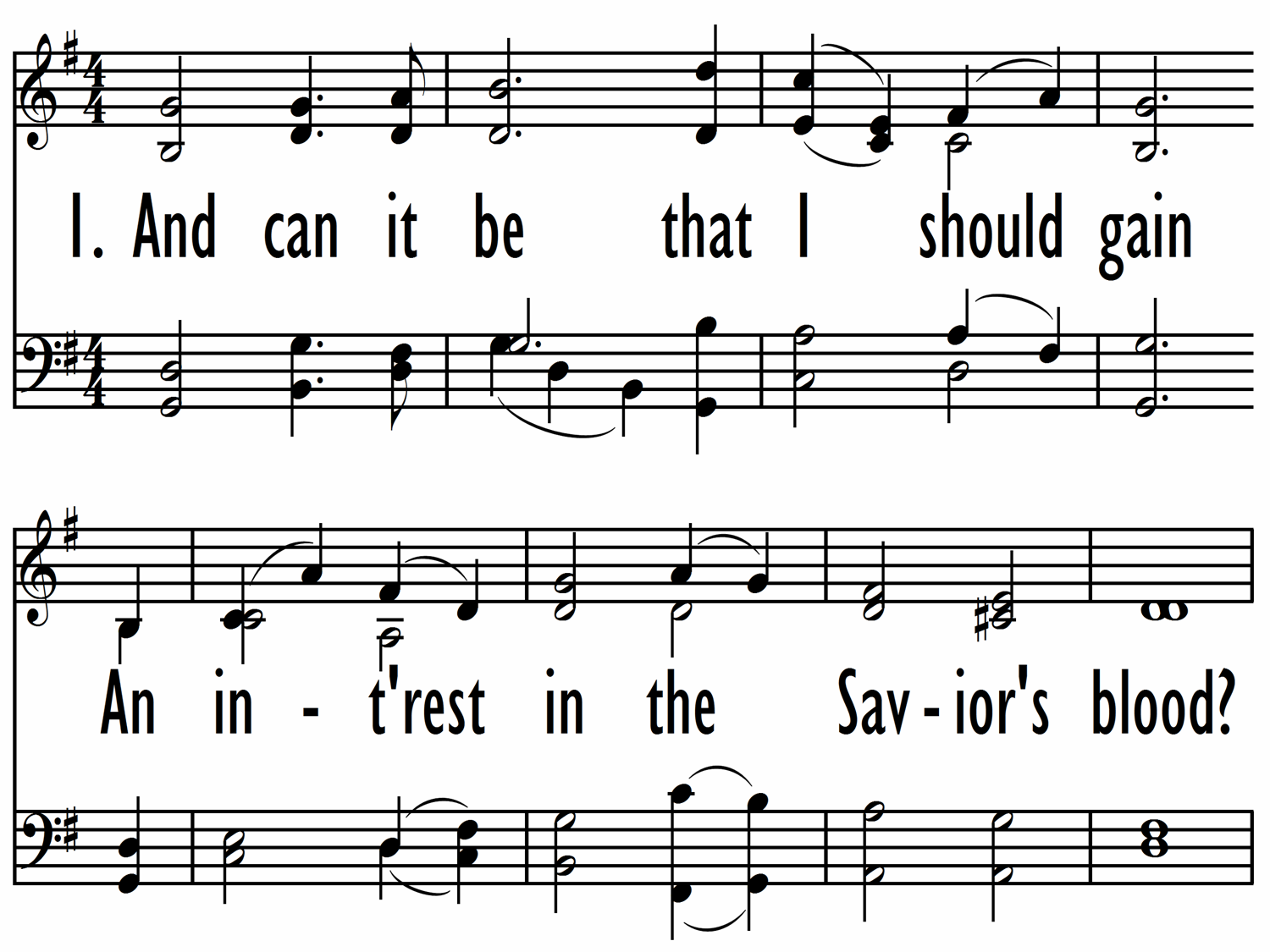
1 And can it be that I should gain
An int'rest in the Savior's blood?
Died He for me, who caused His pain?
For me, who Him to death pursued?
Amazing love! how can it be
That Thou, my God, should die for me?
Refrain:
Amazing love! how can it be
That Thou, my God, should die for me!
2 'Tis mystery all! Th'Immortal dies!
Who can explore His strange design?
In vain the firstborn seraph tries
To sound the depths of love divine!
'Tis mercy all! let earth adore,
Let angel minds inquire no more. [Refrain]
3 He left His Father's throne above,
So free, so infinite His grace;
Emptied Himself of all but love,
And bled for Adam's helpless race;
'Tis mercy all, immense and free;
For, O my God, it found out me. [Refrain]
4 Long my imprisoned spirit lay
Fast bound in sin and nature's night;
Thine eye diffused a quick'ning ray,
I woke, the dungeon flamed with light;
My chains fell off, my heart was free;
I rose, went forth and followed Thee. [Refrain]
5 No condemnation now I dread;
Jesus, and all in Him is mine!
Alive in Him, my living Head,
And clothed in righteousness divine,
Bold I approach th'eternal throne,
And claim the crown, through Christ my own. [Refrain]
Amen.
Sing Joyfully, 1989
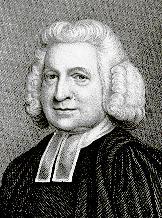
Charles Wesley, the son of Samuel Wesley, was born at Epworth, Dec. 18, 1707. He was educated at Westminster School and afterwards at Christ Church, Oxford, where he graduated M.A. In 1735, he took Orders and immediately proceeded with his brother John to Georgia, both being employed as missionaries of the S.P.G. He returned to England in 1736. For many years he engaged with his brother in preaching the Gospel. He died March 29, 1788. To Charles Wesley has been justly assigned the appellation of the "Bard of Methodism." His prominence in hymn writing may be judged from the fact that in the "Wesleyan Hymn Book," 623 of the 770 hymns were written by him; and he published more than thirty poetical works, written either by himself alone,… Go to person page >| First Line: | And can it be that I should gain |
| Title: | And Can It Be, That I Should Gain? |
| Author: | Charles Wesley (1738) |
| Meter: | 8.8.8.8 |
| Place of Origin: | Great Britain |
| Refrain First Line: | Amazing love! How can it be |
| Publication Date: | 1873 |
| Copyright: | This text in in the public domain in the United States because it was published before 1923. |
| Liturgical Use: | Songs of Response |
Scripture References:
st. 2 = Phil. 2:7-8
st. 3 = Acts 12: 6-8, Acts 16:25-26
st. 4 = Rom. 8:1, Heb. 4:16
In a compact poetic manner, this text exclaims the mystery of God's grace extended to sinners who turn to Christ in faith. These sinners receive the righteousness of Christ and can approach the Lord's throne in confidence. Such is the amazing love of God in Christ! Charles Wesley (b. Epworth, Lincolnshire, England, 1707; d. Marylebone, London, England, 1788) wrote his powerful and joyful hymn text in 1738 in the days immediately following his conversion to belief in Christ (May 21); he sang it with his brother John (b. Epworth, 1703; d. London, 1791) shortly after John's "Aldersgate experience."
"And Can It Be" was first published in john Wesley's Psalms and Hymns (1738). It is subtitled "Free Grace" in John and Charles Wesley's Hymns and Sacred Poems (1739). Traditionally one of the great hymns of Methodism, this text appears in a number of modern hymnals.
Like so many of Charles Wesley's hymn texts, "And Can It Be" is full of allusions to and quotations from Scripture; a few of the more obvious texts are Philippians 2:7, Acts 12:6-8, Romans 8:1, and Hebrews 4:16. Wesley's use of metaphors is also noteworthy – he deftly contrasts light and darkness, life and death, slavery and freedom, and especially Christ's righteousness and our unrighteousness.
Liturgical Use:
Service of confession and forgiveness; adult baptism; in conjunction with doctrinal preaching; many other occasions.
Several members of the Wesley family are significant figures in the history of English hymnody, and none more so than Charles Wesley. Charles was the eighteenth child of Samuel and Susanna Wesley, who educated him when he was young. After attending Westminster School, he studied at Christ Church College, Oxford. It was there that he and George Whitefield formed the Oxford "Holy Club," which Wesley's brother John soon joined. Their purpose was to study the Bible in a disciplined manner, to improve Christian worship and the celebration of the Lord's Supper, and to help the needy. Because of their methods for observing the Christian life, they earned the name “Methodists.”
Charles Wesley was ordained a minister in the Church of England in 1735 but found spiritual conditions in the church deplorable. Charles and John served briefly as missionaries to the British colony in Georgia. Enroute they came upon a group of Moravian missionaries, whose spirituality impressed the Wesleys. They returned to England, and, strongly influenced by the ministry of the Moravians, both Charles and John had conversion experiences in 1738 (see more on this below). The brothers began preaching at revival meetings, often outdoors. These meetings were pivotal in the mid-eighteenth-century "Great Awakening" in England.
Though neither Charles nor John Wesley ever left the Church of England themselves, they are the founders of Methodism. Charles wrote some sixty-five hundred hymns, which were published in sixty-four volumes during his lifetime; these include Collection of Psalms and Hymns (1741), Hymns on the Lord's Supper ( 1 745), Hymns and Spiritual Songs (1753), and Collection of Hymns for the Use of the People called Methodists (1780). Charles's hymns are famous for their frequent quotations and allusions from the Bible, for their creedal orthodoxy and their subjective expression of Christian living, and for their use of some forty-five different meters, which inspired new hymn tunes in England. Numerous hymn texts by Wesley are standard entries in most modern hymnals; fourteen are included in the Psalter Hymnal.
Charles's elder brother John also studied at Christ Church College, Oxford, and was ordained a priest in the Church of England in 1728. A tutor at Lincoln College in Oxford from 1729 to 1735, Wesley became the leader of the Oxford "Holy Club" mentioned above. After his contact with the Moravian missionaries, Wesley began translating Moravian hymns from German and published his first hymnal, Collection of Psalms and Hymns, in Charleston, South Carolina (1737); this hymnal was the first English hymnal ever published for use in worship.
Upon his return to England in 1738 Wesley "felt his heart strangely warmed" at a meeting on Aldersgate Street, London, when Peter Bohler, a Moravian, read from Martin Luther's preface to his commentary on the epistle to the Romans. It was at that meeting that John received the assurance that Christ had truly taken away his sins. That conversion experience (followed a few days later by a similar experience by his brother Charles) led to his becoming the great itinerant evangelist and administrator of the Methodist "societies," which would eventually become the Methodist Church. An Anglican all his life, John Wesley wished to reform the Church of England and regretted the need to found a new denomination.
Most of the hymnals he prepared with his brother Charles were intended for Christians in all denominations; their Collection of Hymns for the Use of the People called Methodists (1780) is one of the few specifically so designated. John was not only a great preacher and organizer, he was also a prolific author, editor, and translator. He translated many classic texts, wrote grammars and dictionaries, and edited the works of John Bunyan and Richard Baxter. In hymnody he is best known for his translation of selections from the German hymnals of Johann Crüger ('Jesus, thy boundless love to me"), Freylinghausen, and von Zinzendorf ('Jesus, thy blood and righteousness"), and for his famous "Directions for Singing," which are still printed in Methodist hymnals. Most significant, however, is his well-known strong hand in editing and often strengthening his brother Charles's hymn texts before they copublished them in their numerous hymnals.
--Psalter Hymnal Handbook
===========================
And can it be that I should gain. C. Wesley. [Thanksgiving for Salvation.] Written at Little Britain, in May, 1738, together with the hymn, "Where shall my wondering soul begin?" on the occasion of the great spiritual change which C. Wesley at that time underwent. His diary of that date gives minute details of the mental and spiritual struggles through which he passed, evidences of which, and the ultimate triumph, are clearly traceable in both hymns. It was first published in J. Wesley's Psalms and Hymns, 1738, and again in Hymns and Sacred Poems, 1739, p. 117, in 6 stanzas of 6 lines. When included in the Wesleyan Hymn Book, 1780, stanza v. was omitted, the same arrangement being retained in the revised edition 1875, No. 201. It has passed from that hymnal into numerous collections in Great Britain and most English-speaking countries. Stevenson's note on this hymn, dealing with the spiritual benefits it has conferred on many, is full and interesting (Methodist Hymn Book Notes, p. 155). Original text in Poetical Works, 1868-72, vol. i. p. 105.
-- John Julian, Dictionary of Hymnology (1907)

“And Can It Be” was written by Charles Wesley in 1738, in response to his conversion to belief in Christ. It was published in John Wesley's Psalms and Hymns in that same year with six stanzas. In a later republication by the Wesleys in 1780, the original fifth stanza was omitted (beginning “Still the small inward voice I hear”), and this revision has been honored ever since.
This hymn usually appears with all five stanzas, though sometimes the second (beginning “'Tis mystery all!”) is omitted. The refrain is a repetition of the last two lines of the first stanza. Sometimes there is an expanded refrain, in which these two lines are sung twice after every stanza, replacing the last two lines of the second through fifth stanzas, but this omits some important lines of the hymn.
In the nineteenth century, FILLMORE was the most common tune this hymn was sung to. However, in the twentieth century this text was paired with SAGINA, and with few exceptions, this is the only tune used today. SAGINA is by Thomas Campbell, about who little is known other than that he published The Bouquet in 1825, a collection of twenty-three tunes with botanical names. “Sagina” is the name of a genus of flowering plants.
The tune is fairly well-known, but it can present difficulties for congregational singing because of its wide range and frequent melismas. It is a good idea to sing in parts, especially on the refrain.
This hymn is used as a song of response, and is especially suited to a service of confession and forgiveness, or an adult baptism. If more than one hymn is desired, try pairing it with another joyful song of response, such as “My Hope is Built on Nothing Less,” or, for contrast, a peaceful one, such as “Amazing Grace.”
One unusual way to use this hymn would be to have the choir sing Lloyd Larson's setting of Wesley's text to the music of classical composer Gabriel Fauré's “Pavane,” titled “How Can It Be?”. The soft, haunting mood of this arrangement is best suited for Lent or Holy Week, and allows the listener to contemplate the sober reality of Christ's sacrifice. The collection “Amazing Love” by Mary MacDonald includes an arrangement for organ and piano duet that is more suited to the jubilant mood this hymn is normally sung with. Another instrumental setting of “And Can It Be” is the trumpet and trombone duet with piano accompaniment by Dana F. Everson. “The Festival Hymn Collection, volume 2” contains a setting of this hymn, with organ introduction, two settings of the verse, and an optional descant.
Tiffany Shomsky Hymnary.org
PowerPoint | ![]() |
Piano/OrganMore Piano/Organ > | ![]() |
ChoralMore Choral > | ![]() |
InstrumentalMore Instrumental > | ![]() |
| Instances (28) | First Line | Text Title | Refrain First Line | Authors | Composers | Meter | Scripture | Tune Title | Tune Key | Incipit | Languages | Publication Date | |||||
|---|---|---|---|---|---|---|---|---|---|---|---|---|---|---|---|---|---|
| Baptist Hymnal 1991 #147 | And can it be that I should gain | And Can It Be | Charles Wesley | Thomas Campbell | 8.8.8.8.8.8 with refrain | Ephesians 2:7 | SAGINA | G Major | 1991 | ||||||||
| Baptist Hymnal 2008 #250 | And can it be that I should gain | And Can It Be | Amazing love! how can it be | Charles Wesley | Thomas Campbell; Dennis Allen | 8.8.8.8.8.8 with chorus | SAGINA | G Major or modal | English | 2008 | |||||||
| Celebrating Grace Hymnal #605 | And can it be that I should gain | And Can It Be | Amazing love! How can it be | Charles Wesley | Thomas Campbell | 8.8.8.8.8.8 with refrain | SAGINA | G Major or modal | 2010 | ||||||||
| Celebration Hymnal #347 | And can it be that I should gain An int'rest in the Savior's blood? | And Can It Be | [And Can It Be] | G Major | 1997 | ||||||||||||
| Church Family Worship #389 | And can it be that I should gain | 1988 | |||||||||||||||
| Church Hymnal, Fifth Edition #218 | And can it be that I should gain | 2000 | |||||||||||||||
| Church Hymnary, Fourth Edition #396b | And can it be, that I should gain | Charles Wesley (1707-1788) | Thomas Campbell | 8.8.8.8.8.8 | SAGINA | G Major or modal | English | 2005 | |||||||||
| Church Hymnary, Fourth Edition #396a | And can it be, that I should gain | Charles Wesley (1707-1788) | Henry Carey (1687-1743); David Evans (1874-1948) | 8.8.8.8.8.8 | SURREY (CAREY'S) | F Major or modal | English | 2005 | |||||||||
| Complete Anglican Hymns Old & New #32 | And can it be that I should gain | And can it be that I should gain | 2000 | ||||||||||||||
| Complete Mission Praise #33 | And can it be that I should gain | 2000 | |||||||||||||||
| Hymns of Faith #57 | And can it be that I should gain | And Can It Be that I Should Gain | Amazing love! how can it be | Charles Wesley | Thomas Campbell | Romans 5:8; Colossians 1:27 | [And can it be that I should gain] | G Major or modal | 1980 | ||||||||
| Hymns Old and New: New Anglican #30 | And can it be that I should gain | 1996 | |||||||||||||||
| Lift Up Your Hearts: psalms, hymns, and spiritual songs #695 | And can it be that I should gain | And Can It Be | Amazing love! How can it be | Charles Wesley | Thomas Campbell | 8.8.8.8 D | Acts 12:6-8; Acts 16:25-26; Romans 8:1; Philippians 2:7-8; Hebrews 4:16 | SAGINA | G Major or modal | 2013 | |||||||
| Psalter Hymnal (Gray) #267 | And can it be that I should gain | And Can It Be | Amazing love! How can it be | Charles Wesley | Thomas Campbell | 8.8.8.8 | Romans 8:1; Philippians 2:6-11; Philippians 3:9-11; Philippians 3:11; Romans 8; Philippians 2:11 | SAGINA | G Major | English | 1987 | ||||||
| Rejoice in the Lord #450 | And can it be that I should gain | And Can It Be That I Should Gain | Charles (or John) Wesley | M. Vulpius | 8.8.8.8.8.8 | Acts 16:16; Romans 8:1; Ephesians 6:14; 1 Peter 1:11-12 | JENA (DAS NEUGEBORNE KINDELEIN) | d minor | English | 1985 | |||||||
| Rejoice in the Lord #451 | And can it be that I should gain | And Can It Be That I Should Gain | Amazing love! How can it be | Charles (or John) Wesley | Thomas Campbell | 8.8.8.8.8.8 | Acts 16:16; Romans 8:1; Ephesians 6:14; 1 Peter 1:11-12 | SAGINA | G Major | English | 1985 | ||||||
| Renew! #193 | And can it be that I should gain | And Can It Be That I Should Gain | Charles Wesley | Thomas Campbell | [And can it be that I should gain] | A Flat Major | English | 1995 | |||||||||
| Revival Hymns and Choruses #65 | And can it be that I should gain | And Can It Be That I Should Gain? | Charles Wesley, 1707-1788 | Thomas Campbell, 1777-1844 | SAGINA | A Flat Major | English | 1982 | |||||||||
| Seventh-day Adventist Hymnal #198 | And can it be that I should gain | SAGINA | 1985 | ||||||||||||||
| Sing and Rejoice!: new hymns for congregations #5 | And can it be that I should gain | And Can It Be | Charles Wesley | Thomas Campbell | SAGINA | A Flat Major | English | 1979 | |||||||||
| Sing Glory: Hymns, Psalms and Songs for a New Century #168 | And can it be that I should gain | 1999 | |||||||||||||||
| Sing Joyfully #307 | And can it be that I should gain | And Can It Be That I Should Gain? | Amazing love! how can it be | Charles Wesley | Thomas Campbell | [And can it be that I should gain] | G Major | English | 1989 | ||||||||
| The Hymnal for Worship and Celebration #203 | And can it be that I should gain | And Can It Be? | Charles Wesley | Joseph Linn; Thomas Campbell | 8.8.8.8.8.8 with refrain | SAGINA | G Major or modal | 1986 | |||||||||
| The United Methodist Hymnal #363 | And can it be that I should gain | And Can It Be that I Should Gain | Charles Wesley | Thomas Campbell | 8.8.8.8.8.8 with repeat | Acts 16:26 | SAGINA | G Major | English | 1989 | |||||||
| The Worshiping Church #473 | And can it be that I should gain | And Can It Be That I Should Gain? | Amazing love! how can it be | Charles Wesley | Thomas Campbell | 8.8.8.8 D | Philippians 3:11; Romans 8; Romans 5:6-8; Ephesians 1:9; Philippians 2:5-8; Colossians 1:27; Acts 12:7; Acts 16:23-32; Isaiah 61:10; Philippians 2:11 | SAGINA | G Major | English | 1990 | ||||||
| Together in Song: Australian Hymn Book II #209 | And can it be that I should gain | 1999 | |||||||||||||||
| Trinity Hymnal #455 | And can it be that I should gain | And Can It Be That I Should Gain | Charles Wesley | Thomas Campbell | 8.8.8.8 D | Philippians 3:11; Romans 8; Romans 5:6-11; Romans 8:1; Philippians 2:5-8; Philippians 2:11 | SAGINA | G Major | English | 1990 | |||||||
| Worship and Rejoice #366 | And can in tbe that I should gain | And Can It Be | Charles Wesley, 1707-1788 | Thomas Campbell, 1777-1844 | 8.8.8.8 D | Philippians 2:5-8; Romans 8:1; Isaiah 61:10; Ephesians 6:14; Romans 6:23; Ephesians 1:22; Romans 5:5-8; Ephesians 1:9; Acts 16:23-32; Colossians 1:27; Galatians 3:27; Acts 12:17 | SAGINA | G Major or modal | 2001 |