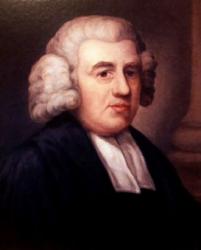
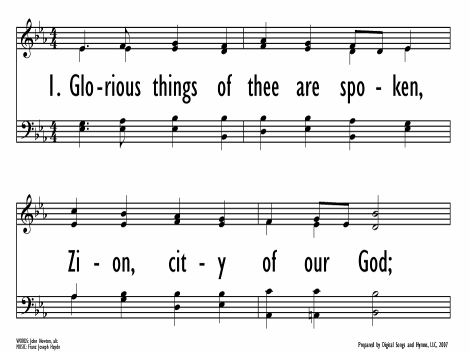
Glorious things of Thee are spoken. J. Newton. [Church of Christ.] First published in the Olney Hymns, 1779, Bk. i., No. 60, in 5 stanzas of 8 lines, and entitled, "Zion, or the City of God," Is. xxxiii. 20, 21. It has attained to great popularity in all English-speaking countries, and ranks with the first hymns in the language. It is used, however, in various forms as follows:—
1. Original text in Snepp's Songs of Grace & Glory People's Hymnal.
2. A cento composed of stanzas i., ii. and v. This appeared in Cotterill's Selection, 1819, from whence it has passed into a great number of collections. It is by far the most popular arrangement of the hymn in use, and may be found in fifty or more hymnals, as in Hymnal Companion, No. 234, and sometimes with Cotterill’s slight alterations, as in the Rev. F. Pott's Hymns, &c, 1861-67.
3. A cento composed of stanzas i., iii. and v., given in Society for Promoting Christian Knowledge Hymns, 1852, but not popular.
4. A cento, stanzas i., ii. and doxology in four lines, not by Newton, in the Cooke and Denton Hymnal, 1853.
5. A cento, in 4 stanzas of 4 lines, beginning, "Glorious things of old were spoken," is given in Isaac G. Smith's Hymn Book, 1855-57. It is thus composed: stanza i., Newton altered; ii., I. G. Smith; iii., Newton; iv., dox. from Cooke & Denton. This is the least successful of any arrangement.
6. The whole hymn revised by J. Keble for the Salisbury Hymn Book, 1857, and included therein, as No. 130, with the four-line doxology from Denton. This, with slight returns to the original in two places (stanzas i., v.), and the omission of the doxology, was repeated in the Sarum Hymnal (broken into two parts, pt. ii. beginning "Blessed city, holy nation), 1868; and a cento therefrom again altered, in 6 stanzas of 4 lines in T. Darling's Hymns, &c, edition 1887. Another cento, also with alterations, is given in the Hymnary, from which it passed into the New Mitre Hymnal, 1875.
7. Cento of stanzas i., ii., iv., v., unaltered as in the Book of Praise Hymnal, Thring's Collection, and others.
8. In the Society for Promoting Christian Knowledge Church Hymns, stanzas i.-iv. with slight alterations in stanzas i., ii., and iii.
In the American collections the same diversity of use prevails as in Great Britain. Sometimes the hymn is broken into two parts, with pt. ii. beginning, "Blest inhabitants of Zion." In addition other arrangements of minor importance are given in collections of less importance; but in most cases the original text is maintained. Stanzas i., ii., v., have been rendered into Latin by the Rev. R. Bingham, and included in his Hymnologia Christiana Latina, 1871, "Dicta do te sunt miranda."
--John Julian, Dictionary of Hymnology (1907)
Hymnary Pro Subscribers
Access
an additional article
on the Canterbury Dictionary of Hymnology:
Hymnary Pro subscribers have full access to the Canterbury Dictionary of Hymnology.
Get Hymnary Pro


 My Starred Hymns
 My FlexScores
 My Hymnals
 My Purchased Files