-
Navigation
On this page:
| Title: | Hail to the Lord's Anointed |
| Author: | James Montgomery (1821) |
| Author: | James Mongtomery |
| Meter: | 7.6.7.6 D |

| Title: | Hail to the Lord's Anointed |
| Author: | James Montgomery (1821) |
| Author: | James Mongtomery |
| Meter: | 7.6.7.6 D |
| Full hymn text | Information about this text |
|---|---|
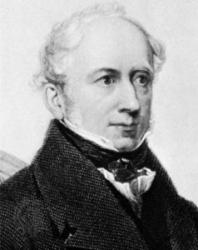
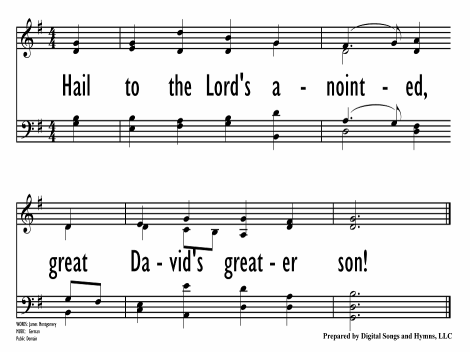
Hail to the Lord's Anointed! He comes with succour speedy, By such shall He be feared, He shall come down like showers, Arabia's desert-ranger Kings shall fall down before Him, For Him shall prayer unceasing, O'er every foe victorious, Sacred Poems and Hymns | For an author who wrote over 400 hymns and is thought to rival Watts and Wesley in skill, James Montgomery (1771-1854) led a very colorful life. His parents became missionaries to the West Indies when he was six years old, leaving him to be educated by the Brethren of Fulneck. When he flunked out of this Moravian school at the age of fourteen he left for London. After a short stint as a clerk in a book shop he went to Sheffield to work at the Sheffield Register. When the editor of the paper had to flee England because of his political views, Montgomery stepped in as editor, and held that position for 31 years. Like his predecessor, Montgomery's social and political activities got him into trouble, though his time spent in jail was put to good use writing poetry and hymns. After some years of "church-hopping" (on any given Sunday he could be found at the Baptist, Methodist, or even the banned Catholic church) he finally returned to the Brethren. In fact, "Hail to the Lord's Anointed" was first sung on Christmas day, 1821 back at the Fulneck Settlement. It gained notoriety when Dr. Adam Clarke heard Montgomery quote it at a missionary conference and liked it so much that he included it in his "Commentary on the Bible." The hymn is a loose paraphrase of Psalm 72, a so-called "Messianic" psalm because it describes a king of such noble character that it can only point to the Messiah. The Psalm bears the heading "Of Solomon" which has been translated to mean written by, written about, or dedicated to Solomon. The King James translation which was used by Montgomery assumes not only that it was written about Solomon, but that his father David wrote it. This davidic lineage is the focus of the hymn, reminding us that though the reign of David would be surpassed by his son Solomon, a greater Son of David would one day eclipse them both. Note: It is interesting to compare Montgomery's treatment of Psalm 72 to that of Isaac Watt's "Jesus Shall Reign Where'er the Sun." --Greg Scheer, 1996 |