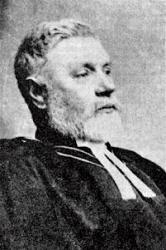
George Matheson (b. Glasgow, Scotland, 1842; d. North Berwick, Scotland, 1906) wrote the text during his stay at Row, Dunbartonshire, Scotland, in 1890. It was pub¬lished that same year in his collection of poems and hymns, Sacred Songs, with the heading, "Christian freedom: Paul the prisoner of Jesus Christ (Eph. 3: 1)." The four short-meter stanzas are taken from the first and fourth stanzas of Matheson's original short-meter-double text.
A brilliant student of philosophy at the University of Glasgow and its divinity school, Matheson wrote several important theological and devotional works, including Aids to the Study of German Theology (1874). This achievement is especially noteworthy because of his failing eyesight during his teen years and virtual blindness by the age of eighteen. He had to rely on others, especially his sisters, for all his reading, research, and writing. Matheson was a very able preacher, serving Presbyterian churches in Glasgow; Clydeside Church in Innellan, Argyllshire (1868-1886); and finally St. Bernard's Church in Edinburgh (1886-1899).
Scripture References:
st. 1 = 2 Cor. 12:9-10, Rom. 6:18, 22
st. 2 = Phil. 4:13
This text is the finest example of sustained use of paradox in the Psalter Hymnal. It is built on a series of paradoxes that amplify the New Testament concept of freedom, which can be achieved only by being a servant, or prisoner, of Christ (see 2 Cor. 12:9-10). By their cumulative effect the contrasts between "captive" and "free"; "sink" and "stand"; "my own" and "thine"; "unbent" and "leaned" grip our imagination and powerfully affirm our servanthood to Christ.
George Matheson (b. Glasgow, Scotland, 1842; d. North Berwick, Scotland, 1906) wrote the text during his stay at Row, Dunbartonshire, Scotland, in 1890. It was pub¬lished that same year in his collection of poems and hymns, Sacred Songs, with the heading, "Christian freedom: Paul the prisoner of Jesus Christ (Eph. 3: 1)." The four short-meter stanzas are taken from the first and fourth stanzas of Matheson's original short-meter-double text.
A brilliant student of philosophy at the University of Glasgow and its divinity school, Matheson wrote several important theological and devotional works, including Aids to the Study of German Theology (1874). This achievement is especially noteworthy because of his failing eyesight during his teen years and virtual blindness by the age of eighteen. He had to rely on others, especially his sisters, for all his reading, research, and writing. Matheson was a very able preacher, serving Presbyterian churches in Glasgow; Clydeside Church in Innellan, Argyllshire (1868-1886); and finally St. Bernard's Church in Edinburgh (1886-1899).
Liturgical Use:
Many occasions of worship, especially after the sermon; adult baptism; profession of faith; ordination; times of testimony to the joy of being "captives" of Christ.
--Psalter Hymnal Handbook


 My Starred Hymns
 My FlexScores
 My Hymnals
 My Purchased Files