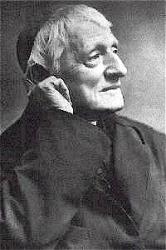
Praise to the Holiest in the height. Cardinal J. H. Newman. [Praise.] Written in 1865, and first published in the author's Verses on Various Occasions, in 1868. It forms part of a poem of some length, entitled The Dream of Gerontius. This Dream describes the journey of a disembodied soul from the body to its reception in Purgatory. Various hymns are introduced throughout the poem, and this is given as being sung by the Fifth Choir of Angelicals" as the disembodied soul is conducted into the presence chamber of Emmanuel previous to passing forward into Purgatory. In 1868 it was transferred to the Appendix to Hymns Ancient & Modern, the only change being the repetition of the first stanza at the close. From Hymns Ancient & Modern it has passed into a large number of hymn-books.
--John Julian, Dictionary of Hymnology (1907)
=====================
Praise to the Holiest in the height, p. 904, ii. The Dream of Gerontius appeared in The Month for May and June, 1865. This hymn is in the June number, p. 537, as sung by the First Choir of Angelicals. A copy of the rare first separate ed. of The Dream (1866) is in the British Museum, and another in the Church House, Westminster.
--John Julian, Dictionary of Hymnology, New Supplement (1907)
Hymnary Pro Subscribers
Access
an additional article
on the Canterbury Dictionary of Hymnology:
Hymnary Pro subscribers have full access to the Canterbury Dictionary of Hymnology.
Get Hymnary Pro


 My Starred Hymns
 My FlexScores
 My Hymnals
 My Purchased Files