Scripture References:
all st. = Matt 21:1-17
Henry H. Milman (b. St. James, London, England, 1791; d. Sunninghill, Berkshire, England, 1868) wrote this text around 1822. It was first published in Reginald Heber's (PHH 249) Hymns Written and Adapted to the Weekly Church Services of the Year (1827). Of the text of this fine Palm Sunday hymn, Stanley L. Osborne (PHH 395) has written,
Objective, robust, confident, and stirring, it possesses that peculiar combination of tragedy and victory which draws the singer into the very centre of the drama. It is this which gives the hymn its power and its challenge (If Such Holy Song, 449).
The text unites meekness and majesty, sacrifice and conquest, suffering and glory–all central to the gospel for Palm Sunday. Each stanza begins with "Ride on, ride on in majesty." Majesty is the text's theme as the writer helps us to experience the combination of victory and tragedy that characterizes the Triumphal Entry. Christ is hailed with "Hosanna" as he rides forth to be crucified (st. 1). That death spells victory: it is his triumph "o'er captive death and conquered sin" (st. 2). God the Father awaits Christ's victory with expectation (st. 3). Finally, Christ rides forth to take his "power … and reign!" (Note how "reign" is subtly offered as both noun and verb.) The original third stanza was not included.
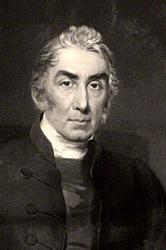
Milman was a playwright, professor of poetry, historian, theologian, churchman, and hymn writer–and he was successful in all these areas. He graduated from Brasenose College, Oxford, England, in 1816, and by 1823 had written three popular plays with religious themes. He was appointed professor of poetry at Oxford in 1821 but turned to the study of church history after 1827. His History of the Jews (1829), which raised vehement protest from reviewers, was influenced by the new critical German methods. Ordained in 1817, Milman served St. Mary's Church in Reading and St. Margaret's Church in London; his most illustrious church appointment was as dean of St. Paul's Cathedral, London, a position he held from 1849 until his death. His finest scholarly work is his History of Latin Christianity (1854). Milman wrote thirteen hymns, all published in Bishop Heber's Hymns (1827).
Liturgical Use:
Obligatory for every Palm Sunday morning worship service (with 375/376).
--Psalter Hymnal Handbook
==========================
Ride on, ride on in majesty . H. H. Milman. [Palm Sunday .] Published in Bishop Heber's posthumous Hymns, &c, 1827, p. 58, in 5 stanzas of 4 lines, and again in Milman's Selection of Psalms & Hymns, 1837, No. i., for Palm Sunday. The opening stanza, which reads:—
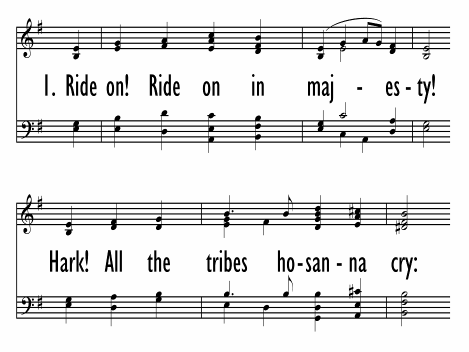
"Ride on! ride on in majesty!
Hark! all the tribes Hosannacry!
Thine humble beast pursues his road,
With palms and scatter'd garments strew'd,"
has failed to be acceptable to most editors. Murray, in his Hymnal, 1852, endeavoured to soften down the third line by making it read:—
"0 Saviour meek, pursue Thy road." This was adopted by Hymns Ancient & Modern., and others. In 1855 Mercer tried another change:—
“With joyous throngs pursue Thy road,"
but this has received but little attention. Several hymnals follow the example of Elliott's Psalms & Hymn, 1835, and omit st. i. These include the Society for Promoting Christian Knowledge Church Hymns, 1871. Original text in Book of Praise, 1862-67. This hymn ranks with the best of the author's lyrics, and is the most popular hymn for Palm Sunday in the English language.
--John Julian, Dictionary of Hymnology (1907)
Hymnary Pro Subscribers
Access
an additional article
on the Canterbury Dictionary of Hymnology:
Hymnary Pro subscribers have full access to the Canterbury Dictionary of Hymnology.
Get Hymnary Pro


 My Starred Hymns
 My FlexScores
 My Hymnals
 My Purchased Files