LES COMMANDEMENS

LES COMMANDEMENS

Attributed: Louis Bourgeois; Harmonizer: Claude Goudimel (1564)
Published in 17 hymnals


Printable scores: PDF, Sibelius
Audio files: MIDI

Attributed: Louis Bourgeois

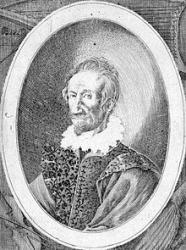
Loys "Louis" Bourgeois (c.1510–1560) was a French composer and music theorist of the Renaissance. He is most famous as one of the main compilers of Calvinist hymn tunes in the middle of the 16th century. One of the most famous melodies in all of Christendom, the Protestant doxology known as the Old 100th, is commonly attributed to him. Next to nothing is known about his early life. His first publication, some secular chansons, dates from 1539 in Lyon. By 1545 he had gone to Geneva (according to civic records) and become a music teacher there. In 1547 he was granted citizenship in Geneva, and in that same year he also published his first four-voice psalms. In 1549 and 1550 he worked on a collections of psalm-tunes, most of which were… Go to person page >

Harmonizer: Claude Goudimel

Claude Goudimel (c. 1514 to 1520 – between 28 August and 31 August 1572) was a French composer, music editor and publisher, and music theorist of the Renaissance. Claude Goudimel was born in Besançon. Few details of his life are known until he is documented in Paris in 1549, where he was studying at the University of Paris; in that year he also published a book of chansons. In the early 1550s he worked with printer Nicolas Du Chemin, and may have still been studying at the University of Paris until 1555; by 1555 he was also Du Chemin's partner in the publishing business. Goudimel moved to Metz in 1557, converting to Protestantism, and is known to have been associated with the Huguenot cause there; however he left Metz due to the in… Go to person page >

Tune Information

Attributed: Louis Bourgeois
Harmonizer: Claude Goudimel (1564)
Meter: 9.8.9.8
Incipit: 11233 44323 43217
Key: F Major or modal
Source: Genevan Psalter, 1547

Texts

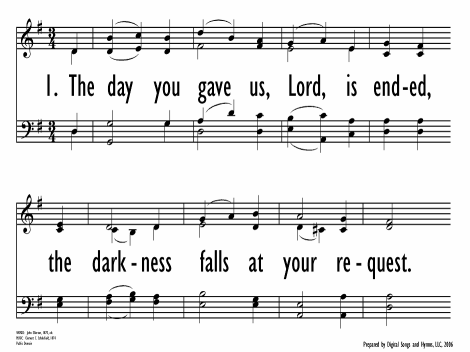
The day thou gavest, Lord, is ended

The day thou gavest, Lord, is ended,
The darkness falls at Thy behest;
To Thee our morning hymns ascended,
Thy praise shall hallow now our rest.
Go to text page >

The Ten Commandments

My soul, recall with reverent wonder
how God amid the fire and smoke
proclaimed his holy law with thunder
from Sinai's mountain when he spoke:
Go to text page >

Bread of the world, in mercy broken

Notes

LES COMMANDEMENS (French for "the commandments"), a rich and graceful tune in the Hypo-Ionian mode (major), was used in the Genevan Psalter (1547) for the Decalogue and for Psalm 140, and later in British psalters and in the Lutheran tradition. The first setting in the Psalter Hymnal derives from Claude Goudimel's (PHH 6) 1564 harmonization; his original harmonization with the melody in the tenor (on facing page in the hymnal) may be used for unison or choral stanzas.

Here are two performance suggestions: (a) the congregation or choir can sing stanzas 1 and 9 as a frame around the solo reading of stanzas 2 through 8 or of the corresponding verses from Scripture; (b) all can sing stanzas 1 and 9 (with the choir singing in harmony from the second setting), and the congregation can sing stanzas 2 through 8 antiphonally in unison. Organists can find preludes by Lutheran composers under the German title for this chorale tune: WENN WIR IN HÖCHSTEN NÖTEN SEIN.

--Psalter Hymnal Handbook

Media

Christian Classics Ethereal Hymnary #792
  • Four-part harmony, full-score (PDF, NWC)
Psalter Hymnal (Gray) #153
Text: The Ten Commandments

Instances

Instances (6)TextImageAudioScore
Christian Classics Ethereal Hymnary #792AudioScore
Common Praise #16Text
Common Praise #81Text
Presbyterian Hymnal #550TextImage
Psalter Hymnal (Gray) #153TextImageAudioScore
Trinity Hymnal #724Text