You help make Hymnary.org possible. More than 10 million people from 200+ countries found hymns, liturgical resources and encouragement on Hymnary.org in 2025, including you. Every visit affirms the global impact of this ministry.

If Hymnary has been meaningful to you this year, would you take a moment today to help sustain it? A gift of any size—paired with a note of encouragement if you wish—directly supports the server costs, research work and curation that keep this resource freely available to the world.

Give securely online today, or mail a check to:
Hymnary.org
Calvin University
3201 Burton Street SE
Grand Rapids, MI 49546

Thank you for your partnership, and may the hope of Advent fill your heart.

Person Results

Topics:fifteenth+sunday+after+trinity
In:people

Planning worship? Check out our sister site, ZeteoSearch.org, for 20+ additional resources related to your search.
Showing 11 - 20 of 64Results Per Page: 102050

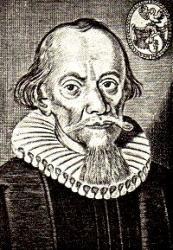
Johann Heermann

1585 - 1647 Person Name: J. Heermann Topics: The Church Year Fifteenth Sunday after Trinity; The Church Year Fifteenth Sunday after Trinity Author of "O God, Thou faithful God" in The Lutheran Hymnary Johann Heermann's (b. Raudten, Silesia, Austria, 1585; d. Lissa, Posen [now Poland], 1647) own suffering and family tragedy led him to meditate on Christ's undeserved suffering. The only surviving child of a poor furrier and his wife, Heermann fulfilled his mother's vow at his birth that, if he lived, he would become a pastor. Initially a teacher, Heermann became a minister in the Lutheran Church in Koben in 1611 but had to stop preaching in 1634 due to a severe throat infection. He retired in 1638. Much of his ministry took place during the Thirty Years' War. At times he had to flee for his life and on several occasions lost all his possessions. Although Heermann wrote many of his hymns and poems during these devastating times, his personal faith and trust in God continued to be reflected in his lyrics. He is judged to be the finest hymn writer in the era between Martin Luther and Paul Gerhardt, one whose work marks a transition from the objective hymns of the Reformation to the more subjective hymns of the seventeenth century. His hymn texts were published in collections such as Devoti Musica Cordis, Hauss- und Hertz-Musica (1630, expanded in 1636, 1644), and Sontags- und Fest-evangelia (1636). Bert Polman =================== Heermann, Johann, son of Johannes Heermann, furrier at Baudten, near Wohlau, Silesia, was born at Baudten, Oct. 11, 1585. He was the fifth but only surviving child of his parents, and during a severe illness in his childhood his mother vowed that if he recovered she would educate him for the ministry, even though she had to beg the necessary money. He passed through the schools at Wohlau; at Fraustadt (where he lived in the house of Valerius Herberger, q. v., who took a great interest in him); the St. Elizabeth gymnasium at Breslau; and the gymnasium at Brieg. At Easter, 1609, he accompanied two young noblemen (sons of Baron Wenzel von Rothkirch), to whom he had been tutor at Brieg, to the University of Strassburg; but an affection of the eyes caused him to return to Baudten in 1610. At the recommendation of Baron Wenzel he was appointed diaconus of Koben, a small town on the Oder, not far from Baudten, and entered on his duties on Ascension Day, 1611, and on St. Martin's Day, 1611, was promoted to the pastorate there. After 1623 he suffered much from an affection of the throat, which compelled him to cease preaching in 1634, his place being supplied by assistants. In October, 1638, he retired to Lissa in Posen, and died there on Septuagesima Sunday (Feb. 17), 1647. (Koch, iii. 16-36; Allgemeine Deutsche Biographie, xi. 247-249, &c.) Much of Heermann's manhood was spent amid the distressing scenes of the Thirty Years' War; and by his own ill health and his domestic trials he was trained to write his beautiful hymns of “Cross and Consolation." Between 1629 and 1634, Koben was plundered four times by the Lichtenstein dragoons and the rough hordes under Wallenstein sent into Silesia by the King of Austria in order to bring about the Counter-Reformation and restore the Roman Catholic faith and practice; while in 1616 the town was devastated by fire, and in 1631 by pestilence. In these troublous years Heermann several times lost all his moveables; once he had to keep away from Koben for seventeen weeks; twice he was nearly sabred; and once, while crossing the Oder in a frail boat loaded almost to sinking, he heard the bullets of the pursuing soldiers whistle just over his head. He bore all with courage and patience, and he and his were wonderfully preserved from death and dishonour. He was thus well grounded in the school of affliction, and in his House and Heart Music some of his finest hymns are in the section entitled "Songs of Tears. In the time of the persecution and distress of pious Christians." As a hymnwriter Heermann ranks with the beat of his century, some indeed regarding him as second only to Gerhardt. He had begun writing Latin poems about 1605, and was crowned as a poet at Brieg on Oct. 8, 1608. He marks the transition from the objective standpoint of the hymnwriters of the Reformation period to the more subjective and experimental school that followed him. His hymns are distinguished by depth and tenderness of feeling; by firm faith and confidence in face of trial; by deep love to Christ, and humble submission to the will of God. Many of them became at once popular, passed into the hymnbooks, and still hold their place among the classics of German hymnody. They appeared principally in— (1) Devoti Musica Cordis. Hauss-und Hertz-Musica &c. Leipzig and Breslau, 1630, with 49 hymns (2nd edition 1636, with 64; 3rd edition 1644, with 69). The first section is entitled "Hymns of Penitence and Consolation from the words of the Ancient Fathers of the Church." Seven of these, however, have no mention in their individual titles of the sources from which they are derived; and the remainder are mostly based not on Latin hymns, but on the prose meditations in Martin Moller's Meditationes sanctorum patrum, or on the mediaeval compilations known as the Meditationes and the Manuale of St. Augustine. (2) Sontags-und Fest-Evangelia. Leipzig and Breslau, 1636, being hymns on the Gospels for Sundays and festivals. (3) Poetische Erquickstunden, Nürnberg, 1656; and its Fernere Fortsetzung, also Nürnberg, 1656 [both in Wernigerode], are poems rather than hymns. The hymns of the Hauss-und Hertz-Musica, with a representative selection from Heermann's other poetical works, were edited by C. E. P. Wackernagel, prefaced by a long biographical and critical introduction, and published at Stuttgart, 1855. Six of the most important of Heermann's hymns are annotated under their respective first lines. The other hymns by Heermann which have passed into English are :— I. Hymns in English common use:-- i. 0 Jesu, du mein Bräutigam. Holy Communion. In his Devoti Musica Cordis, Breslau, 1630, p. 78, in 12 stanzas of 4 lines. Thence in Mützell, 1858, No. 34, in Wackernagel's ed. of his Geistliche Lieder, No. 22, and the Unverfälschter Liedersegen, 1851, No. 283. Seems to be founded on Meditation xi. in the mediaeval compilation known as St. Augustine's Manuale. Translated as:— 0 Jesu, Lord, who once for me, a good translation of stanzas i., ii., iv., v., viii., by A. T. Russell, as No. 158 in his Psalms & Hymns, 1851. Other translations are: (l) 0 Jesu! Bridegroom of my Soul," by J. C. Jacobi, 1722, p. 44 (1732, p. 73). (2) "Dear Saviour, who for me hast borne," by Miss Dunn, 1857. ii. Rett, 0 Herr Jesu, rett dein Ehr. In Time of Trouble. A prayer for deliverance and peace for the Church. In his Devoti Musica Cordis, 1630, p. 119, in 5 stanzas of 4 lines, among the "Songs of Tears." Thence in Mützell, 1858, No. 48, in Wackernagel’s ed., No. 36, and the Unverfälschter Liedersegen, 1851, No. 245. Translated as:— Thine honour rescue, righteous Lord, in full, by Dr. M. Loy, in the Ohio Lutheran Hymnal, 1880. iii. Treuer Wächter Israel. In Time of War. 1630, p. 115, in 13 stanzas of 7 lines, among the "Songs of Tears." In Mützell, 1858, No. 47; in Wackernagel's edition, No. 35, and the Unverfälschter Liedersegen, 1851, No. 594. Lauxmann, in Koch, viii. 549, says of it:— "It is a powerful hymn filled with that prevailing prayer that takes heaven by force," and relates of st. vii.,11. v-7, "Eine Mauer um uns bau," that on Jan. 6, 1814, the Allied Forces were about to enter Schleswig. A poor widow with her daughter and grandson lived in a little house near the entrance of the town. The grandson was reading in his hymnbook those in time of war, and when he came to this said, “It would be a good thing, grandmother, if our Lord God would build a wall around us." Next day all through the town cries of distress were heard, but all was still before their door. On the following morning they had courage to open the door, and lo a snowdrift concealed them from the view of the enemy. On this incident Clemens Brentano composed a beautiful poem "Draus vor Schleswig." It is translated as:— Jesu! as a Saviour, aid. A good tr. of st; vii., viii., xiii., by A. T. Russell, as No. 138 in his Psalms & Hymns, 1851. iv. Zionklagt mit Angst und Schmerzen. Church of Christ. First published in his Devoti Musica Cordis, 2nd ed., 1636 (1644, p. 196), in 6 stanzas of 8 lines, entitled, "From the beautiful golden saying of Isaiah, Chapter xlix." In Mützell, 1858, No. 101, in Wackernagel’s ed., No. 53, and the Unverfälschter Liedersegen, 1851, No. 256. Translated as:— Sion bow'd with anguish weepeth A good translation of stanzas i., iii., v., by A. T. Russell, as No. 141 in his Psalms & Hymns, 1851. Another translation is: "Zion mourns in fear and anguish," by Miss Winkworth, 1869, p. 198. II. Hymns not in English common use:-- v. Ach Jesu! dessen Treu. Love to Christ. 1630, p. 144, in 33 stanzas. One of his finest hymns, full of deep love to Christ, but from its great length very little used in Germany. Translated as, "Ah! Jesus! Lord! whose faithfulness," by Miss Burlingham, in the British Herald, May, 1867, p. 72. vi. Der Tod klopft bei mir an. For the Dying. 1656, p. 22, in 121. Translated as, "That Death is at my door," by Miss Winkworth, 1869, p. 201. vii. Du weinest für Jerusalem. Christ weeping over Jerusalem. 1630, p. 81, in 6 stanzas, entitled, "On the Tears of Christ." Founded on St. Luke xix. 41-44, part of the Gospel for the 10 Sundays after Trinity. The translations are: (1) "With tears o'er lost Jerusalem," by Miss Cox, 1841, p. 159. (2) "Our Lord wept o'er Jerusalem," by Dr. H. Mills, 1845 (1856, p. 295). (3) "Thou weepest o'er Jerusalem," by Miss Winkworth, 1855,p. 70. viii. Herr Jesu Christe mein getreuer Hirte. Holy Communion. 1630, p. 74, in 9 stanzas, founded on M. Moller's Meditationes sanctorum patrum, pt. i. c. 11, and pt. v. c. 2. The translations are: (1) "Dear Saviour, Thou my faithful Shepherd, come” by Miss Dunn, 1857, p. 111. (2) "Lord Jesus Christ, my faithful Shepherd, hear," by Miss Winkworth, 1858, p. 93, repeated in Lyra Eucharistica, 1863-64. ix. Herr unser Gott, lass nicht zu Schanden werden. Christ's Church. 1630, p. 114, as one of the "Songs of Tears," in 5 stanzas. Translated as, "Ah! Lord our God, let them not be confounded," by Miss Winkworth, 1869, p. 197. x. Hilf mir, mein Oott, hilf dass nach dir. Christian Conduct. 1630, p. 32, in 7 stanzas, entitled, "For a better life. From the words of Augustine." Founded on No. i. of the Meditationes current under the name of St. Augustine. This meditation is apparently by St. Anselm of Canterbury. Translated as, "Lord, raise in me a constant Flame," by J. C. Jacobi, 1725, p. 27 (1732, p. 105). xi. Jesu, der du tausend Schmerzen. In Sickness. 1656, in the Fernere Fortsetzung, p. 79, in 12 lines, entitled, "In great bodily pain." Translated as, “Jesu, who didst stoop to prove," by Miss Winkworth, 1869, p. 200. xii. Jesu Tilger meiner Sünden. Lent. 1656, in the Fernere Fortsetzung, p. 1, in 10 lines, entitled, "For Victory in Temptation." Translated as, "Jesu, Victor over sin," by Miss Winkworth, 1869, p. 201. xiii. 0 Jesu, Jesu, Gottes Sohn. Love to Christ, 1630, p. 83, in 7 stanzas, entitled, “Of the Love, which a Christian heart bears to Christ, and will still bear." A beautiful expansion of his motto "Mihi omnia Jesus." The translations are: (1) "What causes me to mourn is this," a translation of stanza ii. by P. H. Molther, as No. 371, in the Moravian Hymn Book, 1789 (1886, No. 461). (2) "O Jesus, Jesus, Son of God," by Miss Burlingham, in the British Herald, Oct. 1865, p. 153, and in Reid's Praise Book, 1872. xiv. Treuer Gott ich muss dir klagen. In Trouble. 1630, p. 103, in 12 stanzas, entitled, "Hymn of a sorrowful heart for increase of faith." Translated as, "Faithful God! I lay before Thee," by J. C. Jacobi, 1720, p. 9(1722, p. 70; 1732, p. 117), and as No. 538 in pt. i. of the Moravian Hymn Book, 1754. xv. Wollt ihr euch nicht, o ihr frommen Christen. Second Advent. 1636, p. 210, in 9 stanzas, entitled, "On the day of the Holy Bishop Nicolaus. Gospel of Luke, 12 Chapter." Translated as: (l) "0 dear Christians, as 'tis needful, wou'd ye," as No. 153 in pt. i. of the Moravian Hymn Book, 1754. (2) “Help us, 0 Christ, to watch and pray," a tr. of st. ix. as st. iii. of No. 868 in the Moravian Hymn Book, 1789 (1849, No. 1221). xvi. Wo soll ich fliehen hin. Lent. 1630, p. 20, in 11 stanzas, entitled, "A hymn of consolation in which a troubled heart lays all its sins in true faith upon Christ. From Tauler." Based on M. Moller's Meditationes, vol. i. pt. i., No. 10. Translated as, "0 whither shall I fly," as No. 447 in pt. i. of the Moravian Hymn Book, 1754. In 1886, No. 279, it begins with "0 Jesus, source of Grace" (stanza ii.). [Rev. James Mearns, M.A.] --John Julian, Dictionary of Hymnology (1907)

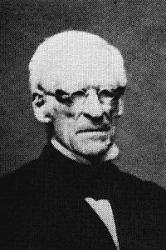
Joseph P. Holbrook

1822 - 1888 Person Name: J. P. Holbrook Topics: Fifteenth Sunday after Trinity Arranger of "JEWETT" in Evangelical Lutheran hymnal Joseph P. Holbrook was a tune writer in the parlor music style, and used the popular melodies of Mason and Hastings, Bradbury and Root, Greatorex and Kingsley in his collections. He furnished settings for the choir hymns in Songs for the Sanctuary in his Quartet and chorus Choir (New York, 1871, and sought more recogniation than had been given him in a hymnal of his own, Worship in Song (New York, 1880); a book that found no welcome. from The English hymn: its development and use in worship By Louis FitzGerald Benson

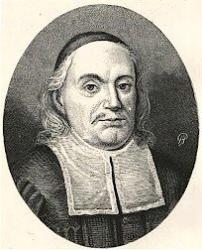
Paul Gerhardt

1607 - 1676 Topics: Fifteenth Sunday after Trinity Sunday Author of "Salig er den Mand, som ikke" in Salmebog for Lutherske Kristne i Amerika Paul Gerhardt (b. Gräfenheinichen, Saxony, Germany, 1607; d. Lubben, Germany, 1676), famous author of Lutheran evangelical hymns, studied theology and hymnody at the University of Wittenberg and then was a tutor in Berlin, where he became friends with Johann Crüger. He served the Lutheran parish of Mittenwalde near Berlin (1651-1657) and the great St. Nicholas' Church in Berlin (1657-1666). Friederich William, the Calvinist elector, had issued an edict that forbade the various Protestant groups to fight each other. Although Gerhardt did not want strife between the churches, he refused to comply with the edict because he thought it opposed the Lutheran "Formula of Concord," which con­demned some Calvinist doctrines. Consequently, he was released from his position in Berlin in 1666. With the support of friends he became archdeacon at Lubben in 1669 and remained there until his death. Gerhardt experienced much suffering in his life;­ he and his parishioners lived in the era of the Thirty Years' War, and his family experi­enced incredible tragedy: four of his five children died young, and his wife died after a prolonged illness. In the history of hymnody Gerhardt is considered a transitional figure-he wrote at a time when hymns were changing from a more objective, confes­sional, and corporate focus to a pietistic, devotional, and personal one. Like other German hymns, Gerhardt's were lengthy and intended for use throughout a service, a group of stanzas at a time. More than 130 of his hymns were published in various editions of Cruger's Praxis Pietatis Melica, the Crüger-Runge Gesangbuch (1653), and Ebeling's Das andere Dutzeud geistliche Andachtslieder Herrn Paul Gerhardts (1666-1667). John Wesley and Catherine Winkworth both made famous English translations of Gerhardt's texts. Bert Polman ====================== Gerhardt, Paulus, son of Christian Gerhardt, burgomaster of Gräfenhaynichen, near Wittenberg, was born at Grafenhaynichen, Mar. 12, 1607. On January 2, 1628, he matriculated at the University of Wittenberg. In the registers of St. Mary's church, Wittenberg, his name appears as a godfather, on July 13, 1641, described still as "studiosus," and he seems to have remained in Wittenberg till at least the end of April, 1642. He appears to have gone to Berlin in 1642 or 1643, and was there for some time (certainly after 1648) a tutor in the house of the advocate Andreas Barthold, whose daughter (Anna Maria, b. May 19, 1622, d. March 5, 1668) became his wife in 1655. During this period he seems to have frequently preached in Berlin. He was appointed in 1651, at the recommendation of the Berlin clergy, Lutheran Probst (chief pastor) at Mittenwalde, near Berlin, and ordained to this post Nov. 18, 1651. In July, 1657, he returned to Berlin as third diaconus of St. Nicholas's church; but becoming involved in the contest between the Elector Friedrich Wilhelm (who was of the Reformed Church) and the Lutheran clergy of Berlin, he was deposed from his office in February, 1666, though he still remained in Berlin. In Nov. 1668, he accepted the post of archidiaconus at Lübben, on the Spree, was installed in June, 1669, and remained there till his death on June 7, 1676 (Koch, iii. 297-326; Allgemeine Deutsche Biographie, viii. 774-783, &c). The outward circumstances of Gerhardt's life were for the most part gloomy. His earlier years were spent amid the horrors of the Thirty Years' War. He did not obtain a settled position in life till he was 44 years of age. He was unable to marry till four years later; and his wife, after a long illness, died during the time that he was without office in Berlin; while of the five children of the marriage only one passed the period of childhood. The sunniest period of his life was during the early years of his Berlin ministry (i.e. 1657-1663), when he enjoyed universal love and esteem; while his latter years at Lübben as a widower with one surviving child were passed among a rough and unsympathising people. The motto on his portrait at Lübben not unjustly styles him "Theologus in cribro Satanae versatus." Gerhardt ranks, next to Luther, as the most gifted and popular hymnwriter of the Lutheran Church. Gervinus (ed. 1842, pt. iii. p. 366), the well-known historian of German literature, thus characterises him:— "He went back to Luther's most genuine type of hymn in such manner as no one else had done, only so far modified as the requirements of his time demanded. In Luther's time the belief in Free Grace and the work of the Atonement, in Redemption and the bursting of the gates of Hell was the inspiration of his joyful confidence; with Gerhardt it is the belief in the Love of God. With Luther the old wrathful God of the Romanists assumed the heavenly aspect of grace and mercy; with Gerhardt the merciful Righteous One is a gentle loving Man. Like the old poets of the people he is sincerely and unconstrainedly pious, naive, and hearty; the bliss fulness of his faith makes him benign and amiable; in his way of writing he is as attractive, simple, and pleasing as in his way of thinking." With a firm grasp of the objective realities of the Christian Faith, and a loyal adherence to the doctrinal standpoint of the Lutheran Church, Gerhardt is yet genuinely human; he takes a fresh, healthful view both of nature and of mankind. In his hymns we see the transition to the modern subjective tone of religious poetry. Sixteen of his hymns begin with, “I." Yet with Gerhardt it is not so much the individual soul that lays bare its sometimes morbid moods, as it is the representative member of the Church speaking out the thoughts and feelings he shares with his fellow members; while in style Gerhardt is simple and graceful, with a considerable variety of verse form at his command, and often of bell-like purity in tone. From the first publication of Gerhardt's hymns they at once came into favour among all ranks and creeds; and a large proportion are among the hymns most cherished and most widely used by German-speaking Christians at the present day. They appeared principally in the various editions of Crüger's Praxis, and the Crüger-Runge Gesang-Buch, 1653. The first collected edition was prepared by J. G. Ebeling, and published in separate "Dozens" 1-4 in 1666, 5-10 in 1667, i.e. 120 in all. In the edition of J. H. Feustking, Zerbst, 1707, a few stanzas were intercalated (from manuscripts in the possession of Gerhardt's surviving son), but no new hymns were added. Among modern editions of Gerhardt's hymns (mostly following the text of Ebeling) may be mentioned those by Langbecker, 1842; Schultz, 1842; Wackernagel, 1843; Becker, 1851; Goedeke, 1877, and Gerok, 1878. The Historico-Critical edition of Dr. J. F. Bachmann, 1866, is the most complete (with 11 additional pieces hardly Church hymns), and reverts to the pre-Ebeling text. The length of many of Gerhardt's hymns ("Ein Lämmlein" is 10 stanzas of 10 lines; "Fröhlich soil," 15 stanzas of 8 lines, &c), and the somewhat intricate metres of others, have caused his hymns to be less used in English than otherwise might have been the case; but a considerable proportion have come in some form or other into English hymnbooks. A large selection, translated with scrupulous faithfulness but not retaining much of the lyric grace of the originals, was published by the Rev. John Kelly, in 1867, as Paul Gerhardt’s Spiritual Songs; while many individual hymns have been translated by John Wesley, Miss Winkworth, Miss Cox, Miss Borthwick, and many others. His translations from St. Bernard are noted under "O Haupt voll Blut." There are separate notes on 19 of his greater hymns. Besides these the following have passed into English:— I. Hymns in English common use: i. Auf den Nebel folgt die Sonn. Thanksgiving after great sorrow and affliction. In Crüger's Praxis, 1656, No. 249, in 15 stanzas of 7 1.; thence in Wackernagel’s ed. of his Geistliche Lieder, No. 87, and Bachmann's ed., No. 64. In the Unverfälschter Liedersegen, 1851, No. 402. Translated as:— Cometh sunshine after rain. A good translation, omitting stanzas iv.-vii., x., xi., by Miss Winkworth, in her Lyra Germanica, 1st Ser., 1855, p. 100 (translations of x., xi. added to 2nd ed., 1856). Repeated, omitting the translations of stanzas ii., x.-xii., as No. 4 in her Chorale Book for England, 1863. In the Christian Hymn Book, Cincinnati, 1865, No. 799, begins with st. xiii., "Now as long as here I roam." Another translation is:—"After clouds we see the sun," by J. Kelly, 1867, p. 261. ii. Die Zeit ist nunmehr nah. Day of Judgment—Second Advent. Founded on Acts iii. 20. In the Crüger-Runge Gesang-Buch 1653, No. 367, iii 18 stanzas of 6 lines, and thence in Wackernagel's edition of his Geistliche Lieder, 1843, No. 119 (1874, No. 124), and Bachmann's edition, No. 40. In the Berlin Geistliche Lieder S., ed. 1863, No. 1517. Translated as:— O Christ! how good and fair. Being a translation of stanzas iii., iv., vi., vii., x.-xiii., xvii., by Mrs. Charles, in her Voice of Christian Life in Song, 1858, p. 242. Her translations of stanzas iii., x., xii., are No. 150 in G. S. Jellicoe's Collection, 1867. Other trs. are:—(1) "May I when time is o'er," of stanzas vii., viii. as part of No. 831 in the Moravian Hymn Book, 1789; in the 1801 and later eds. (1886, No. 1229), beginning, "I shall, when time is o'er." (2) “The time is very near," by J. Kelly, 1867, p. 341. iii. Gottlob, nun ist erschollen. Peace. Thanksgiving for the Proclamation of the Peace of Westphalia, in 1648, after the Thirty Years’ War. In Crüger's Praxis 1656, No. 409, in 6 stanzas of 12 lines, and thence in Wackernagel's edition of his Geistliche Lieder, No. 64, and Bachmann's ed., No. 84; and in the Unverfälschter Liedersegen, 1851, No. 589. Translated as: — Thank God it hath resounded. A full and good tr. by Miss Winkworth, in her Lyra Germanica, 2nd Ser., 1858, p. 156, repeated, omitting stanza ii., in her Chorale Book for England, 1863. St. i., v., vi., form No. 49 in M. W. Stryker's Christian Chorals, 1885. Another tr. is: ”Praise God! for forth hath sounded," by J. Kelly, 1867, p. 251. iv. Ich, der ich oft in tiefes Leid. Ps. cxlv. First published in J. G. Ebeling's edition of his Geistliche Andachten Dritte Dutzet, 1666, No. 27, in 18 stanzas of 7 lines. Thence in Wackernagel's ed., No. 95, and Bachmann's ed., No. 103; also in the Berlin Geistliche LiederSchatz, ed. 1863, No. 1004. Translated as:— I who so oft in deep distress . A good translation, omitting stanzas ii.-iv., by Miss Winkworth, in her Lyra Germanica, 2nd Ser., 1858, p. 149. Her translations of stanzas i., xiii.-xvi., xviii., were included as No. 224, and of stanzas vi., viii., ix., xi. altered, and beginning, "O God! how many thankful songs," as No. 168, in Holy Song, 1869. Another tr. is:—-"Who is so full of tenderness," of stanza viii. as stanza iv. of No. 1075 in the Supplement of 1808 to the Moravian Hymn Book, 1801 (1886, No. 537). v. Ich steh an deiner Krippen bier. Christmas. Included in Crüger's Praxis, 1656, No. 105, in 15 stanzas of 7 lines. Thence in Wackernagel's ed., No. 9, and Bachmann's ed., No. 45; and in the Berlin Geistliche LiederSchatz, ed. 1863, No. 167. A beautiful hymn, in which the poet puts himself in the place of the shepherds and the wise men visiting Bethlehem; and in praise and adoration tenders his devotion, his love and his all, to the Infant Saviour in the manger. Translated as:— My faith Thy lowly bed beholds. A translation of stanzas i., iv., vii., xv., by A. T. Russell, as No. 57 in his Psalms & Hymns, 1851. Other trs. are:— (1) "I stand beside Thy manger-bed," by Miss Manington, 1864, p. 38. (2) "Now at the manger here I stand," by J. Kelly, 1867, p. 32. vi. Ich weiss dass mein Erlöser lebt. Easter. Founded on Job xix. 25-27. First published in J. G. Ebeling's ed. of his Geistliche Andachten Zehende Dutzet, 1667, No. 119, in 9 stanzas of 7 lines; repeated in Wackernagel's ed., 1843, No. 118 (1874, No. 123); in Bachmann's ed., No. 119; and in the Berlin Geistliche Lieder S. ed. 1863, No. 301. Translated as:— I know that my Redeemer lives, In this my faith is fast. A full and spirited translation by J. Oxenford, in Lays of the Sanctuary, 1859, p. 122. His translations of stanzas i., iii., vii.-ix., were included, altered, as No. 779 in Kennedy, 1863. Another tr. is:— "I know that my Redeemer lives, This hope," &c, by Miss Manington, 1863, p. 78. vii. Ich weiss, mein Gott, dass all mein Thun. Supplication. A prayer for success in all Christian works and purpose; founded on Jeremiah x. 23, and Acts v. 38, 39. Included in Crüger's Praxis, 1656, No. 332, in 18 stanzas of 5 lines. In Wackernagel's ed., No. 40; Bachmann's ed., No. 71, and the Berlin Geistliche Lieder S., ed. 1863. Translated as:— I know, my God, and I rejoice. A good translation of stanzas i.-iii., viii., xi., ix., by Miss Winkworth, as No. 121 in her Chorale Book for England, 1863. Another translation is:— "My God! my works and all I do” by J. Kelly, 1867, p. 102. viii. Kommt, und lasst uns Christum ehren. Christmas. Founded on St. Luke ii. 15. First published in J. G. Ebeling's ed. of his Geistliche Andachten Fünffte Dutzet, 1667, No. 56, in 8 stanzas of 4 lines. Thence in Wackemagel's ed., No. 6; Bachmann's ed., No. 110; and the Unverfälschter Liedersegen, 1851, No. 43. Translated as:— 1. Come, unite in praise and singing. Omitting stanzas vi., vii., contributed by A. T. Russell to Maurice's Choral Hymnbook, 1861, No. 707. 2. Bring to Christ your best oblation. A full and good translation by P. Massie in his Lyra Domestica, 1864, p. 96; repeated in Snepp's Songs of Grace & Glory and Reid's Praise Book, 1872. Other translations are:— (1) "Come, and let us Christ revere now," by Miss Manington, 1864, p. 25. (2) "Come, and Christ the Lord be praising," by J. Kelly, 1867, p. 24. ix. Lobet den Herren, alle die ihn fürchten. Morning. Included in the Crüger-Runge Gesang-Buch 1653, No. 7, in 10 stanzas of 5 lines. In Wackernagel's ed., No. 100, and Bachmann's ed., No. 21, and in the Berlin Geistliche Lieder S. edition 1863, No. 1063. Translated as:— Praise God! revere Him! all ye men that fear Him! This is from the version in Bunsen's Allgemeine Gesangbücher, 1846, No. 167, stanza i. being from Gerhardt, and st. ii., iii., from "Lobet den Herren, denn er ist sehr freundlich" (q. v.); and appeared in the Dalston Hospital Hymnbook, 1848, No. 55, signed "A. G." Other translations are:— (1) "Our Lord be praising, All His glory raising," by H. J. Buckoll, 1842, p. 27. (2) "Praise ye Jehovah, all ye men who fear Him," by J. Kelly, 1867, p. 279. x. Micht so traurig, nicht so sehr. Christian Contentment. In the 3rd edition, 1648, of Crüger's Praxis, No. 251, in 15 stanzas of 6 1., repeated in Wackernagel's ed., No. 53; Bachmann's ed., No. 16, and the Berlin Geistliche Lieder S., ed. 1863, No. 851. It is founded on Ps. cxvi. 7; Ps. xlii. 6-12; 1 Tim. vi. 6. Translated as:— Ah! grieve not so, nor so lament. A free translation by Mrs. Findlater, of stanzas i., ii., vii.-x., xiii., xv., in the 1st Ser., 1854, of the Hymns from the Land of Luther, p. 48 (1884, p. 50). Repeated, abridged, in Holy Song, 1869, and Dale's English Hymnbook, 1875. Other translations are:- (l) "Why this sad and mournful guise," by Miss Dunn, 1857, p. 85. (2) "Not so darkly, not so deep," by Miss Warner, 1858 (1861, p. 58). (3) “0 my soul, why dost thou grieve," by J. Kelly, 1867. xi. Nun lasst uns gehn und treten. New Year. Included in the Crüger-Runge Gesang-Buch, 1653, No. 106, in 15 st. of 4 1. Thence in Wackernagel's ed., No. 12; Bachmann's ed., No. 24, and the Berlin Geistliche Lieder S., ed. 1863, No. 200. Evidently written during the Thirty Years' War. Translated as:— In pray'r your voices raise ye. In full, by J. Kelly, 1867, p. 45. From this, 8 st. are included as No. 48 in the Ohio Lutheran Hymnal, 1880. Other translations are:— (1) "Now let each humble Creature," in the Supplement to German Psalter, ed. 1765, p. 4, and Select Hymns from German Psalter, Tranquebar, 1754. p. 7. In the Moravian Hymnbook, 1789, No. 507 (1849, No. 1106), greatly altered, and beginning, “Year after year commenceth." (2) "0 come with prayer and singing," by R. Massie in the British Herald , Jan., 1865, p. 8. (3) “Christians all, with one accord," by E. Massie, 1867, p. 168. (4) "With notes of joy and songs of praise," by Dr. R. Maguire, 1883, p. 24. xii. Schaut! Schaut! was ist für Wunder dar? Christmas. First published in J. G. Ebeling's ed. of his Geistliche Andachten Fünffte Dutzet, 1667, No. 55, in 18 stanzas of 4 1. Thence in Wackernagel’s ed., No. 4; Bachmann's ed., No. 109. Translated as:— Behold! Behold! what wonders here. In full, by J. Kelly, 1867, p. 14. From this, 12 st. were included in the Ohio Lutheran Hymnal, 1880, as Nos. 25, 26: No. 26 beginning with the translation of st. xiii., "It is a time of joy today." xiii. Warum willt du draussen stehen. Advent. Suggested by Gen. xxiv. 31. Appeared in the Crüger-Runge Gesang-Buch, 1653, No. 78, in 9 stanzas of 8 lines; viz., stanzas i.—vii., xi., xii., of the full form; st. viii.-x. being added in Ebeling's Geistliche Andachten Fünffte Dutzet, 1667, No. 50. The full text, in 12 stanzas, is also in Wackernagel's ed., No. 2; Bachmann's ed., No. 23, and Geistliche Lieder S., 1851, No. 20. Translated as:— Wherefore dost Thou longer tarry. A good translation, omitting st. viii.-x., by Miss Winkworth, in her Lyrica Germanica, 2nd Ser., 1858, p. 6. In her Chorale Book for England, 1863, No. 153, the translations of st. iii., v., xi., are omitted. Other trs. are:- (l) “Wherefore dost Thou, blest of God," by R. Massie, in Lyra Domestica, 1864, p. 90. (2) “Why, without, then, art Thou staying," by J. Kelly, 1867, p. 5. xiv. Was alle Weisheit in der Welt. Trinity Sunday. In Crüger's Praxis, 1656, No. 212, in 8 stanzas of 9 lines. Thence in Wackernagel's ed., No. 1, and Bachmann's ed., No, 59, and the Berlin Geistliche Lieder S., ed. 1863, No. 50. Translated as:— Scarce tongue can speak, ne'er human ken. In full, by J. Kelly, 1867, p. 1, repeated as No. 111 in the Ohio Lutheran Hymnal, 1880. Another translation is:—"The mystery hidden from the eyes," by R. Massie, in Lyra Domestica, 1864, p. 87. xv. Was Gott gefällt, mein frommes Kind. Resignation. This beautiful hymn, on resignation to “what pleases God," first appeared in the Crüger-Runge Gesang-Buch, 1653, No. 290, in 20 stanzas of 5 lines. Thence in Wackernagel's ed., No. 60; Bachmann's ed., No. 37, and the Unverfälschter Liedersegen, 1851, No. 723. Translated as:—- What God decrees, child of His love. A good translation of stanzas i., ii., v., vi., viii., xii., xv., xviii., xx., by Mrs. Findlater, in the 3rd Ser., 1858, of the Hymns from the Land of Luther, p. 49 (1884, p. 170). Included, in full, in Bishop Ryle's Collection, 1860, No. 171; and abridged in Christian Hymns, Adelaide, 1872, and beginning, "What God decrees, take patiently," in Kennedy, 1863, No. 1344. Other translations are:— (1) "What pleaseth God with joy receive," by Miss Dunn, 1857, p. 94. (2) “What pleases God, 0 pious soul," by Miss Winkworth, 1858, p. 193, (3) ”What pleaseth God, my faithful child," by J. Kelly, 1867, p. 189. xvi. Wie schőn ists doch, Herr Jesu Christ. For Married Persons. Founded on Ps. cxxviii. First published in Ebeling's ed. of his Geistliche Andachten Vierte Dutzet, 1666, No. 38, in 8 st. of 12 1. Thence in Wackernagel's ed., 1843, No. 108 (1874, No. 109); Bachmann's ed., No. 105, and the Unverfälschter Liedersegen S., 1851, No. 680. Translated as:— Oh, Jesus Christ! how bright and fair. In full, by J. Kelly, 1867, p. 307, repeated, altered, and omitting st. iii.—v., in the Ohio Lutheran Hymnal, 1880, No. 339. II. Hymns not in English common use: xvii. Also hat Gott die Welt geliebt. Good Friday. On St. John iii. 16. In Crüger's Praxis, 1661, No. 372, in 17 stanzas. Translated as, "Be of good cheer in all your wants,” by P. H. Molther, of stanza 16, as No. 181 in the Moravian Hymnbook, 1789 (1886, No. 217). xviii. Auf, auf, mein Herz mit Freuden. Easter. In Crüger's Praxis, 1648, No. 141, in 9 stanzas. The translations are:-- (1) "Up! Up! my heart with gladness, See," by J. Kelly, 1867, p. 71. (2) "Up, up, my heart, with gladness; Receive," by N. L. Frothingham, 1870, p. 228. xix. Du bist zwar mein und bleibest mein. For the Bereaved. A beautiful hymn of consolation for parents on the loss of a son. Written on the death of Constantin Andreas, younger son of Johannes Berkov, pastor of St. Mary's Church, Berlin, and first printed as one of the "Dulcia amicorum solatia" at the end of the funeral sermon by Georg Lilius, Berlin, 1650. Included in Ebeline's ed. of Gerhardt's Geistliche Andachten Sechste Dutzet, Berlin, 1667, No. 72, in 12 stanzas. The translations are: (1) "Thou'rt mine, yes, still thou art mine own”, by Miss Winkworth, 1858, p. 123. (2) "Yes, thou art mine, still mine, my son," by J. D. Burns, in the Family Treasury, 1861, p. 8, and his Remains, 1869, p. 249. (3) "Mine art thou still, and mine shalt be," by J. Kelly, 1867, p. 333. (4) "Thou art mine own, art still mine own," by Dr. J. Guthrie, 1869, p. 100. xx. Du, meine Seele, singe. Ps. cxlvi. In the Crüger-Runge Gesang-Buch, Berlin, 1653, No. 183, in 10 stanzas. Translated as, “O come, my soul, with singing," by Miss Burlingham, in the British Herald, Jannary, 1866, p. 207, and as No. 423 in Reid's Praise Book, 1872. xxi. Gieb dich zufrieden, und sei stille. Cross and Consolation—-Ps. xxxvii. 7. In Ebeling Erstes Dutzet, 1666, No. 11, in 15 stanzas. Translated as: (1) “Be thou content: be still before," by Miss Winkworth, 1855, p. 156, and in Bishop Ryle's Collection, 1860, No. 269. (2) “Be thou contented! aye relying," by J. Kelly, 1867, p. 202. (3) “Tranquilly lead thee, peace possessing," by N. L. Frothingham, 1870, p. 246. xxii. Hőr an! mein Herz, die sieben Wort. Passiontide. On the Seven Words from the Cross. Founded on the hymn noted under Bőschenstein, J. (q.v.). In Crüger's Praxis, 1656, No. 137, in 15 stanzas. Translated as: (1) “Come now, my soul, thy thoughts engage," by Dr. H. Mills, 1845 (1856, p. 309). (2) "Seven times the Saviour spake my heart," by R. Massie, in the British Herald, Sept., 1865, p. 133. (3) "My heart! the seven words hear now," by J. Kelly, 1867, p. 63. xxiii. Ich hab in Gottes Herz und Sinn. Resignation. In Crüger's Praxis, 1648, No. 249, in 12 st. Translated as: (1) "I into God's own heart and mind," by J. Kelly, 1867, p. 219. (2) "To God's all-gracious heart and mind”, by Miss Winkworth, 1869, p. 213, repeated in Statham's Collection, Edinburgh, 1869 and 1870. xxiv. 0 Jesu Christ! dein Kripplein ist. Christmas. At the Manger of Bethlehem. In Crüger's Praxis, 1656, No. 101, in 15 stanzas. Translated as: (1) Be not dismay'd—-in time of need" (st. xi.) in the Moravian Hymnbook, 1789, No. 236. (2) "O blessed Jesus! This," by Miss Winkworth, 1858, p, 18. (3) "O Jesus Christ! Thy cradle is," by Miss Manington, 1864, p. 41. (4) "Thy manger is my paradise," by J. Kelly, 1867, p. 26. xxv. Voller Wunder, voller Kunst. Holy Matrimony. In Ebeling Vierte Dutzet, 1666, No. 40, in 17 st. Often used in Germany at marriages on the way to church. Translated as: (1) "Full of wonder, full of skill," by Dr. H. Mills, 1845 (1856, p. 215). (2) "Full of wonder, full of skill," in Mrs. Stanley Carr's translation of Wildenhahn's Paul Gerhardt, ed. 1856, p. 52. (3) "Full of wonder, full of art," by J. Kelly, 1867, p. 302. (4) "Full of wonder, full of art," by Miss Winkworth, 1869, p. 215. xxvi. Warum machet solche Schmerzen. New Year. On St. Luke ii. 21. In Crüger's Praxis, 1648, No. 97, in 4 stanzas. Bunsen, in his Versuch, 1833, No. 120, gives st. iii., iv. altered to "Freut euch, Sünder, allerwegen." Tr. as: (1) "Mortals, who have God offended," by Miss Cox, 1841, p. 21, from Bunsen. (2) "Why should they such pain e'er give Thee," by J. Kelly, 1867, p. 43. xxvii. Weg, mein Herz, mit den Gedanken. Lent. On St. Luke xv. In Crüger's Praxis, 1648, No. 36, in 12 stanzas. Translated as: (1) "Let not such a thought e'er pain thee," by J. Kelly, 1867, p. 83. (2) "Hence, my heart, with such a thought," by Miss Winkworth, 1869, p. 210. Besides the above, a considerable number of other hymns by Gerhardt have been translated by Mr. Kelly, and a few by Dr. Mills, Miss Manington, and others. The limits of our space forbid detailed notes on these versions. [Rev. James Mearns, M.A.] -- John Julian, Dictionary of Hymnology (1907) ============================= Gerhardt, Paulus, pp. 409, ii., 1565, i. The most recent edition of Gerhardt's hymns is in vol. iii. of the Fischer-Tümpel Deutsche evangelische Kirchenlied des Siebzehnten Jahr-hunderts, 1906, Nos. 389-495. In fixing the text the compilers have been enabled to use the recently discovered 1647, 1653 and 1657 Berlin editions of Cruger's Praxis Pietatis Melica. [Rev. James Mearns, M.A.] --John Julian, Dictionary of Hymnology, New Supplement (1907)

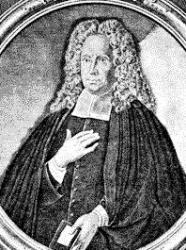
Johann Anastasius Freylinghausen

1670 - 1739 Person Name: Joh. Freylinghausen Topics: Fifteenth Sunday after Trinity Sunday Author of "Kommer, hvo vil Visdom lære" in Salmebog for Lutherske Kristne i Amerika Freylinghausen, Johann Anastasius, son of Dietrich Freylinghausen, merchant and burgomaster at Gandersheim, Brunswick, was born at Gandersheim, Dec. 2, 1670. He entered the University of Jena at Easter, 1689. Attracted by the preaching of A. H. Francke and J. J. Breithaupt, he removed to Erfurt in 1691, and at Easter, 1692, followed them to Halle. About the end of 1693 he returned to Gandersheim, and employed himself as a private tutor. In 1695 he went to Glaucha as assistant to Francke; and when Francke became pastor of St. Ulrich's, in Halle,1715, Freylinghausen became his colleague, and in the same year married his only daughter. In 1723 he became also sub-director of the Paedagogium and the Orphanage; and after Francke's death in 1727, succeeded him as pastor of St. Ulrich's and director of the Francke Institutions. Under his fostering care these Institutions attained their highest development. From a stroke of paralysis in 1728, and a second in 1730, he recovered in great measure, but a third in 1737 crippled his right side, while the last, in Nov., 1738, left him almost helpless. He died on Feb. 12, 1739, and was buried beside Francke (Koch, vi. 322-334; Allgemine Deutsche Biographie, vii. 370-71; Bode, pp. 69-70; Grote's Introduction, &c.) Almost all Freylinghausen's hymns appeared in his own hymnbook, which was the standard collection of the Halle school, uniting the best productions of Pietism with a good representation of the older "classical" hymns. This work, which greatly influenced later collections, and was the source from which many editors drew not only the hymns of Pietism, but also the current forms of the earlier hymns (as well as the new "Halle" melodies, a number of which are ascribed to Freylinghausen himself) appeared in two parts, viz.:— i. Geistreiches Gesang-Buch, den Kern alter und neuer Lieder...in sich haltend &c, Halle. Gedrucktund verlegt im Waysen-Hause, 1704 [Hamburg], with 683 hymns and 173 melodies. To the second edition, 1705 [Rostock University], an Appendix was added with Hymns 684-758, and 21 melodies. Editions 3-18 are practically the same so far as the hymns are concerned, save that in ed. 11, 1719 [Berlin], and later issues, four hymns, written by J. J. Rambach at Freylinghausen's request, replaced four of those in eds. 1-10. ii. Neues Geistreiches Gesangbuch,&c, Halle . . . 1714 [Berlin], with 815 hymns and 154 melodies. In the 2nd edition, 1719 [Rostock University], Hymns 816-818, with one melody, were added. In 1741 these two parts were combined by G. A. Francke, seven hymns being added, all but one taken from the first edition, 1718, of the so-called Auszug, which was compiled for congregational use mainly from the original two parts: and this reached a second, and last, edition in 1771. So far as the melodies are concerned, the edition of 1771 is the most complete, containing some 600 to 1582 hymns. (Further details of these editions in the Blätter für Hymnologie, 1883, pp. 44-46, 106-109; 1885, pp. 13-14.) A little volume of notes on the hymns and hymnwriters of the 1771 edition, compiled by J. H. Grischow and completed by J. G. Kirchner, and occasionally referred to in these pages, appeared as Kurzgefasste Nachricht von ältern und ncuern Liederverfassern at Halle, 1771. As a hymnwriter Freylinghausen ranks not only as the best of the Pietistic school, but as the first among his contemporaries. His finest productions are distinguished by a sound and robust piety, warmth of feeling depth of Christian experience, scripturalness, clearness and variety of style, which gained for them wide acceptance, and have kept them still in popular use. A complete edition of his 44 hymns, with a biographical introduction by Ludwig Grote, appeared as his Geistliche Lieder, at Halle, 1855. A number of them, including No. v., are said to have been written during severe attacks of toothache. Two (“Auf, auf, weil der Tag erschienen"; "Der Tag ist hin") are noted under their own first lines. i. Hymns in English common use: -- i. Monarche aller Ding. God's Majesty. 1714, as above, No. 139, in 11 stanzas of 6 lines, repeated in Grote, 1855, p. 88, and as No. 38 in the Berlin Geistliche Lieder, ed. 1863. A fine hymn of Praise, on the majesty and love of God. Translated as:— Monarch of all, with lowly fear, by J. Wesley, in Hymns & Sacred Poems, 1739 (P. Works, 1868-1872, vol. i. p. 104), in 8 stanzas of 4 lines, from st. i., ii., v.-vii., ix.-xi. Repeated in full in the Moravian Hymnbook, 1754, pt. i., No. 456 (1886, No. 176); and in J. A. Latrobe's Collection, 1841. The following forms of this translation are also in common use:-- (1) To Thee, 0 Lord, with humble fear, being Wesley's st. i., iii.-v., vii., viii. altered as No. 156 in Dr. Martineau's Hymns for Christian Church & Home, 1840, and repeated in Miss Courtauld's Psalms, Hymns & Anthems, 1860, and in America in the Cheshire Association Unitarian Collection, 1844. (2) Thou, Lord, of all the parent art, Wesley's, st. iii.-v., vii. altered in the College Hymnal, N. Y., 1876. (3) Thou, Lord, art Light; Thy native ray, Wesley's st. iv., v., vii., in Hymns of the Spirit, 1864. ii. 0 reines Wesen, lautre Quelle. Penitence. Founded on Psalm li. 12, 1714, as above, No. 321, in 7 stanzas of 8 lines, repeated in Grote, 1855, p. 41, and in Bunsen's Versuch, 1833, No. 777 (ed. 1881, No. 435). The only translation in common use is:— Pure Essence: Spotless Fount of Light. A good and full translation by Miss Winkworth in the first series of her Lyra Germanica, 1855, p. 43, and in her Chorale Book for England, 1863, No. 113. iii. Wer ist wohl wie du. Names and offices of Christ. One of his noblest and most beautiful hymns, a mirror of his inner life, and one of the finest of the German "Jesus Hymns." 1704, as above, No. 66, in 14 st. of 6 l., repeated in Grote, 1855, p. 33, and is No. 96 in the Berlin Geistliche Lieder, ed. 1863. The translations in common use are: 1. 0 Jesu, source of calm repose, by J. Wesley, being a free translation of st. i., iii., v., viii., xiii. First published in his Psalms & Hymns, Charlestown, 1737 (Poetical Works, 1868-1872, vol. i. p. 161). Repeated in full as No. 462 in pt. i. of the Moravian Hymnbook, 1754. In the 1826 and later editions (1886, No. 233) it begins, "Jesus, Thou source." The original form was included as No. 49 in the Wesley Hymns & Spiritual Songs , 1753, and, as No. 343, in the Wesley Hymnbook, 1780 (1875, No. 353). Varying centos under the original first line are found in Mercer's Church Psalter & Hymn Book, 1855-1864; Kennedy , 1863; Irish Church Hymnal, 1869-1873; J. L. Porter's Collection, 1876, &c. It has also furnished the following centos:— (1) Messiah! Lord! rejoicing still, being Wesley's st. iv.-vi. altered in Dr. Martineau's Collection of Hymns for Christian Worship, 1840. (2) Lord over all, sent to fulfil, Wesley's st. iv., iii., v., vi. in the American Methodist Episcopal Hymnbook, 1849. 2. Who is like Thee, Who? a translation of st. i., ii., v., vii., x., xiii., as No. 687, in pt. i. of the Moravian Hymnbook, 1754. Translations of st. xi., xiv. were added in 1789, and the first line altered in 1801(1886, No. 234), to "Jesus, who with Thee." The translations of st. i., ii., x., xiv., from the 1801, altered and beginning, "Jesus, who can be," are included in America in the Dutch Reformed Hymns of the Church, 1869; Hymns & Songs of Praise, N. Y., 1874; and Richards's Collection, N.Y., 1881. 3. Who is there like Thee, a good translation of st. i., ii., viii., xiv., by J. S. Stallybrass, as No. 234 in Curwen's Sabbath Hymnbook, 1859, repeated in the Irish Church Hymnal, 1873, and in W. F. Stevenson's Hymns for Church & Home, 1873. 4. Who is, Jesus blest, a translation of stanzas i., ii., v., vi., xii., xiv., by M. Loy, in the Ohio Lutheran Hymnal, 1880. 5. Who, as Thou, makes blest, a good translation, omitting st. vii., ix., x., contributed by Dr. F. W Gotch to the Baptist Magazine, 1857. Repeated in the 1880 Supplement to the Baptist Psalms & Hymns, 1858. The translations not in common use are: — (1) "Whither shall we flee," by Miss Dunn, 1857, p. 55. (2) "Who has worth like Thine," in the U. P. Juvenile Miss. Magazine, 1857, p. 217. (3) "Thou art First and Best," by Miss Winkworth, 1869, p. 267. ii. Hymns translated into English but not in common use:— iv. Herr und Gott der Tag und Nächte. Evening. 1705, as above, No. 755, in 6 stanzas, Grote, p. 105. Translated by H. J. Buckoll, 1842, p. 106, beginning with stanza. ii. v. Mein Herz, gieb dioh rufrieden. Cross and Consolation. First in the Halle Stadt Gesangbuch, 1711, No. 503, in 11 stanzas; repeated 1714, No. 450, and in Grote, p. 71. Translated by Dr. G. Walker, 1860, p. 86. vi. 0 Lamm, das keine Sünde je beflecket. Passiontide. 1714, No. 85, in 19 stanzas, Grote, p. 14. Translated as, (1) "Lamb, for Thy boundless love I praises offer," of st. xii. as stanza i. of No. 1023 in the Supplement of 1808 to the Moravian Hymn Book, 1801 (1849, No. 121). (2) "O Lamb, whom never spot of sin defiled," in the British Magazine, June, 1838, p. 625. vii. 0 Lamm, das meine Sündenlast getragen. Easter Eve. 1714, No. 95, in 8 stanzas; Grote, p. 23. Translated as "Christ Jesus is that precious grain," a translation of st. v. by F. W. Foster, as No. 71 in the Moravian Hymnbook, 1789 (1886, No. 921). viii. Zu dir, Herr Jesu, komme ich. Penitence. Founded on St. Matthew xi. 28-30. 1714, as above, No. 306, in 4 stanzas; Grote, p. 39. Translated by Dr. H. Mills, 1845 (1856, p. 80). [Rev. James Mearns, M.A.] --John Julian, Dictionary of Hymnology (1907)

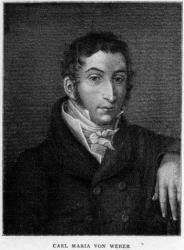
Carl Maria von Weber

1786 - 1826 Person Name: C. M. von Weber Topics: Fifteenth Sunday after Trinity Composer of "JEWETT" in Evangelical Lutheran hymnal Carl Maria von Weber; b. 1786, Oldenburg; d. 1826, London Evangelical Lutheran Hymnal, 1908

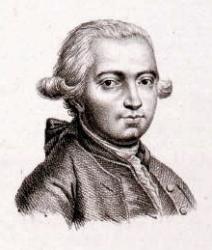
Felice Giardini

1716 - 1796 Person Name: Felice de Giardini, 1716-1796 Topics: Fifteenth Sunday after Trinity Composer of "TURIN" in Evangelical Lutheran hymnal Felice Giardini, born in Italy. When young, he studied singing, harpsichord, and violin. He became a composer and violin virtuoso. By age 12 he was playing in theatre orchestras. His most instructive lesson: While playing a solo passage during an opera, he decided to show off his skills by improvising several bravura variations that the composer, Jommelli, had not written . Although the audience applauded loudly, Jomelli, who happened to be there, went up and slapped Giardini in the face. He learned a lesson from that. He toured Europe as a violinist, considered one of the greatest musical artists of his time. He served as orchestra leader and director of the Italian Opera in London, giving concerts. He tried to run a theatre in Naples, but encountered adversity. He went to Russia, but had little fortune there, where he died. John Perry

Thomas Hastings

1784 - 1872 Person Name: Thomas Hastings, Mus. Doc. Topics: Fifteenth Sunday after Trinity Author of "He that goeth forth with weeping" in Evangelical Lutheran hymnal Hastings, Thomas, MUS. DOC., son of Dr. Seth Hastings, was born at Washington, Lichfield County, Connecticut, October 15, 1784. In 1786, his father moved to Clinton, Oneida Co., N. Y. There, amid rough frontier life, his opportunities for education were small; but at an early age he developed a taste for music, and began teaching it in 1806. Seeking a wider field, he went, in 1817, to Troy, then to Albany, and in 1823 to Utica, where he conducted a religious journal, in which he advocated his special views on church music. In 1832 he was called to New York to assume the charge of several Church Choirs, and there his last forty years were spent in great and increasing usefulness and repute. He died at New York, May 15, 1872. His aim was the greater glory of God through better musical worship; and to this end he was always training choirs, compiling works, and composing music. His hymn-work was a corollary to the proposition of his music-work; he wrote hymns for certain tunes; the one activity seemed to imply and necessitate the other. Although not a great poet, he yet attained considerable success. If we take the aggregate of American hymnals published duriug the last fifty years or for any portion of that time, more hymns by him are found in common use than by any other native writer. Not one of his hymns is of the highest merit, but many of them have become popular and useful. In addition to editing many books of tunes, Hastings also published the following hymnbooks:— (1) Spiritual Songs for Social Worship: Adapted to the Use of Families and Private Circles in Seasons of Revival, to Missionary Meetings, &c, Utica, 1831-2, in which he was assisted by Lowell Mason; (2) The Mother's Hymn-book, 1834; (3) The Christian Psalmist; or, Watts's Psalms and Hymns, with copious Selections from other Sources, &c, N. Y., 1836, in connection with "William Patton; (4) Church Melodies, N. Y., 1858, assisted by his son, the Rev. T. S. Hastings; (5) Devotional Hymns and Poems, N. Y., 1850. The last contained many, but not all, of his original hymns. (6) Mother's Hymn-book, enlarged 1850. The authorship of several of Hastings's hymns has been somewhat difficult to determine. All the hymns given in the Spiritual Songs were without signatures. In the Christian Psalmist some of his contributions were signed "Anon." others "M. S.," whilst others bore the names of the tune books in which they had previously appeared; and in the Church Melodies some were signed with his name, and others were left blank. His MSS [manuscript] and Devotional Hymns, &c, enable us to fix the authorship of over 50 which are still in common use. These, following the chronological order of his leading work, are:— i. From the Spiritual Songs, 1831:— 1. Before Thy footstool kneeling. In Sickness. No. 358, in 3 stanzas of 8 lines. 2. Bleeding hearts defiled by sin. Fulness of Christ. No. 261, in 5 stanzas of 4 lines. 3. Child of sin and sorrow, Filled with dismay. Lent. No. 315, in 2 stanzas of 8 lines. It is sometimes given as "Child of sin and sorrow, Where wilt thou flee?" It is in extensive use. 4. Delay not, delay not, 0 sinner draw near. Exhortation to Repentance. No. 145, in 5 stanzas of 4 lines. Given in several important collections. 5. Forgive us, Lord, to Thee we cry. Forgiveness desired. No. 165, in 4 stanzas of 4 lines. 6. Gently, Lord, 0 gently lead us. Pilgrimage of Life. No. 29, in 2 stanzas of 8 lines. It is given in several collections. The first two lines are taken from a hymn which appeared in the Christian Lyre, 1830. 7. Go forth on wings of fervent prayer. For a blessing on the distribution of Books and Tracts. No. 250, in 4 stanzas of 5 lines. It is sometimes given as “Go forth on wings of faith and prayer," as in the Baptist Praise Book, N. Y., 1871, No. 1252; but the alterations are so great as almost to constitute it a new hymn. 8. Hail to the brightness of Zion's glad morning. Missionary Success. No. 239, in 4 stanzas of 4 lines. In several hymnbooks in Great Britain and America. 9. How calm and beautiful the morn. Easter. No. 291, in 5 stanzas of 6 lines. Very popular. 10. In this calm, impressive hour. Early Morning. No. 235, pt. i. in 3 stanzas of 6 lines. In several collections. 11. Jesus, save my dying soul. Lent. No. 398, in 4 stanzas of 4 lines. A deeply penitential hymn. 12. Now be the gospel banner. Missions. No. 178, in 2 stanzas of 8 lines. In several collections (see below). 13. Now from labour, and from care. Evening. No. 235. Pt. ii. in 3 stanzas of 6 lines. This hymn, with No. 10 above, "In this calm," &c, constitute one hymn of 6 st. in the Spiritual Songs, but divided into two parts, one for Morning and the other for Evening. Both parts are popular as separate hymns. 14. 0 God of Abraham, hear. Prayer on behalf of Children. No. 288, in 5 stanzas of 4 lines. In use in Great Britain. 15. 0 tell me, Thou Life and delight of my soul. Following the Good Shepherd. No. 151, in 5 stanzas of 4 lines, on Cant. i. 7, 8. 16. Return, O wanderer, to thy home. The Prodigal recalled. No. 183, in 3 stanzas of 4 lines, with the refrain, " Return, return " (see below). 17. Soft and holy is the place. Public Worship. No. 351, in 4 stanzas of 4 lines. In Dr. Hatfield's Church Hymn Book, N. Y., 1872, and some other collections, the opening line is altered to "Sweet and holy is the place." 18. That warning voice, 0 sinner, hear. Exhortation to Repentance. No. 231, in 4 stanzas of 6 lines. 19. To-day the Saviour calls. Lent. No. 176, in 4 stanzas of 4 lines. Dr. Hastings says, in a communication to Dr. Stevenson (Hymns for Church and Home, 1873), this hymn “was offered me in a hasty sketch which I retouched." The sketch was by the Rev. S. F. Smith. 20. Why that look of sadness. Consolation. No. 268, in 3 stanzas of 8 lines. 21. Zion, dreary and in anguish. The Church Comforted. No. 160, in 4 stanzas of 4 lines. Concerning the two hymns, No. 12, "Now be the gospel banner"; and No. 16, "Beturn, O wanderer, to thy home," Dr. Stevenson has the following note in his Hymns for Church and Home, London, 1873:— "In a letter to the Editor, Dr. Hastings wrote, not more than a fortnight before his death, 'These two hymns of mine were earlier compositions, the former ["Now be," &c.] for a Utica Sunday School celebration, the latter ["Return, 0 wanderer," &c.] after hearing a stirring revival sermon on the Prodigal Son, by the Rev. Mr. Kint, at a large union meeting in the Presbyterian Church, where two hundred converts were present. The preacher at the close eloquently exclaimed with tender emphasis, "Sinner, come home! come home! come home!" It was easy afterwards to write, "Return, 0 wanderer."'" Several additional hymns in the Spiritual Songs, 1831, have been ascribed to Dr. Hastings, but without confirmation. The sum of what can be said on his behalf is that the hymns are in his style, and that they have not been claimed by others. They are:— 22. Drooping souls, no longer mourn. Pardon promised. No. 40, in 3 stanzas of 8 1., of which st. i., ii. are altered from J. J. Harrod's Public, Parlour, and Cottage Hymns, Baltimore, 1823, that is, 8 years before the Spiritual Songs were published. 23. Dying souls, fast bound in sin. Pardon offered. No. 41, in 5 stanzas of 8 lines. It is usually given in an abridged form. ii. From his Mother's Hymn Book, 1834:—- 24. Forbid them not, the Saviour cried. Holy Baptism. No. 44. 25. God of mercy, hear our prayer. On behalf of Cliildrcn, No. 48, in 5 stanzas of 4 lines. It was included in J. Campbell's Comprehensive Hymn Book, Lond., 1837, and subsequently in several collections. 26. God of the nations, bow Thine ear. Missions. No. 115, in 4 stanzas of 6 lines. In several collections. 27. How tender is Thy hand. Affliction. No. 99, in 5 stanzas of 41. 28. Jesus, while our hearts are bleeding. Death. Resignation. No. 95, in 5 stanzas of 4 lines. This is in extensive use and is one of his best and most popular hymns. 29. Lord, I would come to Thee. Self-dedication of a Child. No. 72, in 4 stanzas of 4 lines. 30. 0 Lord, behold us at Thy feet. Lent. No. 59, in 4 stanzas of 4 lines. It is doubtful if this is by Hastings. It is sometimes signed "Mrs. T." 31. The rosy light is dawning. Morning. No. 11, in 3 stanzas of 8 lines. 32. The Saviour bids us [thee] watch and pray. Watch and Pray. No. 119, in 4 stanzas of 4 lines. 33. Thou God of sovereign grace. On behalf of Children. No. 66, in 6 stanzas of 4 lines. 34. Wherever two or three may meet. Divine Service. No. 56. 35. Within these quiet walls, 0 Lord. Mothers' Meetings. No. 58, in 5 stanzas of 4 lines. In Spurgeon's Our Own Hymn Book, 1866, No. 1010, it begins, "Within these peaceful walls." This reading is from J. Campbell's Comprehensive Hymn Book, London, 1837. It is very doubtful if this is by Hastings. iii. From the Christian Psalmist, 1836:— 36. Children, hear the melting story. On the life of Christ. No. 430, in 3 stanzas of 6 lines. It is given as from the Union Minstrel, and the statement that it is by Hastings is very doubtful, no evidence to that effect being in the possession of his family. Dr. Hatfield, in his Church Hymn Book, dates it 1830, and gives it as "Anon." 37. Go, tune thy voice to sacred song. Praise No. 190, in 5 stanzas of 5 lines, and given as from "ms." 38. He that goeth forth with weeping. Missions No. 212, in 2 stanzas of 8 lines, and given as from "ms." It is in several collections. 39. I love the Lord, Whose gracious ear. Ps. cxvi. Page 186, in 4 stanzas of 6 lines, as from "ms." 40. Lord of the harvest, bend Thine ear. For the Increase of the Ministry. No. 407, in 6 stanzas of 4 lines, as from "ms." This hymn Dr. Hastings altered for his Devotional Hymns & Poems, 1850, but it has failed to replace the original in the hymnbooks. iv. From the Reformed Dutch Additional Hymns, 1846:— 41. Child of sorrow, child of care [woe]. Trust. No. 168, in 2 stanzas of 8 lines, appeared in W. Hunter's Minstrel of Zion, 1845. 42. Heirs of an immortal crown. Christian Warfare. No. 136, in 2 stanzas of 8 lines. 43. O Saviour, lend a listening ear. Lent. No. 175. Stanzas vi., i., iv., v., altered. 44. The Lord Jehovah lives. Ps. xviii. No. 26, in 4 stanzas of 6 lines. These three hymns, together with many others, are given in the Dutch Reformed Hymns of the Church, N. Y., 1869. In the 1847 Psalms & Hymns there were, including these, 38 hymns by Hastings, and 2 which are doubtful. v. From Dr. Hastings's Devotional Hymns and Religious Poems, 1850:— 45. In time of fear, when trouble's near. Encouragement in Trial. Page 95, in 3 stanzas of 4 lines. In use in Great Britain. vi. From Church Melodies, 1858:—- 46. For those in bonds as bound with them. Missions. No. 416, in 5 stanzas of 4 lines, on Heb. xiii. 3. 47. Forget thyself, Christ bids thee come. Holy Communion. No. 683, in 3 stanzas of 6 lines. 48. Jesus, Merciful and Mild. Leaning on Christ. No. 585, in 4 stanzas of 8 1. In several collections. 49. Pilgrims in this vale of sorrow. Self-denial. No. 397, in 4 stanzas of 4 lines. 50. Saviour, I look to Thee. Lent. In time of Trouble. No. 129, in 4 stanzas of 7 lines. 51. Saviour of our ruined race. Holy Communion. No. 379, in 3 stanzas of 6 lines. 52. Why that soul's commotion? Lent. No. 211, in 3 stanzas of 8 lines. It is doubtful if this is by Hastings. vii. In Robinson's Songs of the Church, 1862: 53. Be tranquil, 0 my soul. Patience in Affliction. No. 519, in 4 stanzas of 4 lines. Altered in Robinson's Songs for the Sanctuary, 1865. 54. Peace, peace, I leave with you. Peace, the benediction of Christ. No. 386, in 3 stanzas of 7 lines. 55. Saviour, Thy gentle voice. Christ All in All. No. 492, in 3 stanzas of 7 lines. viii. In Bobinson's Songs for the Sanctuary, 1865:— 56. God of the morning ray. Morning. No. 53, in 2 stanzas of 7 lines. Of Hastings's hymns about 40 are in the Reformed Dutch Psalms & Hymns, 1847; 39 in Robinson's Songs for the Sanctuary, 1865; 15 in Hatfield's Church Hymn Book, 1872; and 13 in the Lyra Sacra Americana, 1868. They are also largely represented in other collections. Many other of his compositions are found in collections now or recently in common use, but these are not of the highest merit. [Rev. F. M. Bird, M.A.] --John Julian, Dictionary of Hymnology (1907) ======================== Hastings, T., p. 494, i. Additional hymns are:— 1. Children hear the wondrous story; and "Sinners, hear the melting story," are altered forms of No. 36, on p. 495, i. 2. Father, we for our children plead. On behalf of Children. 3. Forgive my folly, O Lord most holy. Lent. 4. Hosanna to the King, That for, &c. Praise to Jesus. 5. I look to Thee, O Lord, alone. Pardon desired. 6. Jesus, full of every grace. Pardon desired. 7. O why should gloomy thoughts arise? The Mourner Encouraged. 8. Peace to thee, O favoured one. Peace in Jesus. 9. Saviour, hear us through Thy merit. Forgiveness. Of these hymns, No. 3 is in Hasting’s Spiritual Songs, 1831; No. 9 in his Mother's Hymn Book, 1834, and his Devotional Hymns, 1850; and Nos. 4, 5 & 8 in his Devotional Hymns, 1850. --John Julian, Dictionary of Hymnology, Appendix, Part II (1907)

John Mason

1645 - 1694 Topics: Fifteenth Sunday after Trinity Author of "My God, my only Help and Hope" in Church Book Mason, John. The known facts of his life are scanty. He was the son of a Dissenting Minister, and the grandfather of John Mason, the author of A Treatise on Self-Knowledge. He was educated at Strixton School, Northants, and Clare Hall, Cambridge. After taking his M.A., he became Curate of Isham; and in 1668, Vicar of Stantonbury, Bucks. A little more than five years afterwards he was appointed Rector of Water-Stratford. Here he composed the volume containing The Songs of Praise, his paraphrase of The Song of Solomon, and the Poem on Dives and Lazarus, with which Shepherd's Penitential Cries was afterwards bound up. This volume passed through twenty editions. Besides the Songs of Praise, it contains six Penitential Cries by Mason, and it is this portion of his work which harmonizes with the compositions of Shepherd. Probably his hymns were used in public worship, and if so, they are among the earliest hymns so used in the Church of England. Some of his hymns are often found in the early Hymn Collections of the 18th century. The most notable work besides this volume is Select Remains of the Rev, John Mason, a collection of sententious and practical sayings and Christian letters, published by his grandson, and much eulogized by Dr. Watts. His friend, Shepherd, who was at Water-Stratford at the remarkable period to which reference is made below, published two of Mason's Sermons, with a preface of his own. Mason was a man of true piety and humility; known for eminent prayerfulness; faithful, experimental, effectual preaching; "a light in the pulpit, and a pattern out of it." His friendship with Baxter, and Shepherd, the Nonconformist Minister of Braintree, probably indicates his sympathies and theological position. Baxter calls him "the glory of the Church of England," and says :— "The frame of his spirit was so heavenly, his deportment so humble and obliging, his discourse of spiritual things so weighty, with such apt words and delightful air, that it charmed all that had any spiritual relish.” The close of his life was sensational enough. One night, about a month before his death, he had a vision of the Lord Jesus, wearing on His head a glorious crown, and with a look of unutterable majesty in His face. Of this vision he spoke; and preached a Sermon called The Midnight Cry, in which he proclaimed the near approach of Christ's Second Advent. A report spread that this Advent would take place at Water-Stratford itself, and crowds gathered there from the surrounding villages. Furniture and provisions were brought in, and every corner of the house and village occupied. Most extraordinary scenes occurred, singing and leaping and dancing. The excitement had scarcely died out when the old man passed away (1694), still testifying that he had seen the Lord, and that it was time for the nation to tremble, and for Christians to trim their lamps. His last words were, “I am full of the loving kindness of the Lord." [Rev. H. Leigh Bennett, M.A.] The full titles of his Songs of Praise, and the additions thereto, are:— (1) Spiritual Songs; or, Songs of Praise to Almighty God upon several occasions, 1683. (2) The Song of Songs which is Solomon's first Turned, then Paraphrased in English Verse. Published with the former. (3) Dives and Lazarus, incorporated with the former 1685. (4) Penitential Cries, Begun by the Author of the Songs of Praise, And carried on by another Hand. Licensed and Entered, Sept. 13, 1693. This forms the concluding part of all editions of the Songs of Praise after 1693. The complete work was reprinted by D. Sedgwick in 1859. This reprint was accompanied by a short Memoir. In this reprint Mason's Penitential Cries and Ps. 86 are given under Songs of Praise, pp. 49-61, those under Penitential Cries being all by Shepherd (q.v.). Mason's Life, by John Dunton, was published in 1694, and included some miscellaneous poems; and another, by Henry Maurice, in 1695, in which are two hymns not found elsewhere. We may add that Mason published a Catechism, with some Verses for Children. Of this, however, no copy is known to exist. Mason's Songs are commonly presented in modern hymnbooks in the form of centos, which are sometimes compiled from a single Song, and in other instances from several Songs. Many of these are annotated under their respective first lines. The rest include:— 1. Blest be my God that I was born. Praise for the Gospel. 2. Lord, for the mercies of the night. Morning. 3. Lord of my life, Length of my days. Praise for Deliverance from Immediate danger of Death. 4. My God, a God of pardon is. Praise for Pardon of Sin. 5. My God, my only Help and Hope. Praise for Providence. 6. My God, my reconciled God. Praise for Peace of Conscience. 7. My God was with me all this night. Morning. 8. Thou wast, 0 God; and Thou wast blest. Praise for Creation. 9. Thousands of thousands stand around. Praise. A cento from Songs i. and ii. In Griffith, Farran & Co.'s Ancient and Modern Library, No. 12, Giles Fletcher's Christ's Victory and Triumph, &c, 1888, p. 208 (edited by W. T. Brooke), a short hymn by Mason is given from Multum in Parvo: or the Jubilee of Jubilees, 1732, beginning "High praises meet and dwell within." It is an indifferent example of Mason's powers as a writer of sacred verse. -- John Julian, Dictionary of Hymnology (1907) ==================== Mason, J., p. 716, ii. Mason's Midnight Cry, stated on p. 717, i. as having been preached in 1694, was delivered in 1691. The 1st ed. of this sermon is:— “The Midnight Cry. A Sermon Preached On the Parable of the Ten Virgins . . . . By J. M., M.A., Rector of W. in the County of B., London: Nathanael Ranew . . 1691. This edition has no hymns. To the 4th ed. in 1692, published by the same Nathanael Ranew, there was added:— The Fourth Edition, with the Addition of two Hymns for the Coming of Christ. By the same Author. The first of these hymns begins:— "The evening of the Day Portends a dismal night," and is in 12 stanzas of 8 lines. The second hymn is:— "Come, come, my dearest, dearest Lord, Make haste and come away." This is in 14 stanzas of 4 lines. Of the first and fifth eds. there are copies in the Brit. Museum, and of the first in the Julian Collection of the Church House, London. --John Julian, Dictionary of Hymnology, New Supplement (1907)

Melchior Teschner

1584 - 1635 Person Name: M. Teschner Topics: The Church Year Fifteenth Sunday after Trinity; The Church Year Fifteenth Sunday after Trinity Composer of "[In holy contemplation]" in The Lutheran Hymnary Melchior Teschner (b. Fraustadt [now Wschowa, Poland], Silesia, 1584; d. Oberpritschen, near Fraustadt, 1635) studied philosophy, theology, and music at the University of Frankfurt an-der-Oder and later studied at the universities of Helmstedt and Wittenberg, Germany. From 1609 until 1614 he served as cantor in the Lutheran church in Fraustadt, and from 1614 until his death he was pastor of the church in Oberpritschen. Bert Polman

Philip Doddridge

1702 - 1751 Person Name: Doddridge Topics: Fifteenth Sunday after Trinity Author of "O God of Jacob, by whose hand" in Church Book Philip Doddridge (b. London, England, 1702; d. Lisbon, Portugal, 1751) belonged to the Non-conformist Church (not associated with the Church of England). Its members were frequently the focus of discrimination. Offered an education by a rich patron to prepare him for ordination in the Church of England, Doddridge chose instead to remain in the Non-conformist Church. For twenty years he pastored a poor parish in Northampton, where he opened an academy for training Non-conformist ministers and taught most of the subjects himself. Doddridge suffered from tuberculosis, and when Lady Huntington, one of his patrons, offered to finance a trip to Lisbon for his health, he is reputed to have said, "I can as well go to heaven from Lisbon as from Northampton." He died in Lisbon soon after his arrival. Doddridge wrote some four hundred hymn texts, generally to accompany his sermons. These hymns were published posthumously in Hymns, Founded on Various Texts in the Holy Scriptures (1755); relatively few are still sung today. Bert Polman ======================== Doddridge, Philip, D.D., was born in London, June 26, 1702. His grandfather was one of the ministers under the Commonwealth, who were ejected in 1662. His father was a London oilman. He was offered by the Duchess of Bedford an University training for ordination in the Church of England, but declined it. He entered Mr. Jennings's non-conformist seminary at Kibworth instead; preached his first sermon at Hinckley, to which Mr. Jennings had removed his academy. In 1723 he was chosen pastor at Kibworth. In 1725 he changed his residence to Market Harborough, still ministering at Kibworth. The settled work of his life as a preceptor and divine began in 1729, with his appointment to the Castle Hill Meeting at Northampton, and continued till in the last stage of consumption. He sailed to Lisbon, in 1751, where he died October 26, the same year. Two hundred pupils in all, gathered from England, Scotland and Holland, were prepared in his seminary, chiefly for the dissenting ministry, but partly for professions. The wide range of subjects, including daily readings in Hebrew and Greek, Algebra, Trigonometry, Watts' Logic, outline of Philosophy, and copious Divinity, is itself a proof of Doddridge's learning. He was presented with his D.D. degree by the University of Aberdeen. His fame as a divine, combined with his wide sympathies and gentle, unaffected goodness, won for him the friendship of Watts, Col. Gardiner and Hervey, and the esteem of Seeker and Warburton. He welcomed the work of Wesley and Whitefield, and entertained the latter on his visit to Northampton. His Rise and Progress of Religion in the Soul and The Family Expositor both did good work in their day. For criticism of his hymns see English Hymnody, Early, § XIV. [Rev. H. Leigh Bennett, M.A.] After Dr. Doddridge's death his hymns were published by his friend Job Orton, in 1755, as:— "Hymns founded on Various Texts in the Holy Scriptures. By the late Reverend Philip Doddridge, D.D. Published from the Author's Manuscript by Job Orton . . . Salop. Printed by J. Eddowes and J. Cotton, &c. MDCCLV." Concerning the text of the hymns, Orton says in his Preface:— "There may perhaps be some improprieties, owing to my not being able to read the author's manuscript in particular places, and being obliged, without a poetical genius, to supply those deficiencies, whereby the beauty of the stanza may be greatly defaced, though the sense is preserved." The 1st edition contained 370 hymns; the 2nd, 1759, 374; and the 3rd, 1766, and later editions, 375. In 1839 Doddridge's great-grandson re-edited the hymns from the original manuscript and published the same as:— Scriptural Hymns by the Rev. Philip Doddridge, D.D. New and corrected edition containing many hymns never before printed. Edited from the Original Documents by the Author's great-grandson, John Doddridge Humphreys, Esq. Lond. Darton & Clark, 1839. This work contains 22 additional hymns. The text differs in many instances from Orton's, but these changes have not come into common use. In addition to the manuscript used by Orton and J. D. Humphreys, another containing 100 hymns (five of which are not in any edition of the Hymns), all in the author's handwriting, and most of them dated, is referred to in this Dictionary as the "D. Manuscripts." It is the property of Mr. W. S. Booker and family. A manuscript, not in Doddridge's handwriting, of 77 "Hymns by P. Doddridge, Mar. 16, 1739/1740," is in the possession of Mr. W. T. Brooke. The existence of these manuscripts is accounted for from the fact that Doddridge's hymns were freely circulated in manuscript during his lifetime. It is from his correspondence with R. Blair (q.v.) that the few compositions traceable to him in the Scottish Trans. & Paraphrases were derived. The hymns by Doddridge which have attained to the greatest popularity are:— “Awake, my soul, stretch every nerve"; " Do not I love Thee, O my Lord? " "Grace 'tis a charming sound”; " Hark, the glad sound, the Saviour comes"; "My God, and is Thy table spread?" "O happy day, that fixed my choice"; "O God of Jacob [Bethel], by Whose hand”; " See Israel's gentle Shepherd stand"; "Ye servants of the Lord." These hymns, with many besides, are annotated under their respective first lines. Of the rest, taken from the Hymns, &c, 1755, the following are also in common use:— 1. Behold the gloomy vale. Death anticipated. 2. Behold the Great Physician stands. Christ the Physician. 3. Captives of Israel, hear. Spiritual Deliverance. 4. Eternal God, our wondering souls. Enoch's Piety and Translation. 5. Eternal Source of life and thought. Subjection to the Father. G. Exalted Prince of Life, we own. Christ the Prince and Saviour. 7. Father Divine, the Saviour cried. Christ's Submission to the Father. 8. Father Divine, Thy piercing eye. Secret Prayer. 9. Father of mercies, send Thy grace. Sympathy. The Good Samaritan. 10. Go, saith the Lord, proclaim my grace. Forgiveness. 11. God of Eternity, from Thee. Redeeming the Time. 12. God of my life, through all its [my] days. Praising God continually. 13. God. of salvation, we adore. Praise to God for Redemption. 14. Great Father of mankind. Gentiles brought into the Church. 15. Great God, we sing that mighty hand. The New Tear. 16. Great Leader of Thine Israel's host. During Persecution. 17. Great Lord of angels, we adore. Ordination. 18. Great Spirit of immortal love. Purity of Heart desired. 19. Great Teacher of Thy Church, we own. The Divine Precepts. 20. Hail, everlasting Prince of Peace. Sympathy. 21. Hail to the Prince of life and peace. Praise to Christ. 22. Hear, gracious [Saviour] Sovereign, from Thy throne. The Blessings of the Holy Spirit desired. 23. How gentle God's commands. God's Care of His Own. 24. How rich Thy favours, God of grace. God and His Living Temple. 25. How swift the torrent flows [rolls]. Our Fathers, where are they? 26. Jesus the Lord, our souls adore. Christ the Forerunner. 27. Jesus, we own Thy Sovereign hand. Christ to be fully known hereafter. 28. Loud let the tuneful trumpet sound. Gospel Jubilee. 29. My gracious Lord, I own Thy right. Life in Jesus. 30. My [Dear] Saviour, I am [we are] Thine. Joined to Christ through the Spirit. 31. My soul, with all thy waking powers. The Choice of Moses. 32. Now let our voices join. Singing in the ways of God. 33. 0 injured Majesty of heaven. Lent. 34. 0 Zion, tune thy voice. Glory of the Church of Christ. 35. Peace, 'tis the Lord Jehovah's hand. Resignation. 36. Praise the Lord of boundless might. The Father of Lights. 37. Praise to Thy Name, Eternal God. Growth in Grace desired. 38. Remark, my soul, the narrow bounds. The New Year. 39. Repent, the Voice celestial cries. Lent. 40. Return, my roving heart, return. Heart communing. 41. Salvation, O melodious sound. God our Salvation. 42. Saviour of men, and Lord of love. Ministry and Death of Christ. 43. Searcher of hearts, before Thy face. Peter to Simon Magus. 44. Shepherd of Israel, Thou dost keep. Induction or Settlement of a Minister. 45. Shine forth, eternal Source of light. Knowledge of God desired. 46. Shine on our souls, eternal God. Sunday. 47. Sing, ye redeemed of the Lord. Joy on the Homeward Way. 48. Sovereign of life, before Thine eye. Life and Death in God's hands. 49. The darkened sky, how thick it lours. Sorrow followed by Joy. 50. The day approacheth, O my soul. Judgment anticipated. 51. The King of heaven His table spreads. The Gospel Feast. 52. The promises I sing. The unchanging promises of God. 53. The swift-declining day. Walk in the Light. 54. These mortal joys, how soon they fade. Treasures, Perishable and Eternal. 55. Thy judgments cry aloud. Retributive Providence. 56. Thy presence, Everlasting God. Omnipresence of the Father. 57. 'Tis mine, the covenant of His grace. Death anticipated. 58. To Thee, my God; my days are known. Life under the eye of God. 59. Tomorrow, Lord, is Thine. Uncertainty of Life. 60. Triumphant Lord, Thy goodness reigns. The Divine Goodness. 61. Triumphant Zion, lift thy head. The Church Purified and Guarded. 62. Unite my roving thoughts, unite. Peace. 63. What mysteries, Lord, in Thee combine. Christ, the First and Last. 64. While on the verge of life I stand. Death anticipated with Joy. 65. With ecstacy of Joy. Christ the Living Stone. 66. Ye golden lamps of heaven, farewell. Heaven opening. 67. Ye hearts with youthful vigour warm. The Young encouraged. 68. Ye humble souls, that seek the Lord. Easter. 69. Ye sons of men, with joy record. Praise of the Works of God. 70. Yes, the Redeemer rose. Easter In Dr. Hatfield's Church HymnBook, N. Y., 1872, Nos. 9, 12, 14, 15, 21, 23, 25, 29, 30, 32, 34, 35, 39, 40, 44, 47, 51, 61, 64, 65, 67, 69, 70, as above, are dated 1740. What authority there may be for this date we cannot say, these hymns not being in any “D. MSS." with which we are acquainted, and no dates are given in the Hymns, &c, 1755. Some later American editors have copied this date from Dr. Hatfield. Doddridge's hymns are largely used by Unitarians both in Great Britain and America. As might be expected, the Congregationalists also draw freely from his stores. The Baptists come next. In the hymnals of the Church of England the choicest, only are in use. Taken together, over one-third of his hymns are in common usage at the present time. -- John Julian, Dictionary of Hymnology (1907) ================ Doddridge, Philip, D.D. At p. 305 an account is given of a manuscript volume of Doddridge's Hymns, which is the property of the Rooker family. Since that article was written another manuscript vol. has been found. It was the property of Lady Frances Gardiner, née Erskine, an intimate friend of Doddridge, and wife of Col. Gardiner. It is a copy of the Rooker manuscipt, with the revised text, as in the margin of that ms., and is in Doddridge's hand¬writing. It was from this manuscript that the Doddridge hymns were taken for the Scottish Translationsand Paraphrases, 1745. Additional hymns by Dr. Doddridge still in common use include:— 1. My God, how cheerful is the sound. All in Christ. 2. My Saviour, let me hear Thy voice. Pardon desired. 3. My soul, triumphant in the Lord. Divine Guidance assured. 4. No «iore, ye wise, your wisdom boast. Glorying in God alone. From Hymns, No. 128. 5. Now be that Sacrifice survey'd. Christ our Sacrifice. 6. 0 Israel, blest beyond compare. Happiness of God's Israel. 7. Our fathers, where are they? Considering the Past. From Hymns, No. 164. 8. Praise to the Lord on high. Missions. 9. Praise to the radiant Source of bliss. Praise for Divine Guidance. 10. Return, my soul, and seek thy rest. Rest in Jesus. 11. Salvation doth to God belong. National Thanksgiving. 12. Sovereign of Life, I own Thy hand. On Recovery from Sickness. 13. The sepulchres, how thick they stand. Burial. 14. There is a Shepherd kind and strong. The Good Shepherd. From Hymns, No. 216. 15. Wait on the Lord, ye heirs of hope. Waiting on God. 16. We bless the eternal Source of light. Christ's care of the Church. 17. With transport, Lord, our souls proclaim. Immutability of Christ. 18. Ye mourning saints, whose streaming tears. Death and Burial. These all appeared in Dr. Doddridge's Hymns, 1755. --John Julian, Dictionary of Hymnology, Appendix, Part II (1907)

Pages


Export as CSV
It looks like you are using an ad-blocker. Ad revenue helps keep us running. Please consider white-listing Hymnary.org or getting Hymnary Pro to eliminate ads entirely and help support Hymnary.org.