You help make Hymnary.org possible. More than 10 million people from 200+ countries found hymns, liturgical resources and encouragement on Hymnary.org in 2025, including you. Every visit affirms the global impact of this ministry.

If Hymnary has been meaningful to you this year, would you take a moment today to help sustain it? A gift of any size—paired with a note of encouragement if you wish—directly supports the server costs, research work and curation that keep this resource freely available to the world.

Give securely online today, or mail a check to:
Hymnary.org
Calvin University
3201 Burton Street SE
Grand Rapids, MI 49546

Thank you for your partnership, and may the hope of Advent fill your heart.

Person Results

Topics:judgment
In:people

Planning worship? Check out our sister site, ZeteoSearch.org, for 20+ additional resources related to your search.
Showing 21 - 30 of 761Results Per Page: 102050

Mrs. Harry Coghill

1836 - 1907 Person Name: Anna L. Coghill, 1836-1907 Topics: Judgment Author of "Work, for the night is coming" in The Hymnal Coghill, Annie Louisa, née Walker, daughter of Robert Walker, was born at Kiddermore, Stafford­shire, in 1836, and married Harry Coghill in 1884. During a residence for some time in Canada several of her poetical pieces were printed in the Canadian newspapers. These were gathered together and published c. 1859 in her Leaves from the Backwoods. In addition to novels, plays for children, and magazine work, she edited the Autobiography and Letters of her cousin, Mrs. Oliphant, in 1898. Her popular hymn,"Work, for the night is coming," p. 317, ii., was written in Canada in 1854, and published in a Canadian newspaper, from which it passed, without any acknowledgement of the authorship, into Ira D. Sankey's Sacred Songs and Solos. Authorized text in her Oak and Maple, 1890, p. 17. --John Julian, Dictionary of Hymnology, New Supplement (1907) ====================== [See also: http://biographi.ca/en/bio.php?id_nbr=7126]

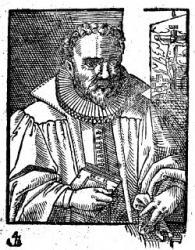
Martin Behm

1557 - 1622 Person Name: M. Behm Topics: Judgment Boldness in Author of "I shall be satisfied, when I awake, with Thy likeness" in Hymnal of the Methodist Episcopal Church Behm, Martin, son of Hans Behm [Bohme, Boehm, Behemb, Behem, Boheim, Bohemus or Bohemius], town-overseer of Lauban in Silesia, was born at Lauban, Sept. 16, 1557. During a protracted famine, 1574, Dr. Paul Fabricius, royal physician at Vienna, a distant kinsman, took him to Vienna, where he acted as a private tutor for two years, and then went to Strassburg, where, from Johann Sturm, Rector of the newly founded University, he received much kindness. Returning home at his mother's request after his father's death, May, 1580, he was, at Easter, 1581, appointed assistant in the Town School, and on Sept. 20, ordained diaconus of the Holy Trinity Church. After his senior had been promoted to Breslau the Town Council kept the post nominally vacant for two years, and then, in June, 1586, appointed Behm chief pastor. For 36 years ho held this post, renowned as a preacher, as a faithful pastor in times of trouble (famine 1590, pestilence 1613, war 1619), and as a prolific author. After preaching on the tenth Sunday after Trinity, 1621, he was seized with illness, and after he had lain for twenty-four weeks on a sick bed, there was ministered to him, on Feb. 5, 1622, the abundant entrance of which he sings in his hymn, "O Jesu Christ, meins Lebenslichtr” (Koch, ii. 227-234; Allg. Deutsche Biographie,ii. 282). He was one of the best hymn-writers of his time. His hymns are true and deep in feeling, dwelling specially on the Passion of Our Lord. They speedily passed into the hymn-books, and long held their place therein. Of about 480 hymns which he composed, the most important appeared in his:— (1) Centuria precationum rhythmicarum, Wittenberg, 1606 (2nd ed., 1611). (2) Centuria secunda precationum rhythmicarum, Wittenberg, 1608 (2nd ed., 1611). (3) Centuria precationum rhythmicarum, "Wittenberg, 1615 (complete edition of the Three Centuries, Jena and Breslau, 1658). A selection of 79 Hymns, ed., with an introduction, by W. Noldeke, appeared at Halle in 1857. Four of his hymns have been translated into English, three being in English common use:— i. O Heilige Dreifaltigkeit. [Morning.] First published in his Kriegesman, Leipzig, 1593, in 7 st. of unequal length, repeated in 1608, as above, in 8 stanzas of 4 lines. Both forms are in Wackernagel, v. p. 197; and the second in Noldeke, 1857, p. 53; and, omitting stanzas vi.-viii., as No. 1126 in the Berlin G. L. S., ed. 1863. In 1593 it was entitled " The ancient Sancta Trinitas et adoranda (Jnitas in German;" but it is rather a versification of the Prayer for Wednesday evening in J. Habermann's Gebet Buck (Wittenberg, 1567). The translations in common use, both of the second form, are:— 1. O Thou most Holy Trinity. A very good translation of stanzas i., iii.-v., by A. T. Russell, as No. 2 in his Ps. and Hys., 1851, and thence in Kennedy, 1863, and Dr. Thomas's Augustine H. Bk., 1866. 2. O holy, blessed Trinity, Divine. A good translation of stanzas i.-v. by Dr. C. H. L. Schuette, as No. 295 in the Ohio Luth. Hymnal, 1880. 3. O holy, holy, holy Three, by H. J. Bucholl, 1842, p. 21. ii. O Jesu Christ, meins Lebens Licht. [For the Dying.] His finest hymn. First pub.lished in a collection entitled Christliche Gebet, 1610, and then in his Zehen Sterbegebet, appended to his Centuria secunda, 1611 (see above), in 14 stanzas of 4 1., entitled " Prayer fora happy journey home, founded upon the sufferings of Christ." Thence in Wackernagel, v. p. 235, Noldeke, 1857, p. 79, and the Unv. L. S., 1851, No. 835. The translations in common use are:— 1. Lord Jesus Christ, my Life, my Light. A very good translation by Miss Winkworth in her Lyra Ger., 2nd Series, 1858, p. 213, st. v., x. being omitted and viii., ix. combined as one stanza. In her Chorale Book for England, 1863, No. 190, she omitted her stanzas v., vi., and united her stanzas iv., vii. as iv. This translation is included more or less abridged in Wilson's Service of Praise, 1865, and in America in the Baptist Hymn Book, Phil, 1871, the Methodist Episcopal Hymnal, 1878/and the Ohio Lutheran Hymnal, 1880, &c. 2. Lord Jesus Christ, my soul's desire. A good and full translation by Dr. John Ker in the Juv. Miss. Mag. of the U. P. Church, May, 1858, p. 25. Stanzas i., iii, v., vii. form No. 49 in the Ibrox Hymnal, 1871. Other translations are:— (l) "Lord Jesu, fountain of my life." by J. C. Jacobi, 1725, p. 52 (1732, p. 195), and repeated in the Moravian hymn books combined in 1826 with J. Cennick's "Though I'm in body full of pain." (2) "Jesu, my light and sure defence," as No. 54 in the Moravian Hymn Book 1742. (3) “O Jesu, life-light of my way," by Miss Warner, 1858 (ed. 1861, p. 176). iii. O Konig aller Ehren. [Epiphany.] Founded on St. Matthew ii., and first published 1606 as above, in 6 stanzas of 8 lines. Thence in Wackernagel, v. p. 210, Noldeke, 1857, p. 31, and the Unv. Leidersegen, 1851, No. 79. The translations in common use are:— 1. O King of Glory, David's Son. A double C. M. version of stanzas i., ii., v., vi. by Miss Winkworth in her Lyra Germanica, 2nd Series, 1858, p. 20, and thence in Dr. Pagenstecher's Collection, 1864, No. 33. Her 2nd translation:— 2. O Jesu, King of Glory, No. 37 in her Chorale Book for England, 1863, is the above version rewritten to the original metre. In the Ohio Lutheran Hymnal, 1880, No. 54, with translation of st. iii., iv. added. iv. Das wait Gott Vater und Gott Sohn. [Morning Prayer.] First published 1608 as above, in 11 st., and thence in Wackernagel, v. p. 215, in Noldeke, 1857, p. 51. Translated as "O God Almighty, Father, Son," by H. J. Buckoll, 1842, p. 15. -John Julian, Dictionary of Hymnology (1907)

Thomas Olivers

1725 - 1799 Person Name: Thomas Olivers, 1725-1799 Topics: Judgment Composer of "HELMSLEY" in Evangelical Lutheran Worship Thomas Olivers was born in Tregonan, Montgomeryshire, in 1725. His youth was one of profligacy, but under the ministry of Whitefield, he was led to a change of life. He was for a time apprenticed to a shoemaker, and followed his trade in several places. In 1763, John Wesley engaged him as an assistant; and for twenty-five years he performed the duties of an itinerant ministry. During the latter portion of his life he was dependent on a pension granted him by the Wesleyan Conference. He died in 1799. --Annotations of the Hymnal, Charles Hutchins, M.A., 1872. ================== Olivers, Thomas, was born at Tregynon, near Newtown, Montgomeryshire, in 1725. His father's death, when the son was only four years of age, followed by that of the mother shortly afterwards, caused him to be passed on to the care of one relative after another, by whom he was brought up in a somewhat careless manner, and with little education. He was apprenticed to a shoemaker. His youth was one of great ungodliness, through which at the age of 18 he was compelled to leave his native place. He journeyed to Shrewsbury, Wrexham, and Bristol, miserably poor and very wretched. At Bristol he heard G. Whitefield preach from the text "Is not this a brand plucked out of the fire?" That sermon turned the whole current of his life, and he became a decided Christian. His intention at the first was to join the followers of Whitefield, but being discouraged from doing so by one of Whitefield's preachers, he subsequently joined the Methodist Society at Bradford-on-Avon. At that town, where he purposed carrying on his business of shoemaking, he met John Wesley, who, recognising in him both ability and zeal, engaged him as one of his preachers. Olivers joined Wesley at once, and proceeded as an evangelist to Cornwall. This was on Oct. 1, 1753. He continued his work till his death, which took place suddenly in London, in March 1799. He was buried in Wesley's tomb in the City Road Chapel burying ground, London. Olivers was for some time co-editor with J. Wesley of the Arminian Magazine, but his lack of education unfitted him for the work. As the author of the tune Helmsley, and of the hymn “The God of Abraham praise," he is widely known. He also wrote “Come Immortal King of glory;" and "O Thou God of my salvation," whilst residing at Chester; and an Elegy on the death of John Wesley. His hymns and the Elegy were reprinted (with a Memoir by the Rev. J. Kirk) by D. Sedgwick, in 1868. --John Julian, Dictionary of Hymnology (1907)

Bernadette Farrell

b. 1957 Person Name: Bernadette Farrell, b. 1957 Topics: Judgment Author of "God Has Chosen Me" in Gather (3rd ed.)

Peter Sohren

1630 - 1693 Topics: Last Things Resurrection and Judgment Composer of "DU LIFVETS BRÖD" in The Hymnal and Order of Service

J. Wilbur Chapman

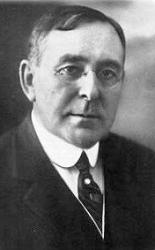
1859 - 1918 Topics: Jesus Christ His Second Coming and Judgment Author of "One Day He's Coming" in Trinity Hymnal (Rev. ed.) Rv John Wilbur Chapman DD LLD USA 1859-1918. Born in Richmond, IN, he attended Quaker Day School and Methodist Sunday school. At age 17 he made a public declaration of his Christian faith and joined the Richmond Presbyterian Church. He received his seminary degree from Lane Theoloical Seminary, Cincinnati, OH. He was later awarded a Doctorate in Divinity from the College of Wooster, and an LL.D. from Heidelberg University. In 1882 he married Irene Steddon. They had a daughter. His wife died in 1886. In 1888 he married Agnes Pruyn Strain, and they had four children. His second wife died in 1907. In 1910 he married Mabel Cornelia Moulton. He held six pastorates in OH, IN, NY, PA, NY, NY before becoming an evangelist, generally traveling with gospel singer, Charles Alexander. In 1893 he preached with D. L. Moody. Billy Sunday was one of his disciples on the circuit. In 1895 he was appointed Corresponding Secretary of the Presbyterian General Assembly's Committeee on Evangelism, overseeing activities of 51 evangelists in 470 cities. He developed campaign tactics to maximize evangelical successes, trying them first in Pittsburgh, then Syracuse. With funding from philanthropist, John H. Converse, a wealthy Presbyterian, Chapman joined with Alexander to launch evangelical campaigns in 1907. He assembled 21 evangelistic teams after that to cover 42 sections of Philadelphia, preaching for several weeks. 8000 conversions resulted. They repeated this in NC. In 1909 they started a worldwide campaign in Vancouver, BC, and took in cities in Australia, the Phillipines, China, Korea, and Japan. Chapman also held religious summer conferences at Winona Lake, IN, Montreat, NC, and Long Island, NY. Mass evangelism was losing favor in 1910, so he was back holding large revivals with Alexander in 1912. He was also elected moderator of the Presbyterian Church General Assembly, and under so much stress, he developed gall stones. The surgery was too much, and he died two days later. He was also a prolific writer of religious works and hymn lyrics. 19 works. John Perry

Joseph Swain

1761 - 1796 Person Name: Swain Topics: Last Judgment Author of "The Coming of Christ to Judgment" in A Selection of Hymns for Public Worship. In four parts (10th ed.) (Gadsby's Hymns) Swain, Joseph, was born at Birmingham in 1761, and after being apprenticed to an engraver, removed to London. After a time he became a decided Christian, and being of an emotional poetic temperament, began to give expression to his new thoughts and feelings in hymns. In 1783 he was baptized by the Rev. Dr. Rippon, and in 1791 became minister of a Baptist congregation in East Street, Walworth. After a short but popular and very useful ministry, he died April 16, 1796 Swain published the following:— (1) A Collection of Poems on Several Occasions, London, 1781; (2) Redemption, a Poem in five Books, London, 1789; (3) Experimental Essays on Divine Subjects, London, 1791; (4) Walworth Hymns, by J. Swain, Pastor of the Baptist Church Meeting there, London, 1792, 129 hymns; with a Supplement, 1794, 192 hymns; (5) A Pocket Companion and Directory, London, 1794. In addition to a limited number of Swain's hymns, annotated under their respective first lines, the following, from his Walworth Hymns1792, and the 2nd ed., 1796, are also in common use:— 1. Brethren, while we sojourn here. Mutual Encouragement. 2. Children of the King of grace. Holy Baptism. 3. Christ the Lord will come again. Second Advent. 4. Come, ye souls, by sin afflicted. The Yoke of Christ. 5. How sweet, how heavenly is the sight. Communion of Saints. 6. In expectation sweet. Second Advent. 7. Lift up your heads, ye gates. Ascension. 8. Love is the sweetest bud that blows. A Flower an Emblem of Christ. 9. 0 how the thought that I shall know. Heaven Anticipated. Sometimes it begins with st. ii., "For ever to behold Him shine". 10. On earth the song begins. Heaven Anticipated. 11. On the wings of faith upspringing. Passiontide. 12. Pilgrims we are to Canaan bound. Pilgrimage of Life. 13. Praise ye the Lord, the eternal King. Divinity of Christ. 14. Praise your Redeemer, praise His Name. Praise for Redemption. 15. 'Tis heaven begun below. Heaven Anticipated. 16. What is it for a saint to die? Death and Burial. 17. What must [will] it be to dwell above? Heaven Anticipated. 18. When firm I [we] stand on Zion's hill. Confidence. Sometimes as "I stand on Zion's mount," in American collections. 19. Who can forbear to sing? Praise of Jesus. From his Redemption, a Poem in Five Books, 1791, the following hymns are also in common use:-- 20. 0 Thou in whose presence my soul takes delight. In Affliction. 21. Ye daughters of Zion, declare, have you see? Comfort in Affliction. Of these hymns the most widely known are Nos. 1, 5, 6, and 20. We may add that several of Swain's hymns appeared in The Theological Miscellany, 1784-1789. [Rev. W. R. Stevenson, M.A.] -- John Julian, Dictionary of Hymnology (1907)

Wolfgang Amadeus Mozart

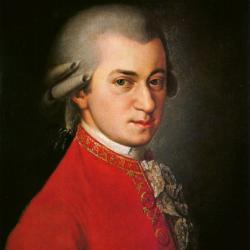
1756 - 1791 Person Name: Mozart Topics: Royalty of Christ Judgment the Prerogative of Composer of "ELLESDIE" in The Psalter Wolfgang Amadeus Mozart Austria 1756-1791. Born at Salzburg, Austria, the son of Leopold Mozart, a minor composer and violinist, and youngest of seven children, he showed amazing ability on violin and keyboard from earliest childhood, even starting to compose music at age four when his father would play a piece and Mozart would play it exactly as did his father. At five, he composed some of his own music, which he played to his father, who wrote it down. When Mozart was eight, he wrote his first symphony, probably transcribed by his father. In his early years his father was his only teacher, teaching his children languages and academic subjects, as well as fundamentals of their strict Catholic faith. Some of his early compositions came as a surprise to his father, who eventually gave up composing himself when he realized how talented his son was. His family made several European journeys and he and his sister, Nanneri, performed as child prodigies, at the court of Prince-elector Maximillian II of Bavaria in Munich, and at the Imperial Courts in Vienna and Prague. A long concert tour followed, for 3.5 years, taking the family to courts in Munich, Mannheim, Paris, London, Dover, The Hague, Amsterdam, Utrecht, Mechelen, and again to Paris, and back home via Zurich, Donaueschingen, and Munich. During these trips Mozart met many musicians, acquainting himself with the works of other composers. He met Johann Christian Bach in London in 1764. Family trips were challenging, and travel conditions were primitive. They had to wait for invitations and reimbursements from nobility, and they endured long, near-fatal illnesses far from home. First Leopold (1764) got sick, then both children (1765). They traveled again to Vienna in 1767 and stayed there over a year. After a year back in Salzburg, Leopold and Wolfgang went to Italy (1769-1771), Leopold wished to display his son’s abilities as a performer and maturing composer. In Bologna, Italy, Wolfgang was accepted as a member of the famous Academia Filamonica. In Rome he heard Gregorio Allegri’s Miserere twice in performance. Back in the Sistine Chapel, Mozart wrote the whole performance out from memory, thus producing the first unauthorized copy of this closely guarded property of the Vatican. In the next few years Mozart wrote several operas performed with success in Italy, but his father’s hopes of securing a professional appointment for his son were not realized. At age 17 he was engaged as a musician at the Salzburg court, but grew restless and traveled in search of a better position. After returning to Salzburg, Mozart was employed as a court musician by the ruler of Salzburg, Prince Archbishop Hieronymus Colloredo. This gave Mozart ample opportunity to develop relationships with other musicians and his admirers, resulting in his development of new symphonies, sonatas, string quartets, masses, serenades, and some minor operas. In 1775 he wrote his only violin concertos, five in all. Again, he was discontent with work in Salzburg and traveled to find more opportunity to write operas. He and his father again visited Munich and Vienna, but neither visit was successful with the exception of his opera ‘La finta giardiniera’ in Munich. In 1777 he resigned his Salzburg position and went to Augsburg, Mannheim, Paris, and Munich again. In Mannheim he met and fell in love with Aloysia Weber, one of four daughters of a musical family. He could find no real employment there and left for Paris in 1778. He might have had a position as organist at Versailles, but he was not interested in that. He fell into debt and started pawning valuables. During these events his mother died. Meanwhile his father was still trying to find him a position in Salzburg. After checking out several other European cities and Munich, he again encountered Aloysia, but she was no longer interested in him, so he returned to Salzburg, having written another symphony, concerto, and piano sonata, and took the new appointment his father had found. However, he was still in discontent. Visiting Vienna in 1781, he was dismissed from his Salzburg position. He wrote another opera, ‘Idomeneo’, in 1781, that was successful in Munich. Two months later he was summoned to Vienna, where his employer, Archbishop Colloredo, wanted him around due to his notoriety. Mozart wished to meet the emperor and perform for him, and finally got that opportunity. It resulted in a part-time position and substantial commissions. Colloredo became a nemesis to Mozart’s career, finally releasing Mozart from his employ with a literal kick in the pants, much against his father’s wishes. However, he was now independent. Mozart then decided to settle in Vienna as a free lance performer and composer. He lived with the Fridolin Weber family, who had moved from Mannheim to Vienna. Fridolin, the father, had died, and they were taking in lodgers to make ends meet. His career there went well, and he performed as a pianist before the Emperor, establishing himself as the finest keyboard player in Vienna. He wrote another opera in 1782, again achieving success. Mozart had now become a prolific and influential composer of the Classical period and was known throughout Europe. Aloysia was now married to actor, Joseph Lange, and Mozart’s interest shifted to her sister, Constanze. In 1782 he married Constanze Weber Mozart Nissen. The marriage started out with a brief separation, and there was a problem getting Mozart’s father’s permission, which finally came. They had six children, but only two survived infancy: Carl and Franz. He lived in Vienna and achieved some notoriety, composing many of his best-known symphonies, concertos, and operas. In 1782-83 he became intimately acquainted with Johann Sebastian Bach and George Friederic Handel, as his friend, Gottfried van Swieten, owned many manuscripts of the Baroque masters, which Mozart studied intently. He altered his style of composition as a result. That year Mozart and his wife visited his father and sister, and he composed a liturgical piece, a Mass, with a singing part for his wife. He also met Joseph Hadyn in Vienna in 1784 and they became friends. They even played together in a string quartet from time to time. Mozart wrote six quartets dedicated to Hadyn. In 1785 Hadyn told Leopold Mozart, “Your son is the greatest composer known to me by person and repute, he has taste, and what is more, the greatest skill in composition”. Over the next several years Mozart booked several piano concertos in various places as a sole performer to delighted audiences, making substantial remuneration for his work. He and his wife then adopted a more luxurious lifestyle. They moved to an expensive apartment and he bought a fine fortepiano and billiard table. They sent their son, Karl, to an expensive boarding school and also kept servants. In 1784 Mozart became a Freemason and even composed Masonic music. Over the next several years he did little operatic writing and focused on his career as a piano soloist and writer of concertos. He again began operatic collaboration in 1785, creating ‘The marriage of Figaro’, then ‘Don Giovanni’ in 1787. That year his father died. Also that year he obtained a steady post under Emperor Joseph II as his chamber composer. This was part-time employment that was important when hard times arrived. However, Joseph aimed at keeping Mozart from leaving Vienna for better work. The Austrio-Turkish War made life difficult for musicians, and his aristocracy support had declined. He moved to save on expenses, but that did not help much, and he was reduced to borrowing funds from his friends, and pleading for loans. During this period he produced his last three symphonies. In 1789 he then set up on a journey to Leipzig, Dresden, and Berlin hoping to improve his fortunes. In 1790 he was highly productive, producing concertos, an opera, ‘The magic flute’, a series of string quintets, a motet, and an (unfinished) Requiem. Finances began to improve and he begin paying back his debts. Public reaction to his works also brought him great satisfaction. In 1791, while in Prague for the premiere of his opera, ‘La clemenza di Tito’, he fell ill. He continued professional functions for a short time, but had to go home and be nursed by his wife over the next couple of months. He died at Vienna, Austria, at the age of 35, a small thin man with undistinguishing characteristics. He was buried in a modest grave, having had a small funeral. Beethoven composed his early works in the shadow of Mozart, and Joseph Hadyn wrote “posterity will not see such a talent (as Mozart) again in 100 years”. 600+ works. Side note: Mozart enjoyed billiards, dancing, and had a pet canary, a starling, a dog, and a horse for recreational riding. He liked off-color humor. He wore elegant clothing when performing and had a modest tenor voice. John Perry

Cornelius Becker

1561 - 1604 Person Name: Cornelius Becker, 1561-1694 Topics: Judgment Author of "Thanks Be to God" in Worship (3rd ed.) Becker, Cornelius, son of Adrian Becker, merchant of Leipzig, was born at Leipzig, Oct. 24, 1561. After studying at the University, where he graduated 1584, he kept a private school till his appointment, in the beginning of 1588, as one of the masters of the St. Thomas School, a post he vacated in Sept., 1588. on being appointed diaconus at Rochlitz. In 1592 he became diaconus, and in 1594, pastor of the church of St. Nicholas, Leipzig; and subsequently Professor of Theology in the University, from which, in 1599, he received the degree of D.D. On account of false accusations he was deprived of his charge on June 5, 1601, but was vindicated and restored on Nov. 29 following. He died suddenly at Leipzig, May 25, 1604 (Koch, ii. 219-223; Allgemeine Deutsche Biographie, ii. 221). He wrote a few hymns, but his principal work was his version of the Psalter, 1602. The only version translated into English is:— Der Herr ist mein getreuer Hirt, Dem ich mich ganz vertraue. [Ps. xxiii.] Appeared in S. Calvidus's Harmonia Cantionum Ecclesiasticarum, Leipzig, 1598, and then in Becker's Der Psalter Dauids Gesangweis, Leipzig, 1602. Thence in Wackernagel, v., p. 369, in 3 stanzas of 7 lines, entitled "The Good Shepherd." In Bunsen's Allgemeine Gesang-Buch, 1846, No. 2. It is translated as "My Shepherd is the Saviour dear," by Miss Dunn, 1857, p. 19. [Rev. James Mearns, M.A.] -- John Julian, Dictionary of Hymnology (1907)

Johannes Matthaeus Meyfart

1590 - 1642 Person Name: Meyfart Topics: Judgment and Eternity Author of "Jerusalem, thou city fair and high" in Hymn Book Meyfart, Johann Matthäus, was born Nov. 9, 1590 at Jena, during a visit which his mother (wife of Pastor Meyfart of Wablwinkel, near Waltershausen, Gotha) was paying to her father. He studied at the Universities of Jena (M.A. 1611; D.D. 1624) and Wittenberg, and was thereafter for some time adjunct of the philosophical faculty at Jena. In 1616, he was appointed professor in the Gymnasium at Coburg and in 1623 director; and during his residence at Coburg was a great moral power. When his colleagues in the Gymnasium made a complaint to the government regarding a dissertation (De disciplina ecclesiastica) which he published in 1633, he accepted the offer of the professorship of theology in the revived University of Erfurt. He entered on his work at Erfurt, July, 1633, was rector of the University in 1634, and in 1636 became also pastor of the Prediger Kirche. He died at Erfurt, Jan. 26, 1642 (Koch iii. 117; Allgemeine Deutsche Biographie xxi. 646, &c.). Meyfart's devotional works (Tuba poenitentiae prophetica, 1625; Tuba Novissima, 1626; Höllisches Sodoma, 1629; Himmlisches Jerusalem, 1630; Jüngste Gericht, 1632) passed through various editions, and produced a great impression by their vivid picturing and their earnest calls to repentance and amendment of life. His well-meant efforts, by books and otherwise, towards raising the tone of student life in Germany, and his exposition of the excesses and defects in both academical and churchly life at that period, brought him much ill will and opposition, and did not produce useful fruit till much later. His hymns were few in number, and appeared mostly in his devotional books. Only one of Meyfart's hymns has passed into English, viz. :— Jerusalem, du hochgebaute Stadt. The New Jerusalem. This splendid hymn appeared in his Tuba Novissima, Coburg, 1626 [Ducal Library, Gotha], a volume containing four sermons preached at Coburg on the Four Last Things, viz. Death, Last Judgment, Eternal Life, and Eternal Punishment. It forms the conclusion of the third sermon (on St. Matt. xvii. 1-9) which is entitled "On the joy and glory which all the Elect are to expect in the Life everlasting." This conclusion is reprinted verbatim et literatim (i.e. with the introductory and closing sentences, and the connecting sentences between st. i., ii., iii. and iv.) in the Blätter für Hymnologie, 1883, pp. 120-124. The text of the hymn, in 8 st. of 8 1., is given unaltered, according to the marginal directions of the original (save st. vii. 1. 6, where the original is "Man spielt"), as No. 1537 in the Berlin Geistliche Lieder ed. 1863. Of it Lauxmann, in Koch viii. 669, says:— "The hymn is a precious gem in our Treasury of Song, in which one clearly sees that from it the whole heart of the poet shines out on us. Meyfart had his face turned wholly to the Future, to the Last Things; and with a richly fanciful mysticism full of deep and strong faith, he united a flaming zeal for the House of the Lord, and against the abuses of his times." He adds that the hymn was a great favourite with Charles Gützlaff, the apostle of China (died at Hong Kong, Aug. 9, 1851), whose last words were "Would God I were in thee" (st. i. 1. 3) ; and of Julius Schnorr of Carolsfeld, the well-known painter, whose last work was the illustrating of this hymn, and at whose funeral in 1872 it was sung. The popularity of the hymn was greatly aided by the magnificent melody, generally ascribed to Melchior Franck [born at Zittau, 1580 ; c. 1604, capellmeister at Coburg; died at Coburg, June 1,1639], but not yet traced earlier than to the Erfurt Gesang-Buch, 1663. Translations in common use:— 1. Jerusalem, thou city built on high. A good tranlation of st. i.-iv., vii., as No. 112 in the Dalston Hospital Hymn Book, 1848. 2. Jerusalem, thou city built on high. A good translation of st. i., iv., vi., vii., by A. T. Russell, as No. 261 in his Psalms & Hymns, 1851. St. i., 11. 1, 2, 4 are from the 1848 translation. The form in Dr. Pagenstecher's Collection, 1864, No. 288, is i. 11. 1-4, ii. as 1848; i. 11. 5-8, vii. as 1851. 3. Jerusalem, thou city fair and high. A good and full translation by Miss Winkworth, in her Lyra Germanica, 2nd Ser., 1858, p. 220; repeated in her Chorale Book for England, 1863, No. 193, set to the melody of 1663. Included in full in the Ohio Lutheran Hymnal, 1880, and, abridged, in the Pennsylvania Lutheran Church Book, 1868, and the Uppingham and Sherborne School Hymn Book, 1874. 4. Jerusalem! high tow’r thy glorious walls. A good and full translation, by Bishop W. R. Whittingham, in the American Episcopal Hymns for Church and Home, 1860, No. 414; and the American Episcopal Hymnal, 1871. St. i., iv., viii. are in M. W. Stryker's Christian Chorals, 1885. Translations not in common use:— (l) "Jerusalem, thou city of the skies." In the United PresbyterianJuvenile Mission Magazine, Dec. 1857. (2) "Jerusalem! thou glorious city-height." By Mrs. Sevan, 1858, p. 19, repeated in L. Rehfuess's Church at Sea, 1868. (3) “Jerusalem, thou high-built, fair abode." In the Christian Examiner (Boston, U. S.), Sept. 1860, p. 254. (4) "Jerusalem, thou city rear'd on high. By Miss Manington, 1863, p. 94. (5) "Jerusalem! thou city towering high." By Miss Cox, in her Hymns from the German, 1864, p. 101, and in Lyra Mystica, 1865, p. 365. (6) "Jerusalem! thou city builded high." By Miss Burlingham, in the British Herald, April, 1866, p. 249, and Reid's Praise Book, 1872. (7) "Jerusalem! high tow'r thy glorious walls." A full and spirited translation by J. H. Hopkins, in his Carols, Hymns and Songs, 1882, p. 182, dated 1862. St. i., 11. 1-2, are taken from Bishop Whittingham's version. [Rev. James Mearns, M.A.] -- John Julian, Dictionary of Hymnology (1907)

Pages


Export as CSV
It looks like you are using an ad-blocker. Ad revenue helps keep us running. Please consider white-listing Hymnary.org or getting Hymnary Pro to eliminate ads entirely and help support Hymnary.org.