You help make Hymnary.org possible. More than 10 million people from 200+ countries found hymns, liturgical resources and encouragement on Hymnary.org in 2025, including you. Every visit affirms the global impact of this ministry.

If Hymnary has been meaningful to you this year, would you take a moment today to help sustain it? A gift of any size—paired with a note of encouragement if you wish—directly supports the server costs, research work and curation that keep this resource freely available to the world.

Give securely online today, or mail a check to:
Hymnary.org
Calvin University
3201 Burton Street SE
Grand Rapids, MI 49546

Thank you for your partnership, and may the hope of Advent fill your heart.

Person Results

Tune Identifier:"^olives_brow_bradbury$"
In:people

Planning worship? Check out our sister site, ZeteoSearch.org, for 20+ additional resources related to your search.
Showing 21 - 29 of 29Results Per Page: 102050

H. L. Hastings

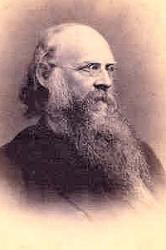
1831 - 1899 Person Name: Horace L. Hastings Author of "Within the garden's whispering shade" in Hymns, Psalms and Gospel Songs Hastings, Horace Lorenzo, was born at Blandford, Mass., Nov. 26, 1831; commenced writing hymns, and preaching, in his 17th year, and laboured as an evangelist in various parts of the U. S. In 1866 he established The Christian, a monthly paper, in which many of his hymns have appeared, and in 1865 the Scriptural Tract Repository in Boston. He published Social Hymns, Original and Selected, Boston, 1865; Songs of Pilgrimage, a Hymnal for the Churches of Christ, Part i., 1880; and in August, 1886, the same completed, to tho extent of 1533 hymns, 450 of which are original and signed "H." The best known of these is "Shall we meet beyond the river," written in N. Y. city, 1858, and lately published as a leaflet in 14 stanzas of 8 lines. The text in Gospel Hymns and elsewhere consists of the 1st half of stanzas i., iv., xi. and ix. The Hastings Birthday Book, extracts from his prose writings, appeared 1886. [Rev. F. M. Bird, M.A.] -- John Julian, Dictionary of Hymnology

Samuel Stewart

Author of "'Tis Midnight, and on Olive's Brow" in Songs of Grace and Glory

William Walsham How

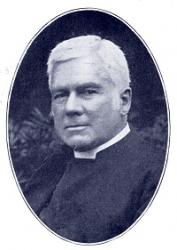
1823 - 1897 Person Name: William Walsham How, 1823-1897 Author of "O Thou through suffering perfect made" in The Hymnal William W. How (b. Shrewsbury, Shropshire, England, 1823; d. Leenane, County Mayo, Ireland, 1897) studied at Wadham College, Oxford, and Durham University and was ordained in the Church of England in 1847. He served various congregations and became Suffragan Bishop in east London in 1879 and Bishop of Wakefield in 1888. Called both the "poor man's bishop" and "the children's bishop," How was known for his work among the destitute in the London slums and among the factory workers in west Yorkshire. He wrote a number of theological works about controversies surrounding the Oxford Movement and attempted to reconcile biblical creation with the theory of evolution. He was joint editor of Psalms and Hymns (1854) and Church Hymns (1871). While rector in Whittington, How wrote some sixty hymns, including many for chil­dren. His collected Poems and Hymns were published in 1886. Bert Polman =============== How, William Walsham, D.D., son of William Wybergh How, Solicitor, Shrewsbury, was born Dec. 13, 1823, at Shrewsbury, and educated at Shrewsbury School and Wadham College, Oxford (B.A. 1845). Taking Holy Orders in 1846, he became successively Curate of St. George's, Kidderminster, 1846; and of Holy Cross, Shrewsbury, 1848. In 1851 he was preferred to the Rectory of Whittington, Diocese of St. Asaph, becoming Rural Dean in 1853, and Hon. Canon of the Cathedral in 1860. In 1879 he was appointed Rector of St. Andrew's Undershaft, London, and was consecrated Suffragan Bishop for East London, under the title of the Bishop of Bedford, and in 1888 Bishop of Wakefield. Bishop How is the author of the Society for Promoting Christian Knowledge Commentary on the Four Gospels; Plain Words , Four Series; Plain Words for Children; Pastor in Parochia; Lectures on Pastoral Work; Three All Saints Summers, and Other Poems , and numerous Sermons , &c. In 1854 was published Psalms and Hymns, Compiled by the Rev. Thomas Baker Morrell, M.A., . . . and the Rev. William Walsham How, M.A. This was republished in an enlarged form in 1864, and to it was added a Supplement in 1867. To this collection Bishop How contributed several hymns, and also to the S. P. C. K. Church Hymns , of which he was joint editor, in 1871. The Bishop's hymns in common use amount in all to nearly sixty. Combining pure rhythm with great directness and simplicity, Bishop How's compositions arrest attention more through a comprehensive grasp of the subject and the unexpected light thrown upon and warmth infused into facia and details usually shunned by the poet, than through glowing imagery and impassioned rhetoric. He has painted lovely images woven with tender thoughts, but these are few, and found in his least appreciated work. Those compositions which have laid the firmest hold upon the Church, are simple, unadorned, but enthusiastically practical hymns, the most popular of which, "O Jesu, Thou art standing"; "For all the Saints who from their labours rest," and "We give Thee but Thine own," have attained to a foremost rank. His adaptations from other writers as in the case from Bishop Ken, "Behold, the Master passeth by," are good, and his Children's hymns are useful and popular. Without any claims to rank as a poet, in the sense in which Cowper and Montgomery were poets, he has sung us songs which will probably outlive all his other literary works. The more important of Bishop How's hymns, including those already named, and "Lord, Thy children guide and keep"; "O Word of God Incarnate"; "This day at Thy creating word"; "Who is this so weak and helpless"; and others which have some special history or feature of interest, are annotated under their respective first lines. The following are also in common use:— i. From Psalms & Hymns, 1854. 1. Before Thine awful presence, Lord. Confirmation. 2. Jesus, Name of wondrous love [priceless worth]. Circumcision. The Name Jesus . 3. Lord Jesus, when we stand afar. Passiontide. 4. O blessing rich, for sons of men. Members of Christ. 5. 0 Lord of Hosts, the earth is Thine. In time of War. 6. O Lord, Who in Thy wondrous love. Advent. ii. From Psalms & Hymns, enlarged, 1864. 7. Lord, this day Thy children meet. Sunday School Anniversary. iii. From Supplement to the Psalms & Hymns, 1867. 8. Hope of hopes and joy of joys. Resurrection. 9. 0 daughters blest of Galilee. For Associations of Women. 10. O happy feet that tread. Public Worship. 11. With trembling awe the chosen three. Transfiguration. iv. From Parish Magazine, 1871, and Church Hymns, 1871. 12. O Jesu, crucified for man. Friday. 13. Yesterday, with worship blest. Monday. v. From the S. P. C. K. Church Hymns. 1871. 14. Bowed low in supplication. For the Parish. 15. Great Gabriel sped on wings of light. Annunciation, of the Blessed Virgin Mary. 16. O blest was he, whose earlier skill. St. Luke. 17. O God, enshrined in dazzling light. Omnipresence. Divine Worship . 18. O heavenly Fount of Light and Love. Witsuntide. 19. O Lord, it is a blessed thing. Weekdays. 20. 0 One with God the Father. Epiphany. 21. O Thou through suffering perfect made. Hospitals. 22. Rejoice, ye sons of men. Purification of the B. V. M. 23. Summer suns are glowing. Summer. 24. The year is swiftly waning. Autumn. 25. Thou art the Christ, O Lord. St. Peter. 26. To Thee our God we fly. National Hymn. 27. Upon the holy Mount they stood. Transfiguration and Church Guilds. 28. We praise Thy grace, 0 Saviour. St. Mark. vi. From the S. P. C. K. Children's Hymns, 1872. 29. Behold a little child. Jesus the Child's Example. 30. Come, praise your Lord and Saviour. Children's Praises. 31. It is a thing most wonderful. Sunday School Anniversary. 32. On wings of living light. Easter. Bishop How's hymns and sacred and secular pieces were collected and published as Poems and Hymns, 1886. The Hymns, 54 in all, are also published separately. He d. Aug. 10, 1897. --John Julian, Dictionary of Hymnology (1907) =================== How, W. W., p. 540, i. He died Aug. 10, 1897. His Memoir, by F. D. How, was published in 1898. --John Julian, Dictionary of Hymnology, New Supplement (1907)

August Crull

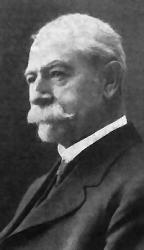
1845 - 1923 Person Name: A. Crull Translator of "O God, Thou Righteous, Faithful Lord" in American Lutheran Hymnal August Crull was born January 27, 1845 in Rostock, Germany, where his father, Hofrat Crull, was a lawyer. He was educated at the Gymnasium in Rostock, and at Concordia College in St. Louis and Fort Wayne where he graduated in 1862. His father died soon after he began studying at the Gymnasium. His mother then married Albert Friedrich Hoppe, who later became the editor of the St. Louis edition of Luther's Works. In 1865, Crull graduated from Concordia Seminary in St. Louis. He became assistant pastor at Trinity Church in Milwaukee and also served as Director of the Lutheran High School. Later he was pastor of the Lutheran Church in Grand Rapids, Michigan. From 1873 to 1915, he was professor of the German language and literature at Concordia College in Fort Wayne, Indiana. After his retirement he returned to Milwaukee, where he died on February 17, 1923. His first wife and three of his four children preceded him in death. His second wife, Katharina John, survived him by many years. Crull was a distinguished hymnologist and translated many hymns that appeared in several Lutheran hymnals. He published a German grammar and edited a book of devotions, Das walte Gott, based on the writings of Dr. C.F.W. Walther. His project of translating Lutheran hymns so they would be accessible to American Lutherans bore its first fruits when he published a book of English hymns at the Norwegian Synod publishers in Decorah, in 1877. --www.hymnsandcarolsofchristmas.com/

William B. Tappan

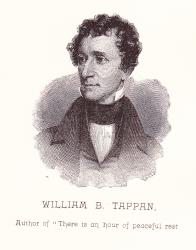
1794 - 1849 Author of "'Tis Midnight; and On Olives' Brow" in Hymns of Zion See also in: Hymn Writers of the Church ============================= Tappan, William Bingham, was born at Beverley, Massachusetts, Oct. 29, 1794, and was apprenticed to a clockmaker at Boston in 1810. In 1815 he removed to Philadelphia, where he was engaged in business for a time. In 1822 he was engaged as Superintendent of the American Sunday School Union. In 1840 he was licensed to preach with the Congregational body, his sphere of usefulness on behalf of Sunday Schools being thereby considerably widened. He died suddenly, of cholera, at West Needham, Massachusetts, June 18,1849. His poetical works include:— (1) New England and Other Poems, 1819; (2) Poems, 1822; (3) Lyrics, 1822; (4) Poetry of the Heart, 1845; (5) Sacred and Miscellaneous Poems, 1848; (6) Poetry of Life, 1848; (7) The Sunday School and Other Poems, 1848; (8) Late and Early Poems, 1849; (9) Sacred Poems, 1849; (10) Gems of Sacred Poetry, 1860. Of these works the earliest are the most-important. His hymns in common use include the following:— 1. Holy be this as was the place. Public Worship. Included in his Lyrics, 1822; and given in Lyra Sacra Americana, 1868. 2. The ransomed spirit to her home. Love. Appeared in Nettleton's Village Hymns, 1824. This is probably his best hymn. 3. There is an hour of hallowed peace. Heaven, a Place of Rest. Given in his New England and Other Poems, 1819. 4. There is an hour of peaceful rest. Heaven a Place of Rest. The author's account of this hymn in his Gems of Sacred Poetry, 1860, is that it "was written by me, in Philadelphia, in the summer of 1818, for the Franklin Gazette, edited by Richard Bache, Esq., and was introduced by him to the public in terms sufficiently flattering to a young man who then certainly lacked confidence in himself. The piece was republished in England and on the Continent, in various newspapers and magazines, and was also extensively circulated in my own native land, where it has found a place in several hymn and music-books. It was published in my first volume of Poems, at Philadelphia, in 1819, and soon after was set to music by A. P. Heinrich, Esq., in the same city." It is in Lyra Sacra Americana, 1868, p. 265. 5. 'Tis midnight, and on Olive's brow. Gethsemane. Appeared in his Poems, 1822, and repeated in Lyra Sacra Americana, 1868, and several hymnals. 6. Wake, isles of the south, your redemption is near. Missions. Appeared in the Lyrics, 1822. It was sung at the wharf in New Haven at the embarkation of Missionaries for the Sandwich Islands, 1822. 7. When sorrow casts its shades around us. Resignation. From his New England and Other Poems, 1819. It is in Lyra Sacra Americana, 1868. 8. While the solemn note of time. Saturday Evening. Published in his Poems, 1822; repeated in Lyra Sacra Americana, 1868, and thence into Thring's Collection, 1882. [Rev F. M. Bird, M.A.] --John Julian, Dictionary of Hymnology (1907)

Walter Rauschenbusch

1861 - 1918 Person Name: W. R. Translator of "Nacht ist's; ein einz'ger heller Stern" in Evangeliums-Lieder 1 und 2 (Gospel Hymns)

Johannes Leon

1530 - 1597 Author of "O God, Thou righteous, faithful Lord" in Evangelical Lutheran hymnal Leon, Johannes, was a native of Ohrdruf, near Gotha. He was for some time an army chaplain, then in 1557 pastor at Königsee (Schwarzburg-Rudolstadt), in 1560 at Gross-Muhlhausen, and in 1575 at Wolfis, near Ohrdruf. He died at Wölfis about Easter, 1597 (Allg. Deutsche Biographie, xviii. 298; Wachernagel, i. pp. 466, 654; iv. p. 490, &c). Leon's hymns appeared principally in his (1) Handbüchlin, Frankfurt-am-Main, 1566, and (2) Trostbülein. The edition printed at Nürnberg, 161-1, has a preface of Dec. 9, 1588, so that the first ed. was probably 1589. His hymns are reprinted in Wackernagel, iv., Nos. 671-715. The only hymn ascribed to him which has passed into English is:— Ich hab mein Sach Gott heimgestellt. For the Dying. Wackernagel, iv. p. 519, gives this, in 18 stanzas of 5 lines, from the Psalmen, geistliche Lieder und Kirchengesäng, Nürnberg, 1589; with a long note, in which he traces all the stanzas save xi., xiv., xv., viii., to Leon's Trostbüchlein, and to his Leich-Predigten [i.e. "Funeral Sermons"], 1581-82. Mützell, No. 347, cites it as in the Psalmen, geistliche Lieder und Lobgesänge, Strassburg, n.d., but apparently before 1587. In the Berlin Geistlicher Lieder Schatz, ed. 1863, No. 1460.This hymn has been frequently ascribed to Dr. Johann Pappus [b. Jan. 16, 1549, at Lindau on the Lake of Constanz; 1571, professor of Hebrew at the University of Strassburg; d. at Strassburg, July 13, 3610]; but this ascription has not been traced earlier than about 1640, e.g. in the Cantionale sacrum, Gotha, pt. iii., 1648, No. 18, and the Königsberg Gesang-Buch, 1650, p. 530. Lauxmann, in Koch, viii. 609, thinks that Pappus may have arranged the hymn in its present form. It was probably suggested by a song beginning, "Ich hab meine Sach zu Gott gestellt," which Wackernagel iii., Nos. 1242, 1243, quotes from a Leipzig broadsheet of 1555, and other sources. This hymn has been translated as:— 1. My Life I now to God resign. By J. O. Jacobi, in his Psalter Germanica, pt. ii., 1725, p. 56 (1732, p. 199), omitting st. vii., xv., xvi. Repeated in the Moravian Hymn Book, 1754, pt. i., No. 313 (1886, No. 1242, beginning with the translation of st. viii., "Teach us to number so our days"), and in J. A. Latrobe's Collection, 1841 and 1852. In the Bible Hymn Book1845, it begins with st. iii., "What is this life? a constant scene." 2. My all I to my God commend. A very good translation of stanzas i., iii., vi., viii., x., xi., xiv., xvii., by A. T. Russell, as No. 246, in his Psalms & Hymns 1851; repeated, abridged, in Dr. Pagenstecher's Collection, 1864, and Kennedy, 1863, No. 156. Dr. Kennedy, also gives a cento, beginning with the translation of stanza x., "Few are our days and sad below." 3. My cause is God's, and I am still. A good tr. of stanzas i., xi.-xiv., xvi.-xviii., by Miss Winkworth, in her Lyra Germanica, 2nd Ser., 1858, p. 210; repeated, omitting the translations of stanzas xii., xvii., in her Chorale Book for England, 1863, No. 127. [Rev. James Mearns, M.A.] --John Julian, Dictionary of Hymnology (1907)

George P. Simmonds

1890 - 1991 Person Name: Geo. P. Simmonds Translator of "Es Noche en los Olivos Ya" in El Himnario Used pseudonyms G Paul S., J. Paul Simon, and J. Pablo Símon

Ángel M. Mergal

1909 - 1971 Person Name: Angel Mergal Translator of "Es medianoche" in Himnos de la Iglesia

Pages


Export as CSV
It looks like you are using an ad-blocker. Ad revenue helps keep us running. Please consider white-listing Hymnary.org or getting Hymnary Pro to eliminate ads entirely and help support Hymnary.org.