You help make Hymnary.org possible. More than 10 million people from 200+ countries found hymns, liturgical resources and encouragement on Hymnary.org in 2025, including you. Every visit affirms the global impact of this ministry.

If Hymnary has been meaningful to you this year, would you take a moment today to help sustain it? A gift of any size—paired with a note of encouragement if you wish—directly supports the server costs, research work and curation that keep this resource freely available to the world.

Give securely online today, or mail a check to:
Hymnary.org
Calvin University
3201 Burton Street SE
Grand Rapids, MI 49546

Thank you for your partnership, and may the hope of Advent fill your heart.

Person Results

Topics:twenty+second+sunday+after+trinity
In:person

Planning worship? Check out our sister site, ZeteoSearch.org, for 20+ additional resources related to your search.
Showing 31 - 40 of 117Results Per Page: 102050

Johan Grosz

Person Name: Joh. Grosz Topics: Twenty second Sunday after Trinity Sunday Author (v. 7-11) of "Ak Herre from" in Salmebog for Lutherske Kristne i Amerika

Thomas Kingo

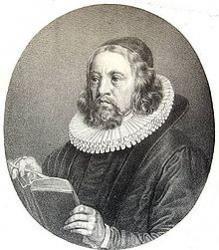
1634 - 1703 Person Name: Kingo Topics: Twenty second Sunday after Trinity Sunday; Twenty second Sunday after Trinity Sunday Author of "I Kristne, I, som træde" in Salmebog for Lutherske Kristne i Amerika

Claude Goudimel

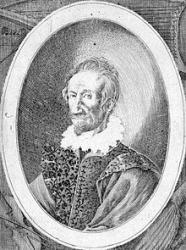
1514 - 1572 Person Name: Cl. Goudimel Topics: Twenty-second Sunday after Trinity Sunday High Mass Composer of "[I Kristne, I som træde]" in M. B. Landstads Kirkesalmebog og "Nokre Salmar" ved Professor Dr. E. Blix, samt følgende tillæg The music of Claude Goudimel (b. Besançon, France, c. 1505; d. Lyons, France, 1572) was first published in Paris, and by 1551 he was composing harmonizations for some Genevan psalm tunes-initially for use by both Roman Catholics and Protestants. He became a Calvinist in 1557 while living in the Huguenot community in Metz. When the complete Genevan Psalter with its unison melodies was published in 1562, Goudimel began to compose various polyphonic settings of all the Genevan tunes. He actually composed three complete harmonizations of the Genevan Psalter, usually with the tune in the tenor part: simple hymn-style settings (1564), slightly more complicated harmonizations (1565), and quite elaborate, motet-like settings (1565-1566). The various Goudimel settings became popular throughout Calvinist Europe, both for domestic singing and later for use as organ harmonizations in church. Goudimel was one of the victims of the St. Bartholomew's Day massacre of Huguenots, which oc­curred throughout France. Bert Polman

Hans Adolf Brorson

1694 - 1764 Person Name: Brorson Topics: Twenty second Sunday after Trinity Sunday Author of "Hvor ser det ud i Verdens Ørk" in Salmebog for Lutherske Kristne i Amerika

Johann Walter

1496 - 1570 Person Name: Johann Walther Topics: The Church Year Twenty-second Sunday after Trinity Composer of "[For help, O whither shall I flee?]" in The Lutheran Hymnary Johann Walther (b. Kahla, Thuringia, Germany, 1496: d. Torgau, Germany, 1570) was one of the great early influences in Lutheran church music. At first he seemed destined to be primarily a court musician. A singer in the choir of the Elector of Saxony in the Torgau court in 1521, he became the court's music director in 1525. After the court orchestra was disbanded in 1530 and reconstituted by the town, Walther became cantor at the local school in 1534 and directed the music in several churches. He served the Elector of Saxony at the Dresden court from 1548 to 1554 and then retired in Torgau. Walther met Martin Luther in 1525 and lived with him for three weeks to help in the preparation of Luther's German Mass. In 1524 Walther published the first edition of a collection of German hymns, Geystliche gesangk Buchleyn. This collection and several later hymnals compiled by Walther went through many later editions and made a permanent impact on Lutheran hymnody. Bert Polman ================ Walther, Johann, was born in 1496 at a village near Cola (perhaps Kahla, or else Colleda, near Sachsenburg) in Thuringia. In 1524 we find him at Torgau, as bassist at the court of Friedrich the Wise, Elector of Saxony. The Elector Johann of Saxony made him "Sengermeister" (choirmaster) in 1526. When the Electoral orchestra (Kapelle) at Torgau was disbanded in 1530, it was reconstituted by the town, and in 1534 Walther was also appointed cantor (singing-master) to the school at Torgau. On the accession of the Elector Moritz of Saxony, in 1548, Walther went with him to Dresden as his Kapellmeister. He was pensioned by decree of Aug. 7, 1554, and soon after returned to Torgau, still retaining the title of "Sengermeister." He died at Torgau, perhaps on March 25, or at least before April 24, 1570. (Monatshefte für Musikgeschichte, 1871, p. 8, and 1878, p. 85; Archiv für Litteraturgeschichte, vol. xii., 1884, p. 185; Dr. Otto Taubert's Pflege der Musilz in Torgau, 1868, and his Gymnasial Singe-Chor zu Torgau, n.d., 1870, &c.) Walther was more distinguished as a musician than as a hymnwriter. In 1524 he spent three weeks in Luther's house at Wittenberg, helping to adapt the old church music to the Lutheran services, and harmonising the tunes in five parts for the Geystliche gesangk Bucklyn, published at Wittenberg in 1524. He was also present in the Stadtkirche at Wittenberg, when, on Oct. 29, 1525, the service for the Holy Communion, as rearranged by Luther and himself, was first used in German. His hymns appeared mostly in his Das christlich Kinderlied D. Martini Lutheri, Erhalt uns Herr, &c. Auffs new in sechs Stimmen gesetzt, und rait etlichen schönen Christlichen Texten, Lateinischen und Teutschen Gesengen gemehrt, &c, Wittenberg. Those of Walther's hymns which have passed into English are:— i. Herzlich Lieb hab ich dich, mein Gott. Trinity Sunday. First published in 1566 as above, and thence in Wackernage, iii. p. 204, in 4 stanzas of 8 lines. Translated as:— 0 God, my Rock! my heart on Thee. This is a good translation of stanza i., iii., iv., by A. T. Russell, as No. 133 in his Psalms & Hymns, 1851. ii. Herzlich thut mich erfreuen. Eternal Life. First published separately, in 33 stanzas, at Wittenberg, in 1552, entitled "A beautiful spiritual and Christian new miner's song, of the Last Day and Eternal Life" [Konigsberg Library]. Thence in Wackernagel, iii. p. 187, in 34 stanzas, stanza 33 being added from the Dresden reprint of 1557. It is set to the melody of a popular song on the Joys of Summer. It is a fresh and beautiful hymn, but is only partially available on account of its length. Translated as:— 1. Now fain my joyous heart would sing. This is a translation of stanza 1, 4, 5, 17, 33, 34, by Miss Winkworth, in her Lyra Germanica 2nd Ser., 1858, p. 223. Her translations of stanzas 1, 4, 5, were included in the English Presbyterian Psalms & Hymns, 1867, No. 325. 2. Soon will the heavenly Bridegroom come. This is by Dr. Kennedy, in his Hymn. Christanza, 1863, No. 1009, and follows the text of the Geistliche Lieder omitting stanza 16, 18, 13. It is repeated in the Laudes Domini, N. Y., 1884, &c. 3. The Bridegroom soon will call us. By Dr. M. Loy, from the Geistliche Lieder, but omitting stanzas 18, 13, as No. 24 in the Ohio Lutheran Hymnal, 1880. [Rev. James Mearns, M.A. ] --Excerpts from John Julian, Dictionary of Hymnology (1907)

August Crull

1845 - 1923 Person Name: Rev. August Crull Topics: Twenty Second Sunday after Trinity Translator of "O God, Thou righteous, faithful Lord" in Evangelical Lutheran hymnal August Crull was born January 27, 1845 in Rostock, Germany, where his father, Hofrat Crull, was a lawyer. He was educated at the Gymnasium in Rostock, and at Concordia College in St. Louis and Fort Wayne where he graduated in 1862. His father died soon after he began studying at the Gymnasium. His mother then married Albert Friedrich Hoppe, who later became the editor of the St. Louis edition of Luther's Works. In 1865, Crull graduated from Concordia Seminary in St. Louis. He became assistant pastor at Trinity Church in Milwaukee and also served as Director of the Lutheran High School. Later he was pastor of the Lutheran Church in Grand Rapids, Michigan. From 1873 to 1915, he was professor of the German language and literature at Concordia College in Fort Wayne, Indiana. After his retirement he returned to Milwaukee, where he died on February 17, 1923. His first wife and three of his four children preceded him in death. His second wife, Katharina John, survived him by many years. Crull was a distinguished hymnologist and translated many hymns that appeared in several Lutheran hymnals. He published a German grammar and edited a book of devotions, Das walte Gott, based on the writings of Dr. C.F.W. Walther. His project of translating Lutheran hymns so they would be accessible to American Lutherans bore its first fruits when he published a book of English hymns at the Norwegian Synod publishers in Decorah, in 1877. --www.hymnsandcarolsofchristmas.com/

George Kingsley

1811 - 1884 Topics: Twenty Second Sunday after Trinity Arranger of "WARNER" in Evangelical Lutheran hymnal Born: July 7, 1811, Northampton, Massachusetts. Died: March 14, 1884, Northampton, Massachusetts. Kingsley played the organ at the Old South Church and Hollis Street Church in Boston, Massachusetts. He also taught music at Girard College in Philadelphia, Pennsylvania, served as music supervisor for public schools in Philadelphia, and compiled a number of music books, including: Sunday School Singing Book, 1832 The Harmonist, 1833 The Social Choir, 1836 The Sacred Choir, 1838 The Harp of David, 1844 The Young Ladies’ Harp, 1847 Templi Carmina (Northampton, Massachusetts: 1853) The Juvenile Choir, 1865 --www.hymntime.com/tch

Ludvig Mathias Lindeman

1812 - 1887 Person Name: Ludv. M. Lindeman Topics: Twenty-second Sunday after Trinity Sunday For Evening Composer of "[Ak Fader lad dit Ord, din Aand]" in M. B. Landstads Kirkesalmebog og "Nokre Salmar" ved Professor Dr. E. Blix, samt følgende tillæg Ludvig M. Lindeman (b. 1812; d. 1887) was a Norwegian composer and organist. Born in Trondheim, he studied theology in Oslo where he remained the rest of his life. In 1839 he succeeded his brother as the organist and cantor of Oslo Cathedral, a position he held for 48 years up until his death. Lindeman was appointed Knight of the Royal Norwegian Order of St. Olav, and was invited to both help christen the new organ in Royal Albert Hall in London, as well as compose for the coronation of King Oscar II and Queen Sophie of Sweden. In 1883, he and his son started the Organist School in Oslo. Lindeman is perhaps best known for his arrangements of Norwegiam folk tales; over the course of his life he collected over 3000 folk melodies and tunes. Laura de Jong

Johan Olof Wallin

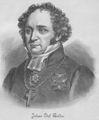
1779 - 1839 Person Name: Wallin Topics: Twenty second Sunday after Trinity Sunday Author of "O se, hvor lifligt det dog er" in Salmebog for Lutherske Kristne i Amerika Johan Olaf Wallin was born at Stora Tuna, in 1779, and early displayed his poetical powers. In 1805, and again in 1809, he gained the chief prize for poetry at Upsala. In the latter year he became pastor at Solna; here his ability as a preacher was so striking that he was transferred to Stockholm, in 1815, as "pastor primarius," a title for which we have no exact equivalent. In 1818 he was made Dean of Westeras, and set about the task of editing a revised hymn-book for the whole of Sweden. This task he completed in 1819, and published it as, Den Swenska Psalmboken, af Konungen gillad och stadfästad (The Swedish hymn-book, approved and confirmed by the King). To it he contributed some 150 hymns of his own, besides translations and recastings; and the book remains now in the form in which he brought it out. It is highly prized by the Swedes, and is in use everywhere. --John Julian, Dictionary of Hymnology, p. 1000 (1907)

Franz Xaver Schnyder von Wartensee

1786 - 1868 Person Name: Xavier Schnyder von Wartensee, 1786-1868 Topics: Twenty Second Sunday after Trinity Composer of "HORTON" in Evangelical Lutheran hymnal

Pages


Export as CSV
It looks like you are using an ad-blocker. Ad revenue helps keep us running. Please consider white-listing Hymnary.org or getting Hymnary Pro to eliminate ads entirely and help support Hymnary.org.