You help make Hymnary.org possible. More than 10 million people from 200+ countries found hymns, liturgical resources and encouragement on Hymnary.org in 2025, including you. Every visit affirms the global impact of this ministry.

If Hymnary has been meaningful to you this year, would you take a moment today to help sustain it? A gift of any size—paired with a note of encouragement if you wish—directly supports the server costs, research work and curation that keep this resource freely available to the world.

Give securely online today, or mail a check to:
Hymnary.org
Calvin University
3201 Burton Street SE
Grand Rapids, MI 49546

Thank you for your partnership, and may the hope of Advent fill your heart.

Person Results

Topics:fifteenth+sunday+after+trinity
In:people

Planning worship? Check out our sister site, ZeteoSearch.org, for 20+ additional resources related to your search.
Showing 41 - 50 of 64Results Per Page: 102050

Frans Michael Franzén

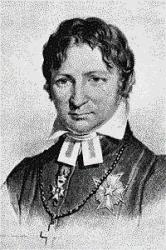
1772 - 1847 Person Name: Franz Mikael Franzen Topics: Way of Salvation Sanctification; Second Sunday after Easter; Trinty, Fourth Sunday; Trinity, Fifteenth Sunday; Names and Office of Christ Shepherd; Faith and Trust Author of "The Little While I Linger Here" in The Hymnal and Order of Service Franzén, Franz Michael, was born at Uleabôrg, Finland, in 1772, and educated at the University of Abo, where he became Librarian and Professor of Literary History. He was subsequently Minister at Kumla, Orebro, Sweden, and then of Santa Clara, in Stockholm. He was consecrated Bishop of Hernosand, in 1841, and died there in 1847. (See Supplement to Longfellow's Poets and Poetry of Europe.) Of his pieces one is in English common use. It begins "Jesum haf i ständigt minne," translated by Mrs. Charles in her Christian Life in Song, 1858, p. 250, as "Jesus in Thy memory keep" (Looking unto Jesus). Usually it begins with stanza ii., "Look to Jesus, till, reviving." --John Julian, Dictionary of Hymnology, Appendix, Part II (1907)

Ludvig Mathias Lindeman

1812 - 1887 Person Name: Ludv. M. Lindeman Topics: Fifteenth Sunday after Trinity Sunday High Mass Composer of "[Sørg, o kjære Fader du]" in M. B. Landstads Kirkesalmebog og "Nokre Salmar" ved Professor Dr. E. Blix, samt følgende tillæg Ludvig M. Lindeman (b. 1812; d. 1887) was a Norwegian composer and organist. Born in Trondheim, he studied theology in Oslo where he remained the rest of his life. In 1839 he succeeded his brother as the organist and cantor of Oslo Cathedral, a position he held for 48 years up until his death. Lindeman was appointed Knight of the Royal Norwegian Order of St. Olav, and was invited to both help christen the new organ in Royal Albert Hall in London, as well as compose for the coronation of King Oscar II and Queen Sophie of Sweden. In 1883, he and his son started the Organist School in Oslo. Lindeman is perhaps best known for his arrangements of Norwegiam folk tales; over the course of his life he collected over 3000 folk melodies and tunes. Laura de Jong

B. K. Kaas

Person Name: Birg. Kaas Topics: Fifteenth Sunday after Trinity Sunday Evening Author of "O Gud, du fromme Gud" in M. B. Landstads Kirkesalmebog og "Nokre Salmar" ved Professor Dr. E. Blix, samt følgende tillæg

Christian Friedrich Richter

1676 - 1711 Person Name: Kr. Fr. Richter Topics: Fifteenth Sunday after Trinity Sunday High Mass Composer of "[Hvad er det godt i Jesu Arme]" in M. B. Landstads Kirkesalmebog og "Nokre Salmar" ved Professor Dr. E. Blix, samt følgende tillæg Richter, Christian Friedrich, son of Sigismund Richter, Rath and Chancellor to Count von Promnitz at Sorau, in Brandenburg, was born at Sorau, Oct. 5, 1676. At the University of Halle he was first a student of medicine and then of theology. In 1698, A. H. Francke appointed him Inspector of the Paedagogium, and then made him, in 1699, physician in general to all his Institutions. In company with his younger brother, Dr. Christian Sigismund Richter, he made many chemical experiments, for which he prepared himself by special prayer; and invented many compounds which came into extensive use under the name of the “Halle Medicines," the most famous being the Essentia dulcis, which was a preparation of gold. He died at Halle, Oct. 5, 1711 (Koch, iv. 354, &c). Richter was one of the most important hymnwriters among the Pietists of the earlier Halle school; and his hymns possess the defects as well as the excellences of his school. They are emotional, and develop the idea of the spiritual union with Christ as the Bridegroom of the soul, with a minuteness that is hardly reverent (e.g. No. xi. below). They are also frequently not clearly thought out, and consequently somewhat obscure. Various of them are in unusual metres, and were wedded to tunes not very devotional in character. Apart from these defects there are various of his hymns worthy of note for their genuine, fervent piety, their childlike spirit of love to God, and the depth of Christian experience embodied in them. They appeared principally in the various Pietistic hymn-books of the period, especially in Freylinghausen's Gesang-Buch, 1704 and 1714, and were collected and appended (as his Geistliche Lieder) to an essay edited by his brother (named above) and published at Halle, in 1718, as Erbauliche Betrachtungen vom Ur sprung und Adel der Seelen. Richter's hymns …which have passed into English are:— i. Gott den ich als Liebe kenne. For the Sick. Included in Freylinghausen's Neues geistreiches Gesang-Buch, 1714, No. 647, in 7 stanzas of 8 lines, repeated, 1718, as above, p. 420, entitled, "Hymn in Sickness." According to Ehmann, in his edition of Gottfried Arnold, 1856, p. xii., it had previously appeared in Arnold's Heilsamer Rath und Unterricht für Kranke und Sterbende, 2nd edition, 1709. It is in the Unverfälschter Liedersegen, 1851, No. 603. Translated as :— God! whom I as love have known. A full and very good translation by Miss Winkworth, in her Lyra Germanica, 1st Ser., 1855, p. 236. Repeated, abridged, in L. Rehfuess's Church at Sea, 1868, p. 53. A cento, in 5 stanzas of 4 lines, taken from st. v., vi., iii., and beginning, "Let my soul beneath her load,” is No. 398, in the Unitarian Hymns of the Spirit, Boston, U. S. A., 1864. Another translation is: O God, Whose attributes shine forth in turn." By Miss Cox, 1864, p. 191. ii. Heine Armuth macht mich schreien. Supplication, or Longing for Christ. In Freylinghausen's Gesang-Buch, 1704, No. 662, in 7 st. of 6 1. Repeated, 1718, as above, p. 381, and in the Unverfälschter Liedersegen, 1851, No. 769. Translated as:— Unto Him my spirit crieth . A good translation of st. i., ii., vi., by A. T. Russell, in his Psalms & Hymns, 1851. iii. Stilles Lamm und Friedefürst. Sanctification. A hymn on the Following of Christ the Lamb of God, and founded on Rev. xiv. 4. In Freylinghausen's Neues geistreiches Gesang-Buch 1714, No. 432, in 8 st. of 5 1. Repeated in 1718, as above, p. 364, entitled. "On the name Agneta, which may be derived from Agnus, which in German is called a Lamb." In Burg's Gesang-Buch, Breslau, 1746, No. 922. Tr. as:— Thou Lamb of God, Thou Prince of Peace . A free tr., omitting st. iii., vii., by J. Wesley, in his Psalms & Hymns, Charlestown, 1736-7, p. 51, and Hymns & Sacred Poems, 1739 (P. Works, 1868-72, i.,p. 129). Included in the Wesleyan Hymn Book, 1780, No. 329 (1875, No. 338), and recently in the Methodist New Congregational Hymn Book, 1863, Mercer's Church Psalter & Hymn Book, 1857 and 1864, Holy Song, 1869, the American Methodist Episcopal Hymn Book 1849, and others. Another tr. is: "Holy Lamb and Prince of Peace." By J. Gambold, as No. 38 in the Moravian Hymn Book, 1742 (1886, No. 486). Eight others of his hymns have been tr. into English, viz:-- iv. Die sanfte Bewegung, die liebliche Kraft. Whitsuntide. In Freylinghausen's Gesang-Buch, 1704, No. 454, in 9 st.; and in 1718 as above, p. 393, entitled, "Of the Joy in the Holy Ghost." Tr. as: "This Impulse so gentle, this Movement so sweet," as No. 551, in pt. i., of the Moravian Hymn Book, 1754. v. Es glänzet der Christen inwendigem Leben. The Life of Faith. In Freylinghausen's Gesang-Buch, 1704, No. 515, in 8 stanzas; and in 1718, as above, p. 398, entitled, "On the hidden life of believers." Repeated in the Unverfälschter Liedersegen, 1851, No. 410. It is Richter's finest hymn, and was (says Koch, viii. 249) a great favourite with Dr. F. Schleiermacher. It is founded on Col. iii. 3, 4, and gives a picture of what the inner life of a Christian should be: described from Richter's own experience. The trs. are: (1) "The Christian's Life inward displays its bright splendour." As No. 620, in pt. i. of the Moravian Hymn Book, 1754. (2) "All fair within those children of the light." By Mrs. Bevan, 1858, p. 26. vi. Hüter! wird die Nacht der Sunden. Morning. A fine hymn, for use especially in Advent, and founded on Isaiah xxi. 11. In Freylinghausen's Gesang-Buch, 1704, No. 599, in 9 st.: 1718, as above, p. 401, and in the Unverfälschter Liedersegen, 1851, No. 460. Tr. as: (1) "Watchman! is the Night retiring." By H. J. Buckoll, 1842, p. 45. (2) "O Watchman, will the night of sin." By Miss Winkworth, 1855, p. 1. Repeated in Miss Warner's Hymns of the Church Militant , 1858, the Gilman-Schaff Library of Religious Poetry , 1881, &c. vii. Jesu, gib mir deine Fülle. Supplication. A prayer to Christ as the Great Physician. In Freylinghausen's Gesang-Buch, 1704, No. 66, in 7 st., st. vii. being entitled "Answer." In 1718, as above, p. 406, entitled, "On Patience." In Burg's Gesang-Buch, Breslau, 1746, No. 289. Tr. as:— "Jesu grant Thou me Thy Fulness." In the Supplement to German Psalmody, ed. 1765, p. 47. viii. Jesus ist das schönste Licht. Love to Christ. On St. John xii. 36. In Freylinghausen's Gesang-Buch, 1704, No. 349, in 9 st.: and in 1718, as above, p. 379, entitled, "On Desire towards God and Christ." In the Berlin Geistlich Lieder, ed. 1863, No. 808. Tr. as:— "Jesus is my light most fair," as No. 630, in pt. i. of the Moravian Hymn Book, 1754 (1886, No. 450). ix. Mein Salomo dein freundliches Regieren. Peace in Believing. A fine hymn, founded on St. John i. 14. In Freylinghausen's Neues geistreiches Gesang-Buch, 1714, No. 512, in 11 st. In 1718, as above, p. 416; and in the Unverfälschter Liedersegen, 1851, No. 424. Tr. as:— (1) "My Solomon! thy kind and gracious Sceptre," as No. 622, in pt. i., of the Moravian Hymn Book, 1754. In 1789, altered to "Jesus, my King, Thy kind and gracious sceptre" (1886, No. 384). (2) "Jesus, my King! Thy mild and kind control." By Dr. Bomberger, in Schaff s Kirchenfreund , 1849, p.337. x. O Liebe die den Himmel hat zerissen. Christmas. In Freylinghausen's Neues geistreiches Gesang-Buch, 1714, No. 34, in 9 st.: and in 1718, as above, p. 414, entitled, "On the Incarnation of the Son of God." In the Unverfälschter Liedersegen, 1851, No. 52. Translated as:-- "Oh! love that did the heavens rend asunder." By Miss Manington, 1864, p. 35. xi. O wie selig sind die Seelen. Love to Christ. Founded on Hosea ii. 19, 20, and Eph. v. 25. In Freylinghausen's Gesang-Buch., 1704, No. 512, in 10 st.: and in 1718, as above, p. 396, entitled, "On the high dignity of believers." In Porst's Gesang-Buch, ed. 1855, No. 412. It was (says Koch, viii. 297) originated by a dream Richter had about 1700, that in the hospital at Halle he would find a truly Christ-like soul. After searching all the wards he found an old neglected patient in a garret, with whom he conversed, and whom he found to be the person he was seeking. Inspired by her relations of her inner experience, he embodied her thoughts in this fine hymn. Tr. as:— "O what joy for them is stored." By Mrs. Bevan, 1858, p. 68. [Rev. James Mearns, M.A.] --John Julian, Dictionary of Hymnology (1907)

Thomas Costellow

? - 1800 Person Name: Costellow Topics: Fifteenth Sunday after Trinity Composer of "SURREY" in Evangelical Lutheran hymnal

August Hermann Francke

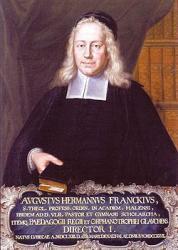
1663 - 1727 Person Name: Aug. Francke Topics: Fifteenth Sunday after Trinity Sunday Author of "Et Trin jeg atter har idag" in Salmebog for Lutherske Kristne i Amerika Francke, August Hermann, son of Johann Francke, a lawyer in Lubeck, was born at Lubeck, March 22, 1663. He studied at the Universities of Erfurt, Kiel, and Leipzig, graduated M.A. at Leipzig, 1685, and thereafter lectured on Biblical subjects at Leipzig for some time. About Michaelmas, 1687, he went to Lüneburg to work under the pious superintendent C. H. Sandhagen; and there while composing his first sermon (on St. John xx. 31) he underwent that change which made him call Lüneburg his spiritual birthplace. After spending the greater part of 1688 at Hamburg, he stayed two months with P. J. Spener at Dresden, and then returned about Lent, 1689, to Leipzig, where he resumed his Biblical lectures until the old orthodox party procured an edict forbidding them in the beginning of 1690. On March 10, 1690, he received a call to become diaconus of the Augustine Church at Erfurt, and there, by his stirring exhortations to renewal of heart, living faith and holy life, he drew many, even Roman Catholics, around him, but by a combination of the old orthodox Lutherans with the Romanists he was expelled from Erfurt, Sept. 27, 1691. After a lengthened visit to P. J. Spener, then Probst of St Nicholas's Church, Berlin, he was appointed by the Elector of Brandenburg, Dec. 22, 1691, as professor of Greek and the Oriental languages, and in 1698 ordinary professor of Theology in the University of Halle; being also appointed in 1691 preacher at St. George's Church in Glaucha (suburb of Halle), a post which he exchanged in 1715 for the pastorate of St. Ulrich's, Halle. After his left side was paralysed in Nov. 1726, he patiently endured much suffering till his death on June 8, 1727, at Halle ( Koch , iv. 305-322; Allgemeine Deutsche Biographie, vii. 219-231). Francke was the spiritual son of P. J. Spener, and became one of the leaders in the " Pietistic" movement which so powerfully influenced Germany, 1680-1750, raised the tone of the community after the depression of the Thirty Years' War, revived the educational system, began systematic provision for the poor, and refined and purified domestic life. Francke was the spiritual leader and teacher, and under him and the band of professors that gathered to Halle, Halle became the headquarters of Pietism. During his time Halle sent out some 6000 graduates in theology, men imbued with his spirit, good exegetes, and devoted pastors, who spread their doctrines all over Germany, and in the early decades of the 18th cent, occupied a majority of the pulpits. The extensive buildings at Halle, which now bear the title of the "Francke Institutions," are a monument of his simple faith and philanthropic zeal. He began at Easter, 1695, by opening a room in his house for instructing the poor children of Glaucha, with a capital of about thirteen shillings. About Whitsuntide, 1695, were the beginnings of the Paedagogium, 1697 of the Latin School, 1698 of the bookselling and apothecary businesses, 1705 of the mission to the East Indies, 1710 of the Bible Society. On a place formerly occupied by beer and dancing gardens, the foundation stone of the great Orphanage was laid July 13, 1698, in a spirit of humble faith in God and fervent prayer, trusting to Him for the means to pay for the work as it progressed; and week by week as they were needed the supplies came in from far and near. In this work, as in regard to his sermons and lectures, Francke had great opposition to meet, but the Commission of Enquiry which his enemies procured resulted in a cabinet order of 1702, which is the Charter of his Institutions. In 1727 there were 134 orphans in the orphanage; and besides these 2207 scholars in the various training schools, of whom some 360, as well as 225 poor students, received daily rations; while in 1863 the value of the buildings was about £45,000., and nearly 3500 scholars received instruction. Distinguished as a professor, as a philanthropist, as a pastor, and as a preacher of gospel simplicity and soul-stirring earnestness, Francke was not prolific as a hymnwriter. Only three hymns are known by him, two of which are:— i. Gottlob em Schritt zur Ewigkeit. New Year, first published in his Schrifftmässige Anweisung recht und Gott wolgefällig zu beten, Halle, 1695, p. 534, in 12 st. of 7 l., as a "Morning and Evening" hymn, entitled "The Voice of the Bride (‘When shall I come and appear before God?’), which she raises as often as she completes a step of her mortal life; and may be used by an upright and believing soul instead of the [usual] morning and evening hymn, as also at other times." Reprinted in the Geistreiches Gesang-Buch, Halle, 1697, p. 294, Freylinghausen's Gesang-Buch, 1704, &c, and is No. 623 in the Unverfälschter Liedersegen 1851. According to Koch, viii. 176-179, it was written immediately after his expulsion from Erfurt, Sept 27, 1691, while on his way to his mother's house at Gotha, and "in the experience of the overflowing consolation of the Holy Spirit." In the spirit of his favourite motto, "Quocunque die ante aeternitatem uno stamus pede," and based on 2 Cor. v. 6 and Rev. xxii. 17-20, it is modelled on a hymn by J. V. Andreä, 1636. "Gottlob ein Schritt zur Ewigkeit Ist abermals vorbei." Koch adds that in his lifetime Francke found cases where this hymn had been blessed, that two days before his death he caused the hymn to be read to him, and said, "My faithful Jesus, I have given myself to Thee, soul and body that is sure;" and that on the day on which he died, June 8, 1727, this hymn was one of those sung at the choir meeting at Herrnhut. The translations in common use are :— 1. Thank God, that towards eternity, a full and good translation by Miss Winkworth, in her Lyra Germanica, 2nd series, 1858, p. 9. In 1860, 1 l. 1-4 of st. i., iv., vi., viii., greatly altered, and beginning, "Bless God, that towards eternity," were included as No. 74 in the American Episcopal Hymns for Church and Home. 2. Oh wouldst Thou in Thy glory come, a translation of st. iv., vii.-xi., founded by Miss Winkworth on her 1858 version, and given as No. 173 in her Chorale Book for England, 1863. Other translations are: (1) "Another step is made with God," in the Supplement to German Psalmody, ed. 1765, p. 50. Previously in Select Hymns from German Psalmody, Tranquebar, 1754, p. 79. (2) "Thank God! towards Eternity," by J. Gambold, as No. 626 in pt. i. of the Moravian Hymnbook, 1754 (1886, No. 1232). (3) "Thank God! another stage of time," by Dr. H. Mills, 1856, p. 227. ii. Was von aussen und von innen. Cross and Consolation. A fine hymn of trust in God, founded on Ps. lxii. 5-8. Written in memory of Eleonore, neé Kubitz, wife of J. H. Michaelis, professor at Halle, and appended to the funeral sermon preached by Francke on Ps. lxii. 2, in St. George's Church, Glaucha, Nov. 1, 1711. Included as No. 500 in Freylinghausen's Neues geistreiches Gesang-Buch, 1714, in 9 st. of 8 l., and recently as No. 2250 in Knapp's Evangelischer Lieder-Schatz, 1837 (1865, No. 1997). Lauxmann, in Koch, viii. 508-512, speaks of this lady as one who suffered severe afflictions, but "what from without or from within pressed on her soul she bore in quiet waiting on the help of the Lord, of Whom she could at last gratefully say 'He hath done all things well.'" Lauxmann adds, "This hymn is also a beautiful clear mirror of Francke's own thought and conversation, heart and life experiences." In his Segensvolle Fussstapfen, 1709, he was able already to relate thirty instances in which the Lord had enabled him to receive, exactly at the time when he needed it, pecuniary help in answer to his prayers during the building and conducting of the great Orphanage at Halle. Of this hymn (which should be read with the history of his great work at Halle) the only translation in common use is:— What within me and without, a good and full translation by Miss Winkworth in the first edition of her Lyra Germanica, 1855, p. 126 (st. iii. being added in the 2nd ed., 1856), and thence as No. 139 in her Chorale Book for England, 1863. With the altered first line, "Lord, Thou art my Rock of strength," three centos are in American common use:— 1. St. ii., iv., vii., ix. in Boardman's Selections, Philadelphia, 1861. 2. St. ii., vii., ix. in the Pennsylvania Lutheran Chorale Book, 1868, Dutch Reformed Hymns of the Church, 1869, and Bichards's Collection, 1881. 3. St. ii., iv., ix. in Robinson's Songs for the Sanctuary, 1865, and the Hymns & Songs of Praise, N. Y., 1874. [Rev. James Mearns, M.A.] --John Julian, Dictionary of Hymnology

Hans Adolf Brorson

1694 - 1764 Person Name: Brorson Topics: Fifteenth Sunday after Trinity Sunday High Mass Author of "Et er nødigt, dette Ene" in M. B. Landstads Kirkesalmebog og "Nokre Salmar" ved Professor Dr. E. Blix, samt følgende tillæg

Thomas Gibbons

1720 - 1785 Topics: Fifteenth Sunday after Trinity Author of "When Jesus dwelt in mortal clay" in Evangelical Lutheran hymnal Gibbons, Thomas, was born at Beak, near Newmarket, May 31, 1720; educated by Dr. Taylor, at Deptford; ordained in 1742, as assistant to the Rev. Mr. Bures, at Silver Street Chapel, London; and in 1743 became minister of the Independent Church, at Haberdashers' Hall, where he remained till his death, Feb. 22, 1785. In addition to his ministerial office he became, in 1754, tutor of the Dissenting Academy at Mile End, London; and, in 1759, Sunday evening lecturer at Monkwell Street. In 1760 the College at New Jersey, U.S., gave him the degree of M.A. and in 1764 that of Aberdeen the degree of D.D. His prose works were (1) Calvinism and Nonconformity defended, 1740; (2) Sermons on various subjects, 1762; (3) Rhetoric, 1767; (4) Female Worthies, 2 vols., 1777. Three volumes of sermons were published after his death. His poetical works were:— (1) Juvenilia; Poems on various subjects of Devotion and Virtue, 1750, was published by subscription. Among the subscribers is found the name of the Rev. Mr. George Whitefield, B.A. It was dedicated to the Countess of Huntingdon, and bears her coat of arms. In this volume are included versions of six of the Psalms, and a few hymns. (2) Hymns adapted to Divine wor¬ship in two books. Book I. Derived from select passages of Holy Scriptures. Book II., Written on sacred subjects and particular occasions, partly collected front various authors, but principally composed by Thomas Gibbons, D.D., 1769. (3) Hymns adapted to Divine worship in two books. Book I. Derived from select passages of the Holy Scriptures. Book II. Written on sacred subjects and particular occasions by Thomas Gibbons, D.D., 1784. (4) The Sermons, published in 1762, included fifteen hymns, one being appended to each sermon. (5) The Christian Minister in three poetical epistles to Philander, 1772. This volume included (i.) Poetical versions of several parts of Scripture, (ii.) Translations of poems from Greek and Latin writers, (iii.) Original pieces on various occasions. (6) An English version of the Latin Epitaphs on the Nonconformist's Memorial, with a poem to the memory of the 2000 ministers ejected in 1662, 1775. (7) Select Portions of Scripture, and Remarkable Occurrences, versified for the Instruction and entertainment of Youth of both Sexes, 1781. Reprinted in America, 1805. Dr. Gibbons may be called a disciple in hymnwriting of Dr. Watts, whose life he wrote. His hymns are not unlike those of the second rank of Watts. He lacked "the vision and faculty divine," which gives life to hymns and renders them of permanent value. Hence, although several are common use in America, they are dying out of use in Great Britain. The most popular are, "Now let our souls on wings sublime"; "Great God, the nations of the earth"; "Thy goodness, Lord, our souls confess"; "To Thee, my God, whose presence fills." [Rev. W. Garrett Horder] The less important of Dr. Gibbons's hymns, which are still in common use are:— 1. And be it so that till this hour. Hope. This is No. 50 in Book ii. of his Hymns adapted to Divine Worship, &c, 1769, in 5 stanzas of 4 lines, and headed, "Encouragement against Despair; or, Hope still set before us." Originally a Sacramental hymn in Rippon's Selections, 1787, No 230, it was altered to a general hymn, with special reference to "Hope." 2. Assist us, Lord, Thy Name to praise. Life, a race. In Rippon's Baptist Selections, 1787, No. 326, in 4 stanzas of 4 lines. 3. Eternal life, how sweet the sound. Eternal Life. This is one of three hymns on Titus iii. 7, in his Hymns adapted to Divine Worship, &c, 1784, Book i., No. 156, in 5 stanzas of 4 lines. In the American Dutch Reformed Hymns of the Church, 1869, No. 843 begins with st. ii., "Eternal life, how will it reign?" 4. Father, is not Thy promise pledged? Missions. This is Pt. iii.of his hymn, "Great God, the nations of the earth" (q. v.). 5. Forgiveness, 'tis a joyful sound. Pardon. From his Hymns adapted to Divine Worship, &c, 1769. Book i., No. 69, in 5 stanzas of 4 lines into several modern collections in Great Britain and America. It is based on St. Luke, vii. 47. 6. From winter's barren clods. [Spring.] Appeared in his Hymns, &c, 1784, Book ii., No. 27, in 5 stanzas of 4 lines, and headed, "The Return of the Spring celebrated in the Powerful and Gracious Work of God." In 1787 it was repeated anonymously in Rippon's Baptist Selections, No. 499. The hymn, "Great God, at Thy command, Seasons in order rise," begins with st. iii. of this hymn. 7. Happy the men in ancient days. Public Worship. In his Hymns adapted to Public Worship, &c, 1784. 8. On Zion, his most holy mount. Gospel Feast. From his Hymns adapted for Divine Worship, &c, 1769, Book i., No. 35, in 6 stanzas of 4 lines. It was originally a Sacramental hymn, but in its abbreviated form, as in use in America, that element is eliminated. 9. Our Father, high enthroned above. Lord's Prayer. Appeared in the Bristol Baptist Collection of Ash & Evans, 1769, No. 41, in 9 stanzas of 4 lines. In 1772 it was reprinted in a revised form, and with an additional stanza, in Gibbons's Christian Minister, p. 74. 10. Thy goodness, Lord, our souls confess. Providence and Grace. Appeared in the Gospel Magazine, 1775, and in his Hymns adapted to Divine Worship, &c, 1784, Bk. ii., No. 11, in 7 stanzas of 4 lines. In Dobell's Selections, 1806, st. i.-iv., and vi. were given with alterations, which were not improvements, as No. 9. This arrangement is repeated in modern hymnbooks, including the Baptist Hymnal, 1879, and others. 11. When Jesus dwelt in mortal clay. Jesus our Example. From his Hymns adapted to Divine Worship, &c, 1784, Book i., No. 128, in 9 stanzas of 4 lines into a few American collections, including the Baptist Praise Book, 1871. The more important of Dr. Gibbons's hymns are annotated under their respective first lines. [William T. Brooke] -- John Julian, Dictionary of Hymnology (1907) ====================== Gibbons, Thomas, p. 420, i. From his Hymns, &c, of 1784, are also in common use:— 1. Lord God, omnipotent to bless. Divine Help desired. 2. Now may the God of peace and love. Close of Service. (1769. Pt. i.) 3. O what stupendous mercy shines. Benevolence. --John Julian, Dictionary of Hymnology, Appendix, Part II (1907)

Jane Eliza Leeson

1807 - 1882 Person Name: Jane E. Leeson Topics: Fifteenth Sunday after Trinity Author of "Savior, teach me, day by day" in Evangelical Lutheran hymnal Leeson, Jane E.. The earliest work by Miss Leeson with which we are acquainted is her Infant Hymnings. Then followed Hymns and Scenes of Childhood, or A Sponsor's Gift (London, James Burns; Nottingham, Dearden), 1842, in which the Infant Hymnings were incorporated. Concerning Pt. ii. of the Hymns and Scenes, &c, Miss Leeson says, "For the best of the Poems in the second part, the Writer is indebted to a friend." In the Rev. Henry Formby's Catholic Hymns arranged in order for the principal Festivals, Feasts of Saints, and other occasions of Devotion throughout the Year, London, Burns and Lambert, N.D. [1851], "Imprimatur, N. Cardinalis Wiseman, May 3rd, 1853," her translation of Victimae Paschali (“Christ the Lord is risen to-day"), and her "Loving Shepherd of Thy Sheep" (also in Hymns & Scenes, 1842), were given under the signature "M. L." Her Paraphrases and Hymns for Congregational Singing (most of " which were re-written from the Scottish Translations and Paraphrases (q.v.), 1781) were published by Wertheimer & Co., London, in 1853. In the Irvingite Hymns for the Use of the Churches, 1864, there are five of her original hymns and four of her translations from the Latin under the signature of "J. E. L.; "and most of these were repeated in the 2nd edition, 1871. In addition Miss Leeson is the author of several other works, including The Christian Child's Book, 1848, The Child's Book of Ballads, 1849, Songs of Christian Chivalry, 1848, Margaret, a Poem, 1850, The Seven Spiritual Works of Mercy, and others. Her hymns in common use include:— 1. A little child may know. God's love of little Children. In Hymns & Scenes of Childhood, 1842, No. 20, in 5 stanzas of 4 lines. 2. Dear Saviour, to Thy little lambs. For Purity. In Hymns & Scenes of Childhood, 1842, No. 19, in 4 stanzas of 8 lines. 3. Father, I [we] love Thy house of prayer. Public Worship. In Hymns & Scenes of Childhood, 1842, No. 76, in 3 stanzas of 12 lines. It is usually abbreviated. 4. Have ye counted the cost? Soldiers of the Cross . In Songs of Christian Chivalry, 1848, p. 8, in 10 stanzas of 9 lines. Usually abbreviated as in the Enlarged London Hymn Book, 1873. 5. In the dark and silent night. Confidence. In The Christian Child's Book, 1848, in 3 stanzas of 3 lines, with the refrain, "Hallelujah." It is in the Irish Church Hymnal , 1873, and other collections. 6. Jesus Christ, my Lord and King. Child's Praise of Christ. In Hymns & Scenes of Childhood, 1842, No. 18, in 6 stanzas of 4 lines. 7. King of Saints and King of glory. All Saints . In her Paraphrases & Hymns, 1853, p. 84, in 2 stanzas of 8 lines. 8. Saviour, teach me day by day. Obedience. In Hymns & Scenes of Childhood, 1842, No. 49, in 4 stanzas of 8 lines. In several hymn-books in Great Britain and America. 9. Songs of glory fill the sky. Christmas. In the Irvingite Hymns for the Use of the Churches, 1864, No. 21, in 3 stanzas of 8 lines, with the refrain "Hail! Lord Jesu." 10. Stand we prepared to see and hear. Advent. In the Irvingite Hymns for the Use of the Churches, 1864, No. 173, in 4 stanzas of 8 lines. Written in 1800. 11. Sweet the lesson Jesus taught. Christ blessing little Children. In Hymns & Scenes of Childhood, 1842, No. 1, in 5 stanzas of 4 lines. 12. Wake the song, 0 Zion's daughter. A cento of much excellence, which see. 13. Wake, ye saints, the song of triumph. Ascension . Written in 1861, and published in the Irvingite Hymns for the Use of the Churches, 1864, No. 60, in 4 stanzas of 6 lines, with the refrain "Hallelujah." In stanza ii., lines 3, 4, and 6 are from C. Wesley's "Hail the day that sees Him rise." Miss Leeson's most popular hymn, “Loving Shepherd of Thy Sheep," and her translations from the Latin are noted elsewhere in this work. Of Miss Leeson's personal history we can gather nothing. Born 1807; died 1882. --John Julian, Dictionary of Hymnology (1907)

Ludwig Andreas Gotter

1661 - 1735 Person Name: Ludvig Gotter Topics: Fifteenth Sunday after Trinity Sunday Author of "O Naadens Sol og Glæde" in Salmebog for Lutherske Kristne i Amerika Gotter, Ludwig Andreas, son of Johann Christian Gotter, Court preacher and Superintendent at Gotha, was born at Gotha, May 26, 1661. He was at first privy secretary and then Hofrath at Gotha, where he died Sept. 19, 1735. He was a pious, spiritually-minded man, with tendencies towards Pietism; and one of the best hymnwriters of the period. Of his printed hymns the earliest appeared in the Geistliches Gesang-Buch, Halle, 1697. Of the 23 included in Freylinghausen's Geistleiches Gesang-Buch, 1704, and Neues, 1714, seven have been translated into English, besides his version of J. W. Petersen's "Salve, crux beata, salve (q. v.). J. C. Wetzel, who had become acquainted with him during a visit Gotter made to Römhild in 1733, mentions a complete version of the Psalter (now in manuscript in the Ducal Library at Wernigerode) by him, and quotes from his manuscript the first lines of 42 hymns still unprinted (Wetzel's Analecta Hymnica, ii. 22-30; Koch, iv. 400-402; Allegemeine Deutsche Biographie, ix. 456). Of his hymns those translated into English are:— i. In English common use:— i. Erquicke mich, du Heil der Sunder. [The Great Physician.] On the Gospel for the third Sunday in Advent (St. Matt, xi.), turning it into a prayer for cures of our moral nature similar to the miracles of physical healing there recorded. In Freylinghausen, 1714, No. 771, in 10 st. of 6 1., and in Knapp's Evangelisches Lieder-Schatz, 1837, No. 196. The only translation in common use is:— Saviour of sinners, now revive us, of st. i., ii., v., x., by Miss Borthwick, as No. 236, in Dr. Pagenstecher's Collection, 1864. ii. Treuer Vater, deine Liebe. [True and False Christianity.] 1697, as above, p. 608, in 23 st. of 6 1., repeated in Freylinghausen, 1704; and in Porst's Gesang-Buch, 1713 (1855, No. 324). The only translation in common use is:— Father, Thine eternal kindness, omitting st. x, in J. C. Jacobi's Psalmodia Germanica, 1720, p. 3. Considerably altered in his edition, 1722, p. 50, and 1732, p. 78; and from this 8 st. were included as No. 542 in pt. i. of the Moravian Hymn Book, 1754. The translations of st. xii., xiii., altered from the 1732, and beginning, "Has temptation well nigh won me," were included in the Scottish Evangelical Union Hymn Book, 1856, and in Dr. J. Paterson's Collection, Glasgow, 1867. iii. Womit soil ioh dich wohl loben. [Praise and Thanksgiving.] A beautiful hymn of Thanksgiving (founded on Ps. xci.) for the wonderful ways by which God in His love and goodness has led us, and of trust in the continuance of His love to the end. 1697, as above, p. 577, in 14 st. of 6 l., and the refrain (altered from Hornburg's "Jesus, meines Lebens Leben.") "Tausend, tausend Mai sei dir, Grosser König, Dank dafür." Repeated in Freylinghausen, 1704, and as No. 1033, in the Berlin Geistliche Lieder S., ed. 1863. Lauxmann, in Koch, viii. 348-9, relates that st. iv. was adopted as a thanksgiving by the German Missionaries in Abyssinia on their deliverance by the capture of Magdala in 1868, and st. xi., by C. H. Bogatzky, after a narrow escape on one of his journeys in Bohemia; and adds that as the hymn, with its Swabian melody, was a great favourite of the poet Uhland, it was accordingly played by the trumpeters from the tower of St. George's Church, on July 14,1873, at the ceremony of the unveiling of the statue erected to his memory in Tübingen. The only translation in common use is :— Lord of Hosts! how shall I render. A good and full translation in Dr. J. Guthrie's Sacred Lyrics, 1869, p. 131; and from this st. i., ii., ix., xiii., xiv., were included as No. 50 in the Ibrox Hymnal, 1871. Another translation is, "With what fervour of devotion," by J. C. Jacobi, 1732, p. 157. ii. Hymns not in English common use:— iv. Herr Jesu, Gnadensonne. [Sanctification.] Perhaps his finest hymn. 1697, as above, p. 525, in 8 st. The translations are: (1) "Lord Jesus! Sun of graces," In the Supplement to German Psalter, edition 1765, p. 43. (2) “O shed abroad, Lord Jesus," a translation of st. vi., as No. 1086, in the Supplement of 1808 to the Moravian Hymn Book, 1801. v. 0 Jesu meine Zurersicht. [Lent.] 1714, as above, No. 772, in 14 st. Translated by N. L. Frothingham, 1870, p. 213, beginning with st. vii. vi. Sei hochgelobt, barmherz'ger Gott. [Praise for Redemption.] On Eph. i. 3. first in the Geistleiches Gesang-Buch, Darmstadt, 1698, p. 485, in 16 st. Translated as, "High praise to Thee, all-gracious God," by J. Wesley, in Hymns and Sacred Poems, 1740 (P. Works, 1868-72, v. i. p. 339). vii. Wachet auf, ihr faulen Christen. [Spiritual Watchfulness.] On St. Matt. xxvi. 41. 1697, as above, p. 425, in 7 st., each beginning and ending with the word, "Wachet." Translated as, "Arise! ye lingering saints, arise!" by Mrs. Findlater, in Hymns from the Land of Luther 1854. [Rev. James Mearns, M.A.] -- John Julian, Dictionary of Hymnology (1907)

Pages


Export as CSV
It looks like you are using an ad-blocker. Ad revenue helps keep us running. Please consider white-listing Hymnary.org or getting Hymnary Pro to eliminate ads entirely and help support Hymnary.org.