You help make Hymnary.org possible. More than 10 million people from 200+ countries found hymns, liturgical resources and encouragement on Hymnary.org in 2025, including you. Every visit affirms the global impact of this ministry.

If Hymnary has been meaningful to you this year, would you take a moment today to help sustain it? A gift of any size—paired with a note of encouragement if you wish—directly supports the server costs, research work and curation that keep this resource freely available to the world.

Give securely online today, or mail a check to:
Hymnary.org
Calvin University
3201 Burton Street SE
Grand Rapids, MI 49546

Thank you for your partnership, and may the hope of Advent fill your heart.

Person Results

Text Identifier:"^to_guds_venner_vandre_silde$"
In:people

Planning worship? Check out our sister site, ZeteoSearch.org, for 20+ additional resources related to your search.
Showing 1 - 2 of 2Results Per Page: 102050

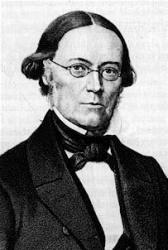
M. B. Landstad

1802 - 1880 Person Name: Landstad Translator of "To Guds Venner vandre silde" in Salmebog for Lutherske Kristne i Amerika Magnus Brostrup Landstad (born 7 October 1802 in Måsøy, Norway and died 8 October 1880 in Kristiania) was a Norwegian minister, psalmist and poet who published the first collection of authentic Norwegian traditional ballads in 1853. This work was criticized for unscientific methods, but today it is commonly accepted that he contributed significantly to the preservation of the traditional ballads. Landstad lived with his father Hans Landstad (1771–1838) who was also a minister, first in 1806 to Øksnes, to Vinje in 1811 and to Seljord in 1819. He took a theological degree (cand. theol) in 1827, and worked after that as the resident chaplain in Gausdal for six years. After that he worked in different parishes in Telemark, Østfold before he became minister of Sandar in Vestfold in 1859. He married Wilhelmine Margrete Marie Lassen, in 1828. He is well known for introducing popular, contemporary Norwegian language into the hymns he wrote, contributing significantly to the spirit of Norwegian romantic nationalism which grew in Norway in this period. His greatest single achievement was the Landstad Hymnbook (Kirkepsalmebog), which with later revisions was used in Norwegian (bokmål) parishes from 1869 until 1985. The current official church hymnbook contains a lot of his hymns and his translations of foreign hymns. He was the cousin of Hans Peter Schnitler Krag. The Landstad-institute, which lies in Seljord, is named after him. He was a great grandfather of Magny Landstad, also a famous writer. Publications-- 1852: Norske Folkeviser. 3 vols. Christiania: C. Tönsberg, [1852-]1853. 1869: Kirkesalmebok: efter offentlig Foranstaltning. Kristiania: J. W. Cappelens Forlag, 1871 --http://en.wikipedia.org/wiki/ See also in: Wikipedia

Johann Neunherz

1653 - 1737 Person Name: Joh. Neunherz Author of "To Guds Venner vandre silde" in Salmebog for Lutherske Kristne i Amerika Neunhertz, Johannes, son of Johannes Neunhertz, weaver at Waltersdorf, near Kupferberg, in Silesia, was born at Waltersdorf Aug. 16, 1653, and entered the University of Leipzig in June, 1673 (M.A. 1676). In 1678 he was appointed assistant preacher at Lauban, in Silesia; in 1680 pastor at Kiesslingswalde; and in 1696 pastor at Geibsdorf, both near Lauban. He then became, in 1706, diaconus of the Holy Trinity Church, and also morning preacher at the Holy Cross Church in Lauban. Finally, in 1709, he was appointed chief pastor at Hirschberg, in Silesia, and died there Nov. 26, 1737 (S. J. Ehrhardt's Presbyterologie Schlesiens, 1780-89, iii. pt. ii. p. 187; Koch, v. 450; Allgemeine Deutsche Biographie xxiii. 549; Bode, p. 121—-the first dating his birth 1652). Neunhertz was the author of a large number of hymns, good and flowing in style, but often lengthy and with little power or concentration. They appeared in his various works:— (1) Eyangelische Sabbaths-Freude, Zittau, 1690. (2) Christliche Leid-Andachten, Lauban, 1698. (3) Evangelische Ilertz-Ermunterung, Leipzig, 1701. (4) Tröstliche . . . Andachten, Lauban, 1709; 2nd edition as Andachts-Flammen, Budissin, 1717; and in the Silesian hymn-books of the period. A large number are given in the Hirschberg Gesang-Buch, 1741, a few in Burg's Gesang-Buch, Breslau, 1746, and some still survive in modern collections. The only hymn by him which seems to have passed into English is:— Zweene Jünger gehn mit Sehnen. Eastertide. A hymn on the Two Disciples on their way to Emmaus (St. Luke xxiv. 13-35). Included in the Lauban Gesang-Buch, 1707, p. 162 [Wernigerode Library], as No. 5 of the Easter Hymns, in 9 st. of 8 1., and marked as by M J. Neunhertz. Also in the Berlin Geistliche Lieder, ed. 1863, No. 326. The form translation into English is: "Trauernd und mit bangem Sehnen." This appeared in the Liegnitz Gesang-Buch,1804 (ed. 1819, No. 155), and is repeated in the Württemberg Gesang-Buch, 1842, No. 176, in 7 stanzas. It is a recast by L. E. S. Müller. The translation in common use is:— Sad with longing, sick with fears. A full and good translation from the 1842 text by Miss Winkworth, in her Lyra Germanica, 2nd Ser. 1858, p. 43. In the Pennsylvania Lutheran Church Book, 1868, the translations of st. iv.-vii. altered and beginning, "Truest Friend, Who canst not fail," were given as No. 440. [Rev. James Mearns, M.A.] --John Julian, Dictionary of Hymnology (1907)

Export as CSV
It looks like you are using an ad-blocker. Ad revenue helps keep us running. Please consider white-listing Hymnary.org or getting Hymnary Pro to eliminate ads entirely and help support Hymnary.org.