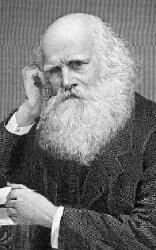
1794 - 1878 Author of "All that in this wide world we see" Bryant, William Cullen. First in order of time of the great American poets, Bryant was born at Cummington, Mass., Nov. 3, 1794, and was educated at Williams College. In 1815 he'was called to the Bar, and practised for a time at Great Barrington. In 1825 he retired from the Bar, settled at New York, and devoted himself to literary pursuits, founding the New York Review, and editing for a short time the New York Evening Post. He died June 12, 1878. His poetical and other works are well known. His hymns were written at intervals during his long life. They were collected and privately printed in 1869, and number over 20. Those in common use are:—
1. Almighty, listen while we raise. Praise. This is given as "Almighty hear us,” &c, in the Unitarian Hymn and Tune Book, Boston, 1868. It was introduced into Great Britain through Beard's Collection, 1857.
2. Deem not that they are blest alone. Mourning. In this form it is in Beard's Collection, 1837. It is best known as "0 deem not they are," &c, and in this form it is No. 964 in Songs for the Sanctuary, N. Y., 1865-72, No. 452, in Dr. Martineau's Hymns of Prayer and Praise, Lond., 1873, &c.
3. Father, to Thy kind love we owe. God's Lovingkindness. This is given in several modern collections, including the Unitarian Hymn and Tune Book, Boston, 1868, Martineau, 1873, &c.
4. 0 God, whose dread and dazzling brow. Compassion desired. Is No. 57 in the Boston Hymn and Tune Book, 1868, as above.
5. When he who from the scourge of wrong. Hope of the Resurrection. This is seldom found in modern hymnals. Text in Lyra Sacra Americana, 1868.
The above hymns (1-5) appeared in Dr. H. D. Sewall's (Unitarian) Psalms & Hymns for Social and Private Worship, 1820, and were written at the instance of a Miss Sedgwick. Following as near as possible the chronological order of the hymns we have next:—
6. O Thou Whose own vast temple stands. Opening of a Place of Worship. Written in 1835 for the Dedication of a Chapel in Prince Street, N. Y. This is the most widely known of this author's hymns. It was introduced into Great Britain as early as 1837, when it was included in Beard's Collection, No. 405. It is in 4 stanzas of 4 lines. Orig. text in Songs for the Sanctuary, N. Y., 1865, No. 1017, and Martineau, 1873, No. 727. Another form of the hymn is "Thou, Whose unmeasured temple stands," This is No. 569 in the American Presb. Psalms and Hymns, Richmond, 1867, Horder's Congregational Hymns, Lond. 1884, No. 747, and others.
7. All that in this wide world we see. Omnipresence. This is dated 1836. In his Collection in 1837, No. 17, Beard gives it as an original contributed thereto, thus fixing its first publication.
8. Thou unrelenting past. The Past. Dates from 1836. Also in Martineau, 1873, No. 508.
9. Not in the solitude. God in the City. Dates from 1836, and is No. 26 in Martineau, 1873.
10. Whither, midst falling dew. Divine Guidance. This, in common with Nos. 8 and 9, is more a poem than hymn. It is addressed "To a Waterfowl," and dates from 1836. In Martineau, 1873.
11. Dear ties of mutual succour bind. Charity Sermons. No. 905 in the Amer. Methodist Episcopal Hymnal, 1878. It dates from about 1836.
12. 0 Thou whose love can ne'er forget. Ordination. Given (but not as an original contributed thereto) in Beard's Collection (Eng.), 1837.
13. Mighty One, before Whose face. Ordination. This is dated 1840 (but is probably earlier), and is given in several collections, including Mr. Beecher's Plymouth Collection, 1855, and others.
14. Look from Thy sphere of endless day. Home Missions. This hymn has also attained to considerable use both in Great Britain and America. It dates from 1840. It is in the Song. for the Sanctuary, N. Y., 1865, Horder's Congregational Hymns, 1884, &c.
15. Lord, who ordainest for mankind. Thanks for a Mother's love. Written at Dr. Osgood's suggestion, and printed in his Christian Worship, 1862. It is repeated in Martineau, 1873.
16. All praise to Him of Nazareth. Holy Communion. Dr. Hatfield in his Church Hymn Bk., 1872, No. 736, gives this in 3 stanzas of 4 lines. In the Songs for the Sanctuary it is in its full form of 5 stanzas. It dates from 1864.
17. As shadows cast by cloud and sun. Epiphany. In the Methodist Episcopal Hymnal, N. Y., 1878. It was contributed to that Hymnal, 1877, but was composed for the Semi-Centennial Celebration of the Church of the Messiah, Boston, March 19, 1875.
18. When doomed to death the Apostle lay. On behalf of Drunkards. Also in the Methodist Episcopal Hymnal, 1878.
In addition to the above the following hymns by Bryant are in limited use:—
19. All things that are on earth. Love of God. In Beard's Collection, 1837.
20. Close softly, fondly, while ye weep. Death. In Mr. Beecher's Plymouth Coll., 1855.
21. How shall I know thee in the sphere which keeps? The Future Life. In the Supplement to the Boston Hymns for the Church of Christ, 1853.
22. Standing forth in life's rough way. On behalf of Children. In Dr. Alton's Children's Worship, 1878; Horder's Congregational Hymns, 1884, and others.
23. When this song of praise shall cease. Death anticipated. In his Hymns, 1869, and W. R. Stevenson's School Hymnal, 1880, No 313.
24. When the blind suppliant in the way. Opening the eyes of the blind. In the Methodist Episcopal Hymnal, 1878, N. Y., No. 201. It dates from 1874.
25. Wild was the day, the wintry sea. The Pilgrim Fathers. In Hymns of the Spirit, by Longfellow and Johnson. Boston, 1864.
In 1869, Hymns by W. C. Bryant, 12mo, were privately printed. In this work the texts of many of the older hymns are altered. The dates of his hymns are difficult to determine, and many of those given above are approximate only. Bryant's genius was cool, meditative, and not distinguished by lyric fire. His hymns are correct and solid, but none reach the highest rank. [Rev. F. M. Bird, M.A.]
-- John Julian, Dictionary of Hymnology (1907)
William Cullen Bryant


 My Starred Hymns
 My FlexScores
 My Hymnals
 My Purchased Files






