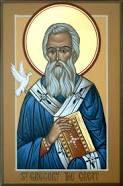
540 - 604 Person Name: Gregory the Great, 540-604 Author of "O Kind Creator" in The Hymn Book of the Anglican Church of Canada and the United Church of Canada Gregory I., St., Pope. Surnamed The Great. Was born at Rome about A.D. 540. His family was distinguished not only for its rank and social consideration, but for its piety and good works. His father, Gordianus, said to have been the grandson of Pope Felix II. or III., was a man of senatorial rank and great wealth; whilst his mother, Silvia, and her sisters-in-law, Tarsilla and Aemiliana, attained the distinction of canonization. Gregory made the best use of his advantages in circumstances and surroundings, so far as his education went. "A saint among saints," he was considered second to none in Rome in grammar, rhetoric, and logic. In early life, before his father's death, he became a member of the Senate; and soon after he was thirty and accordingly, when his father died, he devoted the whole of the large fortune that he inherited to religious uses. He founded no less than six monasteries in Sicily, as well as one on the site of his own house at Rome, to which latter he retired himself in the capacity of a Benedictine monk, in 575. In 577 the then Pope, Benedict I, made him one of the seven Cardinal Deacons who presided over the seven principal divisions of Rome.
The following year Benedict's successor, Pelagius II, sent him on an embassy of congratulation to the new emperor Tiberius, at Constantinople. After six years' residence at Constantinople he returned to Rome. It was during this residence at Rome, before he was called upon to succeed Pelagius in the Papal chair, that his interest was excited in the evangelization of Britain by seeing some beautiful children, natives of that country, exposed for sale in the slave-market there ("non Angli, sed Angeli"). He volunteered to head a mission to convert the British, and, having obtained the Pope's sanction for the enterprise, had got three days' journey on his way to Britain when he was peremptorily recalled by Pelagius, at the earnest demand of the Roman people.
In 590 he became Pope himself, and, as is well known, carried out his benevolent purpose towards Britain by the mission of St. Augustine, 596. His Papacy, upon which he entered with genuine reluctance, and only after he had taken every step in his power to be relieved from the office, lasted until 604, when he died at the early age of fifty-five. His Pontificate was distinguished by his zeal, ability, and address in the administration of his temporal and spiritual kingdom alike, and his missionaries found their way into all parts of the known world. In Lombardy he destroyed Arianism; in Africa he greatly weakened the Donatists; in Spain he converted the monarch, Reccared: while he made his influence felt even in the remote region of Ireland, where, till his day, the native Church had not acknowledged any allegiance to the See of Rome. He advised rather than dictated to other bishops, and strongly opposed the assumption of the title of "Universal Patriarch" by John the Faster of Constantinople, on the ground that the title had been declined by the Pope himself at the Council of Chalcedon, and declared his pride in being called the “Servant of God's Servants." He exhibited entire toleration for Jews and heretics, and his disapproval of slavery by manumitting all his own slaves. The one grave blot upon his otherwise upright and virtuous character was his gross flattery in congratulating Phocas on his accession to the throne as emperor in 601, a position the latter had secured with the assistance of the imperial army in which he was a centurion, by the murder of his predecessor Mauricius (whose six sons had been slaughtered before their father's eyes), and that of the empress Constantina and her three daughters.
Gregory's great learning won for him the distinction of being ranked as one of the four Latin doctors, and exhibited itself in many works of value, the most important of which are his Moralium Libri xxxv., and his two books of homilies on Ezekiel and the Gospels. His influence was also great as a preacher and many of his sermons are still extant, and form indeed no inconsiderable portion of his works that have come down to us. But he is most famous, perhaps, for the services he rendered to the liturgy and music of the Church, whereby he gained for himself the title of Magister Caeremoniarum. His Sacramentary, in which he gave its definite form to the Sacrifice of the Mass, and his Antiphonary, a collection which he made of chants old and new, as well as a school called Orplianotrophium, which he established at Rome for the cultivation of church singing, prove his interest in such subjects, and his success in his efforts to render the public worship of his day worthy of Him to Whom it was addressed. The Gregorian Tones, or chants, with which we are still familiar after a lapse of twelve centuries, we owe to his anxiety to supersede the more melodious and flowing style of church music which is popularly attributed to St. Ambrose, by the severer and more solemn monotone which is their characteristic.
The contributions of St. Gregory to our stores of Latin hymns are not numerous, nor are the few generally attributed to him quite certainly proved to be his. But few as they are, and by whomsoever written, they are most of them still used in the services of the Church. In character they are well wedded to the grave and solemn music which St. Gregory himself is supposed to have written for them.
The Benedictine editors credit St. Gregory with 8 hymns, viz. (1) “Primo dierum omnium;" (2) "Nocte surgentes vigilemus;" (3) "Ecce jam noctis tenuatur tunbra;" (4) “Clarum decus jejunii;" (5) "Audi benigne conditor;" (6) "Magno salutis gaudio;" (7) “Rex Christe factor omnium;" (8) "Lucis Creator Optime." Daniel in his vol. i. assigns him three others. (9) “Ecce tempus idoneum;" (10) "Summi largitor praemii;" (11) "Noctis tempus jam praeterit." For translations of these hymns see under their respective first lines. (For an elaborate account of St. Gregory, see Smith and Wace's Dictionary of Christian Biography.) [Rev. Digby S. Wrangham, M.A.]
-- John Julian, Dictionary of Hymnology (1907)
===================
Gregory I., St., Pope, p. 469, i. We have been unable to discover any grounds which justified the Benedictine editors and Daniel in printing certain hymns (see p. 470, i.) as by St. Gregory. Modern scholars agree in denying him a place among hymnwriters; e.g., Mr. F. H. Dudden, in his Gregory the Great (London, 1905, vol. i.,p. 276), says "The Gregorian authorship of these compositions [the hymns printed by the Benedictine editors] however cannot be maintained... Gregory contributed ... nothing at all to the sacred music and poetry of the Roman Church." [Rev. James Mearns, M.A.]
--John Julian, Dictionary of Hymnology, New Supplement (1907)
Pope Gregory I


 My Starred Hymns
 My FlexScores
 My Hymnals
 My Purchased Files