You help make Hymnary.org possible. More than 10 million people from 200+ countries found hymns, liturgical resources and encouragement on Hymnary.org in 2025, including you. Every visit affirms the global impact of this ministry.

If Hymnary has been meaningful to you this year, would you take a moment today to help sustain it? A gift of any size—paired with a note of encouragement if you wish—directly supports the server costs, research work and curation that keep this resource freely available to the world.

Give securely online today, or mail a check to:
Hymnary.org
Calvin University
3201 Burton Street SE
Grand Rapids, MI 49546

Thank you for your partnership, and may the hope of Advent fill your heart.

Search Results

Text Identifier:"^to_god_be_glory_peace_on_earth_to_all$"

Planning worship? Check out our sister site, ZeteoSearch.org, for 20+ additional resources related to your search.

Texts

text icon
Text authorities
TextPage scans

To God be glory, peace on earth

Appears in 37 hymnals Lyrics: 1 To God be glory, peace on earth, To all mankind good will! We bless, we praise, we worship Thee, And glorify Thee still, And glorify Thee still. 2 And thanks for Thy great glory give, That fills our soul with light; O Lord, our heavenly King, the God And Father of all might! 3 And Thou, begotten Son of God, Before time had begun; O Jesus Christ, Thou Lamb of God, The Father's Only Son: 4 Have mercy, Thou that tak'st the sins Of all the world away! Have mercy, Savior of mankind, And hear us when we pray! 5 O Thou, who sitt'st at God's right hand, Upon the Father's throne, Have mercy on us Thou, O Christ, Who art the Holy One! 6 Thou only, with the Holy Ghost, Whom earth and heaven adore, In glory of the Father art Most high for evermore. Topics: Christian Life and Hope The Walk of Godliness: Praise; Christian Life and Hope The Walk of Godliness: Praise Used With Tune: CHRISTMAS Text Sources: Tate and Brady's Supplement, 1703

Tunes

tune icon
Tune authorities
Page scansAudio

THANKSGIVING

Meter: 8.6.8.6 Appears in 313 hymnals Composer and/or Arranger: J. Crüger Tune Sources: German chorale: Nun danket all und bringet Ehr Tune Key: G Major Incipit: 16512 33235 43215 Used With Text: To God Be Glory, Peace On Earth
Page scansAudio

CHRISTMAS

Appears in 703 hymnals Composer and/or Arranger: George Fraderick Handel, 1685-1759 Tune Key: D Major Incipit: 34517 65123 34555 Used With Text: To God be glory, peace on earth
Page scansAudio

ARISE, ALL WHO ON EARTH DO DWELL

Meter: 8.6.8.6 Appears in 241 hymnals Composer and/or Arranger: N. Hermann, 1554 Tune Key: E Flat Major Incipit: 15555 65432 34566 Used With Text: To God be glory, peace on earth

Instances

instance icon
Published text-tune combinations (hymns) from specific hymnals
TextPage scan

To God Be Glory, Peace On Earth

Hymnal: American Lutheran Hymnal #11 (1930) Meter: 8.6.8.6 Lyrics: 1 To God be glory, peace on earth, To all mankind good will! We bless, we praise, we worship Thee, And glorify Thee still. 2 For Thy great glory thanks we give, That fills our souls with light; O Lord, our heav'nly King, the God And Father of all might. 3 And Thou, begotten Son of God Before time had begun, O Jesus Christ, Thou Lamb of God, The Father's only Son. 4 Have mercy, Thou that tak'st the sins Of all the world away! Have mercy, Savior of mankind, And hear us when we pray! 5 O Thou, who sitt'st at God's right hand, Upon the Father's throne, Have mercy on us, Thou, O Christ, Who art the Holy One! 6 Thou only, with the Holy Ghost, Whom earth and heav'n adore, In glory of the Father art Most high forevermore. Topics: Opening of Worship Languages: English Tune Title: THANKSGIVING
TextPage scan

To God be glory, peace on earth

Hymnal: Christian Hymns #68 (1898) Meter: 8.6.8.6 Lyrics: 1 To God be glory, peace on earth, To all mankind good will! We bless, we praise, we worship Thee, And glorify Thee still, And glorify Thee still. 2 And thanks for Thy great glory give, That fills our soul with light; O Lord, our heavenly King, the God And Father of all might, And Father of all might! 3 And Thou, begotten Son of God Before all time begun; O Jesus Christ, Thou Lamb of God, The Father's only Son, The Father's only Son: 4 Have mercy, Thou that tak'st the sins Of all the world away! Have mercy, Saviour of mankind, And hear us when we pray, And hear us when we pray! 5 O Thou, who sitt'st at God's right hand, Upon the Father's throne, Have mercy on us, Thou O Christ, Who art the Holy One, Who art the Holy One! 6 Thou only, with the Holy Ghost, Whom earth and heaven adore, In glory of the Father art Most high forevermore, Most high forevermore. Topics: TheChurch Year Trinity; Christ Lamb; Mercy, prayed for; Praise and Thanksgiving Languages: English Tune Title: ARISE, ALL WHO ON EARTH DO DWELL
TextPage scan

To God be glory, peace on earth

Hymnal: Evangelical Lutheran Hymnal. 9th ed. #a358 (1895) Meter: 8.6.8.6 Lyrics: 1 To God be glory, peace on earth, To all mankind good will! We bless, we praise, we worship Thee, And glorify Thee still: 2 And thanks for Thy great glory give, That fills our soul with light; O Lord, our heavenly King, the God And Father of all might! 3 And Thou, begotten Son of God, Before time had begun; O Jesus Christ, Thou Lamb of God, The Father's Only Son: 4 Have mercy, Thou that tak'st the sins Of all the world away! Have mercy, Savior of mankind, And hear us when we pray! 5 O Thou, who sitt'st at God's right hand, Upon the Father's throne, Have mercy on us Thou, O Christ, Who art the Holy One! 6 Thou only, with the Holy Ghost, Whom earth and heav'n adore, In glory of the Father art Most high for evermore. Topics: Christian Life and Hope ; The Walk of Godliness Praise Languages: English

People

person icon
Authors, composers, editors, etc.

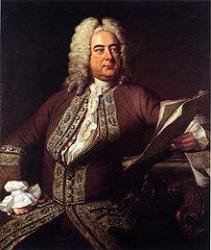
George Frideric Handel

1685 - 1759 Person Name: George Fraderick Handel, 1685-1759 Composer of "CHRISTMAS" in Evangelical Lutheran hymnal George Frideric Handel (b. Halle, Germany, 1685; d. London, England, 1759) became a musician and composer despite objections from his father, who wanted him to become a lawyer. Handel studied music with Zachau, organist at the Halle Cathedral, and became an accomplished violinist and keyboard performer. He traveled and studied in Italy for some time and then settled permanently in England in 1713. Although he wrote a large number of instrumental works, he is known mainly for his Italian operas, oratorios (including Messiah, 1741), various anthems for church and royal festivities, and organ concertos, which he interpolated into his oratorio performances. He composed only three hymn tunes, one of which (GOPSAL) still appears in some modern hymnals. A number of hymnal editors, including Lowell Mason, took themes from some of Handel's oratorios and turned them into hymn tunes; ANTIOCH is one example, long associated with “Joy to the World.” Bert Polman

Johann Crüger

1598 - 1662 Person Name: J. Crüger Composer of "THANKSGIVING" in American Lutheran Hymnal Johann Crüger (b. Grossbriesen, near Guben, Prussia, Germany, 1598; d. Berlin, Germany, 1662) Crüger attended the Jesuit College at Olmutz and the Poets' School in Regensburg, and later studied theology at the University of Wittenberg. He moved to Berlin in 1615, where he published music for the rest of his life. In 1622 he became the Lutheran cantor at the St. Nicholas Church and a teacher for the Gray Cloister. He wrote music instruction manuals, the best known of which is Synopsis musica (1630), and tirelessly promoted congregational singing. With his tunes he often included elaborate accom­paniment for various instruments. Crüger's hymn collection, Neues vollkomliches Gesangbuch (1640), was one of the first hymnals to include figured bass accompaniment (musical shorthand) with the chorale melody rather than full harmonization written out. It included eighteen of Crüger's tunes. His next publication, Praxis Pietatis Melica (1644), is considered one of the most important collections of German hymnody in the seventeenth century. It was reprinted forty-four times in the following hundred years. Another of his publications, Geistliche Kirchen Melodien (1649), is a collection arranged for four voices, two descanting instruments, and keyboard and bass accompaniment. Crüger also published a complete psalter, Psalmodia sacra (1657), which included the Lobwasser translation set to all the Genevan tunes. Bert Polman =============================== Crüger, Johann, was born April 9, 1598, at Gross-Breese, near Guben, Brandenburg. After passing through the schools at Guben, Sorau and Breslau, the Jesuit College at Olmütz, and the Poets' school at Regensburg, he made a tour in Austria, and, in 1615, settled at Berlin. There, save for a short residence at the University of Wittenberg, in 1620, he employed himself as a private tutor till 1622. In 1622 he was appointed Cantor of St. Nicholas's Church at Berlin, and also one of the masters of the Greyfriars Gymnasium. He died at Berlin Feb. 23, 1662. Crüger wrote no hymns, although in some American hymnals he appears as "Johann Krüger, 1610,” as the author of the supposed original of C. Wesley's "Hearts of stone relent, relent" (q.v.). He was one of the most distinguished musicians of his time. Of his hymn tunes, which are generally noble and simple in style, some 20 are still in use, the best known probably being that to "Nun danket alle Gott" (q.v.), which is set to No. 379 in Hymns Ancient & Modern, ed. 1875. His claim to notice in this work is as editor and contributor to several of the most important German hymnological works of the 16th century, and these are most conveniently treated of under his name. (The principal authorities on his works are Dr. J. F. Bachmann's Zur Geschichte der Berliner Gesangbücher 1857; his Vortrag on P. Gerhard, 1863; and his edition of Gerhardt's Geistliche Lieder, 1866. Besides these there are the notices in Bode, and in R. Eitner's Monatshefte für Musik-Geschichte, 1873 and 1880). These works are:— 1. Newes vollkömmliches Gesangbuch, Augspur-gischer Confession, &c, Berlin, 1640 [Library of St. Nicholas's Church, Berlin], with 248 hymns, very few being published for the first time. 2. Praxis pietatis melica. Das ist: Ubung der Gottseligkeit in Christlichen und trostreichen Gesängen. The history of this, the most important work of the century, is still obscure. The 1st edition has been variously dated 1640 and 1644, while Crüger, in the preface to No. 3, says that the 3rd edition appeared in 1648. A considerable correspondence with German collectors and librarians has failed to bring to light any of the editions which Koch, iv. 102, 103, quotes as 1644, 1647, 1649, 1650, 1651, 1652, 1653. The imperfect edition noted below as probably that of 1648 is the earliest Berlin edition we have been able to find. The imperfect edition, probably ix. of 1659, formerly in the hands of Dr. Schneider of Schleswig [see Mützell, 1858, No. 264] was inaccessible. The earliest perfect Berlin edition we have found is 1653. The edition printed at Frankfurt in 1656 by Caspar Röteln was probably a reprint of a Berlin edition, c. 1656. The editions printed at Frankfurt-am-Main by B. C. Wust (of which the 1666 is in the preface described as the 3rd) are in considerable measure independent works. In the forty-five Berlin and over a dozen Frankfurt editions of this work many of the hymns of P. Gerhardt, J. Franck, P. J. Spener, and others, appear for the first time, and therein also appear many of the best melodies of the period. 3. Geistliche Kirchen-Melodien, &c, Leipzig, 1649 [Library of St. Katherine's Church, Brandenburg]. This contains the first stanzas only of 161 hymns, with music in four vocal and two instrumental parts. It is the earliest source of the first stanzas of various hymns by Gerhardt, Franck, &c. 4. D. M. Luther's und anderer vornehmen geisU reichen und gelehrten Manner Geistliche Lieder und Psalmen, &c, Berlin, 1653 [Hamburg Town Library], with 375 hymns. This was edited by C. Runge, the publisher, and to it Crüger contributed some 37 melodies. It was prepared at the request of Luise Henriette (q.v.), as a book for the joint use of the Lutherans and the Re¬formed, and is the earliest source of the hymns ascribed to her, and of the complete versions of many hymns by Gerhardt and Franck. 5. Psalmodia Sacra, &c, Berlin, 1658 [Royal Library, Berlin]. The first section of this work is in an ed. of A. Lobwasser's German Psalter; the second, with a similar title to No. 4, and the date 1657, is practically a recast of No. 4,146 of those in 1653 being omitted, and the rest of the 319 hymns principally taken from the Praxis of 1656 and the hymn-books of the Bohemian Brethren. New eds. appeared in 1676, 1700, 1704, 1711, and 1736. [Rev. James Mearns, M.A.] -- Excerpt from John Julian, Dictionary of Hymnology (1907) ======================= Crüger, Johann, p. 271, ii. Dr. J. Zahn, now of Neuendettelsau, in Bavaria, has recently acquired a copy of the 5th ed., Berlin, 1653, of the Praxis. --John Julian, Dictionary of Hymnology, Appendix, Part II (1907)

Anonymous

Author of "Glory to God, through peace on earth" in The Gospel Psalmist In some hymnals, the editors noted that a hymn's author is unknown to them, and so this artificial "person" entry is used to reflect that fact. Obviously, the hymns attributed to "Author Unknown" "Unknown" or "Anonymous" could have been written by many people over a span of many centuries.
It looks like you are using an ad-blocker. Ad revenue helps keep us running. Please consider white-listing Hymnary.org or getting Hymnary Pro to eliminate ads entirely and help support Hymnary.org.