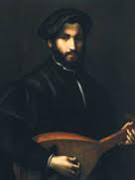
1563 - 1626 Person Name: J. Dowland, c. 1563-1626 Composer of "DIVINE PARADOX" in Evangelical Lutheran Hymnary John Dowland, (born 1562/63, Westminster, London, England—died January 21, 1626, London), English composer, virtuoso lutenist, and skilled singer, one of the most famous musicians of his time.
Nothing is known of Dowland’s childhood, but in 1580 he went to Paris as a “servant” to Sir Henry Cobham, the ambassador to the French court. In 1588 he received a bachelor of music degree from the University of Oxford. His conversion to Roman Catholicism, he believed, caused his rejection for a post as a court lutenist in 1594, and after that disappointment he left England to travel on the Continent. He visited the duke of Brunswick at Wolfenbüttel and the landgrave of Hesse at Kassel and was received with esteem at both courts. His travels also took him to Nürnberg, Genoa, Florence, and Venice, and by 1597 he had returned to England.
In 1598 Dowland became lutenist to Christian IV of Denmark, but he was dismissed for unsatisfactory conduct in 1606. Between 1609 and 1612 he entered the service of Theophilus, Lord Howard de Walden, and in 1612 he was appointed one of the “musicians for the lutes” to James I.
Although a respecter of tradition, Dowland worked during a time of musical transition and absorbed many of the new ideas he had encountered on the Continent. His 88 lute songs (printed 1597–1612) particularly reflect those influences. The early songs are presented with an alternative version for four voices. Possessing enchanting melodies, they show simple strophic settings, often in dance forms, with an almost complete absence of chromaticism. Later, in such through-composed songs as "In Darkness Let Me Dwell" (1610), "From Silent Night" (1612), and "Lasso vita mia" (1612), he introduced the Italian declamatory style, chromaticism, and dissonance; no alternative four-voice versions are given.
Dowland composed about 90 works for solo lute; many are dance forms, often with highly elaborate divisions to the repeats. His famous Lachrimae, or Seaven Teares Figured in Seaven Passionate Pavans (1604), became one of the most widely known compositions of the time. In his chromatic fantasies, the finest of which are "Forlorne Hope Fancye" and "Farewell," he developed this form to a height of intensity unequaled by any other writer for the Renaissance lute. His compositions also include several psalm harmonizations and sacred songs printed in contemporary music books.
--www.britannica.com/
John Dowland


 My Starred Hymns
 My FlexScores
 My Hymnals
 My Purchased Files






