

 My Starred Hymns
 My FlexScores
 My Hymnals
 My Purchased Files
Planning worship?
Check out our sister site, ZeteoSearch.org,
for 20+ additional resources related to your search.
- |
User Links
Search Results

MERRILL (Kerr)
Meter: 7.7.7.7 Appears in 4 hymnals Composer and/or Arranger: Robert P. Kerr Incipit: 12314 13212 13213
MERRILL (Kerr)


Thine forever! God of love
Author: Mrs. M. F. Maude Appears in 355 hymnals Used With Tune: MERRILL
Thine forever! God of love
Oft in danger, oft in woe
Author: H. K. White ( -1806) Appears in 354 hymnals Used With Tune: MERRILL
Oft in danger, oft in woe
Sovereign Ruler of the skies
Author: John Ryland Appears in 165 hymnals Used With Tune: MERRILL
Sovereign Ruler of the skies


Sovereign Ruler of the skies
Author: John Ryland Hymnal: Hymns of the Ages #110 (1891) Languages: English Tune Title: MERRILL
Sovereign Ruler of the skies
Oft in danger, oft in woe
Author: H. K. White ( -1806) Hymnal: Hymns of the Ages #111 (1891) Languages: English Tune Title: MERRILL
Oft in danger, oft in woe
Jesus, Jesus, visit me
Author: Rev. R. P. Dunn; Angelus ( -1677) Hymnal: Hymns of the Ages #112 (1891) Languages: English Tune Title: MERRILL
Jesus, Jesus, visit me


Robert P. Kerr
1850 - 1923 Person Name: Rev. Robert P. Kerr Composer of "MERRILL" in Hymns of the Ages Born: 1850, Greensboro, Alabama.
Buried: Mount Olivet Cemetery , Nashville, Tennessee.
Kerr, Robert P., D.D., b. at Greensborough, Alabama, graduated at Union Theological Seminary, Va., 1873, and was ordained by the Presbytery of Lafayette, 1874. His Hymns of the Ages, a collection on conservative Evangelical lines which hardly justified its title, was published in N.Y., 1891. In it appeared his hymn,"Blessed country, home of Jesus," 1891, A later hymn, "Galilean King and Prophet," is dated 1901. [Rev. L. F. Benson, D.D.]
--John Julian, Dictionary of Hymnology, New Supplement (1907)
Robert P. Kerr
John Ryland

1753 - 1825 Author of "Sovereign Ruler of the skies" in Hymns of the Ages Ryland, John, D.D., son of Rev. John Collett Ryland, was born at Warwick, Jan. 29, 1753. At that time his father was Baptist minister at Warwick, but in 1759 removed to Northampton. "J. Ryland, junior," as for many years he was accustomed to subscribe himself, was in 1781 ordained co-pastor with his father at Northampton. In 1794 he accepted the presidency of the Baptist College and the pastorate of the church in Broadmead, Bristol, and these offices he retained until his death on June 25, 1825. Dr. Ryland was a man of considerable literary culture, and received the degree of D.D. from Brown University, Rhode Island. He was one of the founders of the Baptist Missionary Society, and for the three years following the death of Rev. A. Fuller, in 1815, acted as its secretary. His prose works were Memoirs of Rev. B. Hall, Arnsby (2nd ed., 1852); A candid statement of the reasons which induce Baptists to differ from their Christian brethren; and many Sermons and Charges. After his death appeared 2 vols. of Discourses, selected from his manuscripts, and entitled Pastoral Memorial. To these discourses are appended many of his hymns, with their dates. Dr. Ryland's hymns were composed at different times, from his sixteenth year to the year of his death. The earliest were published when he was 16, in his Serious Essays, 1771. These 36 hymns were never republished. Several appeared in the Gospel Magazine from 1771 to 1782, and the Protestant Magazine, 1782-83; others in Rippon's Baptist Selection, 1787; 2 in the Collection for the Monthly Prayer Meeting at Bristol, 1797 ; 2 in Andrew Fuller's Memoirs, 1831; and 25 in the Pastoral Memorials, 1825. His Hymns and Verses on Sacred Subjects, to the number of 99, were reprinted from his mss. by D. Sedgwick, and were published, with a Memoir, in 1862. The hymns are dated therein from the mss. [Rev. W. R. Stevenson, M.A.]
Those of Dr. Ryland's hymns now in common use include:—
1. For Zion's sake I'll not restrain. Missions. Dated 1798, and printed by D. Sedgwick from Ryland's manuscripts, 1862.
2. Had not the Lord, my soul may say [cry] . Ps. cxxiv. From his Serious Essays, 1771. It is No. 124 in Spurgeon's Our Own Hymn Book, 1866. Not in Sedgwick's reprint.
3. Holy, holy, holy Lord, self-existent Deity. Holy Trinity. Dated 1796. It was given in the tenth edition of Rippon's Baptist Selection, 1800, Pt. 2, No. 22; in the Pastoral Memorials, 1825; and Sedgwick's reprint, 1862, in 5 stanzas of 8 lines. It is in common use in Great Britain and America.
4. Look down, my soul, on hell's domain. Gratitude for escape. This is No. 881 in Spurgeon's Our Own Hymn Book. 1866, and dated 1777. We cannot trace it in any of Ryland's works or amongst his hymns.
5. Lord, teach a little child to pray. A Child's Prayer. Dated 1786. The note to this hymn by Dr. Ryland's son, in Sedgwick's reprint, 1862, p. 15, is:— "This and the following hymn ["God is very good to me “was composed at the request of Mrs. Fuller, wife of the Rev. Andrew Fuller, of Kettering, for the use of Miss Sarah Fuller, who died May 30th, 1789, aged six years and six months." It was published in Andrew Fuller's Memoirs, 1831, p. 442, andsin Sedgwick's reprint, 1862.
6. Now let the slumbering church awake. Activity in the Church desired. Dated "Feb. 20, 1798." Published in the Pastoral Memorials, 1825, and in Sedgwick's reprint, 1862. In Spurgeon's Our Own Hymn Book, 1866.
7. O Lord, I would delight in Thee. Delight in Christ. Dated "Dec. 3, 1777." Dr. Ryland added this note to the ms.:—-" I recollect deeper feelings of mind in composing this hymn, than perhaps I ever felt in making any other." It was published in Rippon's Selection 1798, No. 248; in the Pastoral Memorials, 1825; and in Sedgwick's reprint, 1862, in 7 st. of 41. It is in extensive use in its original, or an abbreviated form; or as "O Lord we would delight in Thee." In the American Methodist Episcopal Hymns, 1849; and their Hymn, 1878, st. i., ii., vi., vii. are rewritten in S. M. as "Lord, I delight in Thee."
8. Out of the depths of doubt and fear. Ps. cxxx. From the Serious Essays, 1771 (misdated in Spurgeon's Our Own Hymn Book 1775). It is not in the Pastoral Memorials, 1825, nor in Sedgwick's reprint, 1862.
9. Rejoice, the Saviour reigns. Missions. Dated "Jan. 19, 1792." In the 10th ed. of Rippon's Selection, 1800, 422 (2nd pt.) it is given in 6 st. of 6 1., as in the Ryland ms., and then after the word "Pause" two stanzas are added on, which are not in the ms. The 6 stanzas were repeated in the Pastoral Memorials, 1825; in Sedgwick's reprint, 1862; and in Spurgeon's Our Own Hymn Book, 1866 (abbreviated), and other modern hymnals.
10. Sovereign Ruler of the skies. Guidance, Peace, and Security in God. Dated "Aug. 1,1777." Included in Rippon's Selection, 1787, No. 545 ; the Pastoral Memorials, 1825 ; and Sedgwick's reprint, 1862, in 9 st. of 4 1.
11. Thou Son of God, and Son of Man. Praise to God, the Son. This is undated. It was given in the Pastoral Memorials, 1825; and Sedgwick's reprint, 1862.
12. When Abraham's servant to procure. Onward, Heavenward. Dr. Ryland's son, under the date of Nov. 4, 1861, informed D. Sedgwick that this hymn "was written with a slate pencil on a rusty iron blower by moonlight, past twelve o'clock, Dec. 30, 1773," and he gives these words as a quotation from his father's manuscript. It is almost needless to add that this account does not agree with the generally received history of the hymn, as set forth in Miller's Singers and Songs, 1869, p. 313. In the May number of the Gospel Magazine, 1775, p. 235, the hymn was given in 9 st. of 4 1., with the heading" Hinder me not-—Gen. xxiv. 56," and signed "Elachistoteros." It was repeated in Rippon's Selection, 1787, No. 447; and Sedgwick's reprint, 1862. In Rippon a note is added, "This hymn may begin with 6th verse." This direction has been followed in some modern collections, the result being the hymn commonly known as "In all my Lord's appointed ways."
13. When the Saviour dwelt below. Compassion of Christ. Dated 1806. Included in the Pastoral Memorials, 1825, and Sedgwick's reprint, 1862.
Dr. Ryland's hymns are plain and simple, but they lack poetry and passion, and are not likely to be largely drawn upon, for future hymnals.
--John Julian, Dictionary of Hymnology (1907)
John Ryland
Henry Kirke White
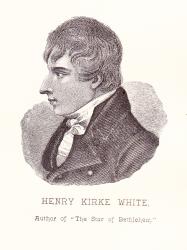
1785 - 1806 Person Name: H. K. White ( -1806) Author of "Oft in danger, oft in woe" in Hymns of the Ages White, Henry Kirke, a gifted English poet who died early in life, was born in Nottingham, England, March 21, 1785. Very early he manifested a remarkable love for books and a decided talent for composition. But his parents were poor, and he was apprenticed in early boyhood to a stocking weaver, from which uncongenial servitude he escaped as soon as he could and began the study of law; but later he was converted and felt called to the ministry. The story of his conversion from deism to Christianity is briefly but beautifully told in the poem titled "The Star of Bethlehem." He entered St. John's College, Cambridge, in 1805 as a servitor; but died October 19, 1806, in the second year of his college course, when only twenty-one years of age. In 1803 he published a small volume of poems. Some of them are very fine, but no doubt he would have produced others far better if he had lived to the ordinary age of man. His rare poetic genius, his victory over skepticism and subsequent faith and piety, his hard struggle with poverty and early death invest the story of his life with more than ordinary pathos. His hymns, ten in number, appeared in Collyer's Collection, 1812.
Oft in danger, oft in woe 412
The Lord our God is clothed with 99
When marshaled on the mighty 124
Hymn Writers of the Church, 1911
============================
White, Henry Kirk, remarkable both for the early development of his genius and for the untimely termination of his brief life of splendid promise, was born at Nottingham, March 21, 1785. His father was a butcher, but his mother must have been a superior woman, since for a number of years she successfully conducted a boarding-school for girls. The writing-master in her establishment was for some time Henry's teacher, and under his instruction he made remarkable progress in Latin and other subjects. At the age of 13 he composed the lines "To an early Primrose," which were subsequently printed with his poems. At 14 he left school, and was put to the stocking-frame in order to learn prac¬tically the business of a hosier; but, disliking the employment, he was removed to an attorney's office in Nottingham, with a view to the legal profession. All his spare time was now devoted to literary pursuits, the acquisition of languages, and the composition of poetical and other contributions for the periodicals of the day. At the age of 15 he obtained from the Monthly Preceptor a silver medal for a translation from Horace, and a pair of globes for the best description of an imaginary tour from London to Edinburgh. When only 17 he was encouraged to publish his Clifton Grove and other Poems, which were certainly excellent as the compositions of a mere boy. About this time he was inclined to scepticism, but. through the perusal of Scott's Force of Truth and the arguments and appeals of a young friend, R. W. Almond (afterwards Rector of St. Peter's, Nottingham), he was led to earnest faith in Christianity. His well-known hymn "When marshall'd on the nightly plain" is understood to be a figurative description of his spiritual experience at this period.
He now desired to become a Christian minister, and through the generosity of his employers he was released from his articles in 1804. With the help of the Rev. C. Simeon and other friends, he became a student of St. John's College, Cambridge. There he speedily distinguished himself, and the highest honours seemed within his grasp; but over application to study destroyed his health, and he fell ill and died Oct. 19, 1806, in the 22nd year of his age. Universal regret was expressed at his untimely end. Southey published his Remains, accompanied by a short memoir. Lord Byron composed some beautiful lines on the sad event. Josiah Conder and others wrote commemorative verses. The entire literary young manhood of England and America seemed moved with sympathy. A monumental tablet, with a medallion by Chantrey, was erected in All Saints Church, Cambridge, at the expense of a citizen of Boston, in the United States. Ten hymns are ascribed to H. K. White, which were printed by the Rev. Dr. W. B. Collyer in his Supplement to Dr. Watts's Psalms & Hymns, London, 1812. Of these four of the most popular are annotated as follows: "Awake, sweet harp of Judah, wake"; "Christians, brethren, ere we part"; "Much in sorrow, oft in woe"; “When marshalled on the nightly plain." These are all in extensive use. The rest, all in common use at the present time, are:—
1. 0 Lord, another day has flown. Evening. From this the hymn "0 let Thy grace perform its part" is taken.
2. 0 Lord, my God, in mercy turn. Penitence and Faith.
3. The Lord our God is full [clothed in] of might. Divine Sovereignty.
4. The Lord our God is Lord of all. Divine Sovereignty.
5. Through sorrow's night and danger's path. The Resurrection. Sometimes given as "When sorrow's path and danger's road."
6. What is this passing scene? Human Frailty. This hymn consists of selected stanzas from his “Ode on Disappointment." [Rev. W. R. Stevenson, M.A.]
-- John Julian, Dictionary of Hymnology (1907)
Henry Kirke White





