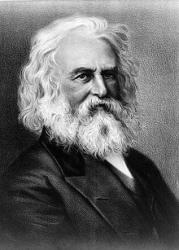
1807 - 1882 Person Name: Henry W. Longfellow Author of "I heard the bells on Christmas Day" in The Church School Hymnal for Youth Longfellow, Henry Wadsworth , D.C.L. was born at Portland, Maine, Feb. 27, 1807, and graduated at Bowdoin College, 1825. After residing in Europe for four years to qualify for the Chair of Modern Languages in that College, he entered upon the duties of the same. In 1835 he removed to Harvard, on his election as Professor of Modern Languages and Belles-Lettres. He retained that Professorship to 1854. His literary reputation is great, and his writings are numerous and well known. His poems, many of which are as household words in all English-speaking countries, display much learning and great poetic power. A few of these poems and portions of others have come into common use as hymns, but a hymn-writer in the strict sense of that term he was not and never claimed to be. His pieces in common use as hymns include:—
1. Alas, how poor and little worth. Life a Race. Translated from the Spanish of Don Jorge Manrique (d. 1479), in Longfellow's Poetry of Spain, 1833.
2. All is of God; if He but wave His hand. God All and in All. From his poem "The Two Angels," published in his Birds of Passage, 1858. It is in the Boston Hymns of the Spirit, 1864, &c.
3. Blind Bartimeus at the gate. Bartimeus. From his Miscellaneous Poems, 1841, into G. W. Conder's 1874 Appendix to the Leeds Hymn Book.
4. Christ to the young man said, "Yet one thing more." Ordination. Written for his brother's (S. Longfellow) ordination in 1848, and published in Seaside and Fireside, 1851. It was given in an altered form as "The Saviour said, yet one thing more," in H. W. Beecher's Plymouth Collection, 1855.
5. Sown the dark future through long generations. Peace. This, the closing part of his poem on "The Arsenal at Springfield," published in his Belfrey of Bruges, &c, 1845, was given in A Book of Hymns, 1848, and repeated in several collections.
6. Into the silent land. The Hereafter. A translation from the German.
7. Tell me not in mournful numbers. Psalm of Life. Published in his Voices of the Night, 1839, as "A Psalm of Life: What the heart of the Young Man said to the Psalmist." It is given in several hymnals in Great Britain and America. In some collections it begins with st. ii., "Life is real! Life is earnest."
The universal esteem in which Longfellow was held as a poet and a man was marked in a special manner by his bust being placed in that temple of honour, Westminster Abbey. [Rev. F. M. Bird, M.A.]
--John Julian, Dictionary of Hymnology (1907), p. 685
=======================
http://en.wikipedia.org/wiki/Henry_Wadsworth_Longfellow
Henry Wadsworth Longfellow


 My Starred Hymns
 My FlexScores
 My Hymnals
 My Purchased Files






