Scripture References:
st. 1 = Job 12:7-10, Ps. 148:3
st. 2 = Ps. 148:8
st. 4 = Ps. 148:9
st. 5 = Ps. 148:11-13
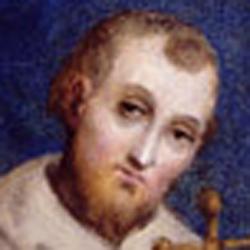
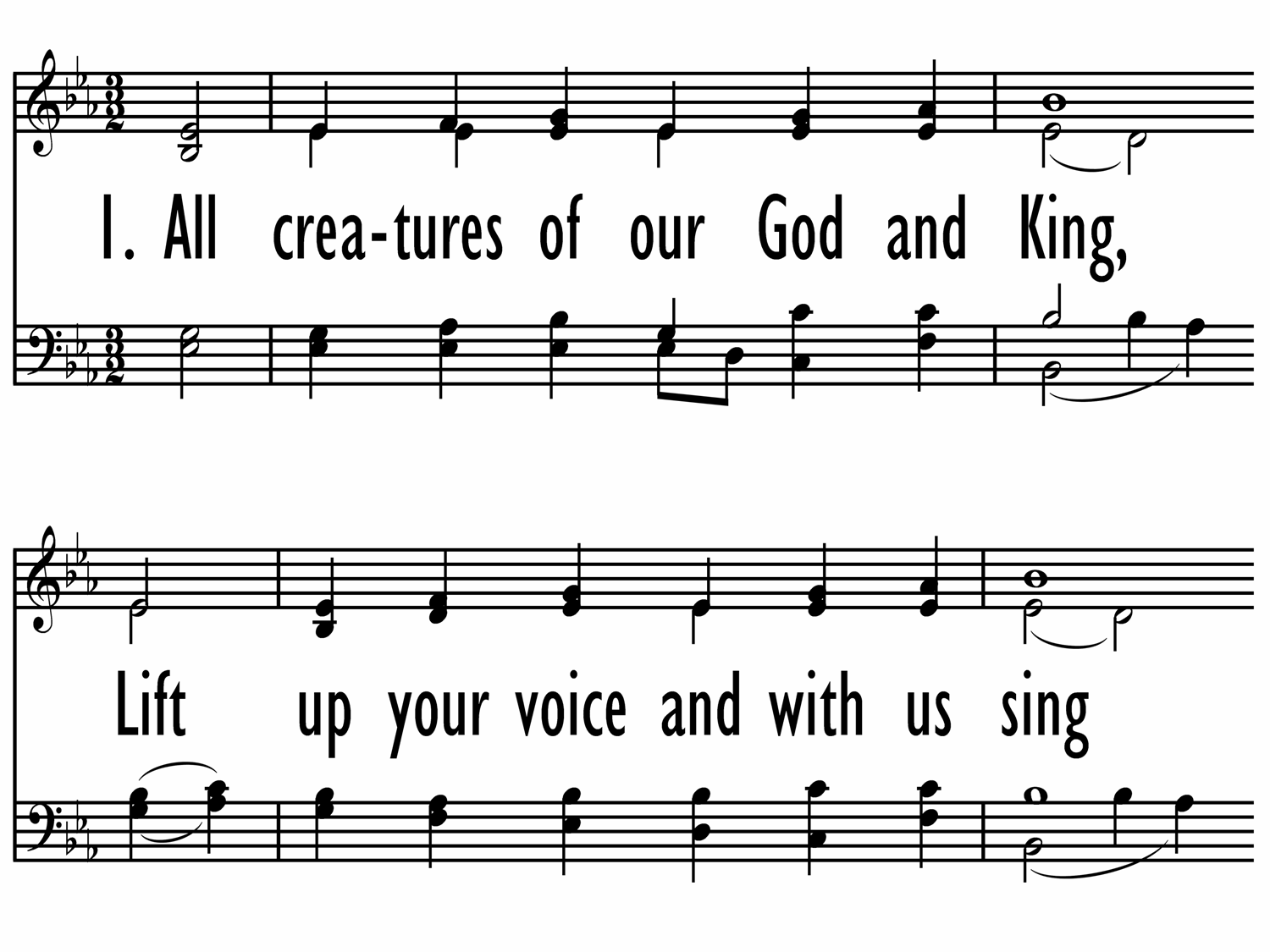
Virtually blind and unable to endure daylight, St. Francis (b, Assisi, Italy, c. 1182; d. Assisi, 1226) wrote this nature hymn during the summer of 1225 in the seclusion of a hut near San Damiano, Italy. The text is a meditation on Psalm 145 (although it also reflects Psalm 148 as well as the Canticle of the Three Young Men in the Furnace-an apocryphal addition to Dan. 3). Originally in Italian ("Laudato sia Dio mio Signore"), the text is known as the "Song of All Creatures" and as the "Canticle of the Sun."
St. Francis of Assisi is universally known for preaching to the birds and urging them to praise God. But his whole life was one of service to God and humanity. The son of a wealthy cloth merchant, Francis led a carefree, adventurous life as a youth, but after an illness and a pilgrimage to Rome in 1205, he voluntarily began a traveling life of poverty. He restored run-down chapels and shrines, preached, sang devotional "laudi spirituali" (adapted from Italian folk songs), and helped the poor and the lepers. Other young men joined him, and Francis founded the order named after him; the Franciscans were approved by the Pope in 1210. Legends about Francis abound, and various stories, prayers, and visions are attributed to him.
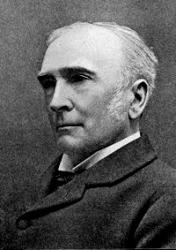
William H. Draper (b. Kenilworth, Warwickshire, England, 1855; d. Clifton, Bristol, England, 1933) translated–or rather paraphrased–the text (which appears in virtually all English hymnals) for a children's Whitsuntide (Pentecost) Festival in Leeds, England, around 1910. Originally in seven stanzas, Draper's translation was published with the tune LASST UNS ERFREUEN in the Public School Hymn Book (1919). The modernized version in the Psalter Hymnal omits the original stanza 6 (about death) and combines the original stanzas 5 and 7 into one (now st. 5).
Educated at Cheltenham College and Keble College, Oxford, England, Draper was ordained in the Church of England in 1880. He served at least six churches during his lifetime, including the Temple Church in London (1919-1930). He is known for his sixty translations of Latin, Greek, and German hymns, many published in The Victoria Book of Hymns (1897) and Hymns for Holy Week (1899).
"All Creatures" is a catalog text that enumerates various features of the creation and summons all to praise the Lord with their "alleluias." Although not found in the original text, the "alleluias" make splendid sense and are necessary for the tune. Repeating the words "O praise him" each stanza emphasizes the cosmic praise of all creation: the sun and moon (st. 1); wind, clouds, and light (st. 2); water and fire (st. 3); the earth and its produce (st. 4); all creatures (st. 5).
Liturgical Use:
Many occasions as a strong opening hymn of praise; a congregational call to worship; springtime prayer services for crops/industry and for harvest thanksgiving (especially st. 4); festive processionals (use a concertato arrangement with brass and choral parts).
--Psalter Hymnal Handbook
Hymnary Pro Subscribers
Access
2 additional articles
on the Canterbury Dictionary of Hymnology:
Hymnary Pro subscribers have full access to the Canterbury Dictionary of Hymnology.
Get Hymnary Pro


 My Starred Hymns
 My FlexScores
 My Hymnals
 My Purchased Files