Scripture References:
st. 1 = Matt. 2:1-12
st. 2 = John 2:1-11, John 3:13-17
st. 3 = Matt. 4:1-11, 23-24
ref. = Mark 8:29, John 1:14
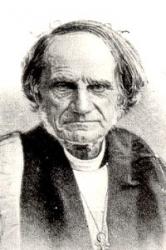
Christopher Wordsworth (b. Lambeth, London, England, 1807; d. Harewood, Yorkshire, England, 1885), nephew of the great Romantic poet William Wordsworth, wrote this hymn in five stanzas. It was published in his Holy Year (1862) John 3:13-17 with the heading "Sixth Sunday after Epiphany." Wordsworth described the text as follows
[It is a] recapitulation of the successive manifestations of Christ, which have already been presented in the services of the former weeks throughout the season of Epiphany; and anticipation of that future great and glorious Epiphany, at which Christ will be manifest to all, when he will appear again to judge the world.
The didactic text teaches the meaning of Epiphany–the manifestation of Christ in his birth (st. 1), baptism, miracle at Cana (st. 2), healing of the sick, power over evil, and coming as judge (st. 3). Originally the refrain line was "Anthems be to thee addressed, God in man made manifest." The revised refrain borrows Peter's confession, "You are the Christ!" (Mark 8:29), and makes that our corporate confession as we acknowledge the 'Word become flesh" who lived among us.
Wordsworth was a prolific author and the most renowned Greek scholar of his day. Included in his works are Memoirs of William Wordsworth (1851), Commentary on the Mole Bible (1856-1870), Church History (1881-1883), innumerable sermons and pamphlets, and The Holy Year (1862), which contained 117 of his original hymns as well as 82 others written for all the Sundays and Christian holy days according to the Book of Common Prayer. Wordsworth was educated at Trinity College, Cambridge, England, where he distinguished himself as a brilliant student. He later taught at Trinity College and was headmaster of Harrow School (1836-1844). Ordained a priest in the Church of England in 1835, he was canon of Westminster in 1844, a country priest in Stanford-in-the-Vale, Berkshire (1850-1869), and then Bishop of Lincoln (1869-1885).
Liturgical Use:
Throughout the Epiphany season.
--Psalter Hymnal Handbook
=================================
Songs of thankfulness and praise. Bishop C. Wordsworth, of Lincoln. [Epiphany.] First published in his Holy Year, 1862, No. 23, in 5 stanzas of 8 lines, with the heading:—
"Sixth Sunday after the Epiphany.—Recapitulation of the Subjects presented in the Services of former weeks throughout the season of Epiphany; and Anticipation of the future great and glorious Epiphany, at which Christ will appear again, to judge the World."
In Bishop Wordsworth's revised and enlarged edition of the Holy Year, 1863, stanzas v., 1. 2, was changed from "Mirror'd in Thy holy word," to "Present in Thy holy word;" and the heading expanded to the following:—
"Sixth Sunday after the Epiphany.—A Recapitulation of the successive Epiphanies or Manifestations of Christ, which have been already presented in the Services of the former weeks throughout the season of Epiphany; and which are preparatory to that future great and glorious Epiphany, at which Christ will be manifested to all, when He will appear again to judge the World. See Collect, Epistle, and Gospel for this week."
This hymn is one of the most popular of Bishop Wordsworth's hymns, and is in extensive use in most English-speaking countries.
-- John Julian, Dictionary of Hymnology (1907)
Hymnary Pro Subscribers
Access
an additional article
on the Canterbury Dictionary of Hymnology:
Hymnary Pro subscribers have full access to the Canterbury Dictionary of Hymnology.
Get Hymnary Pro


 My Starred Hymns
 My FlexScores
 My Hymnals
 My Purchased Files