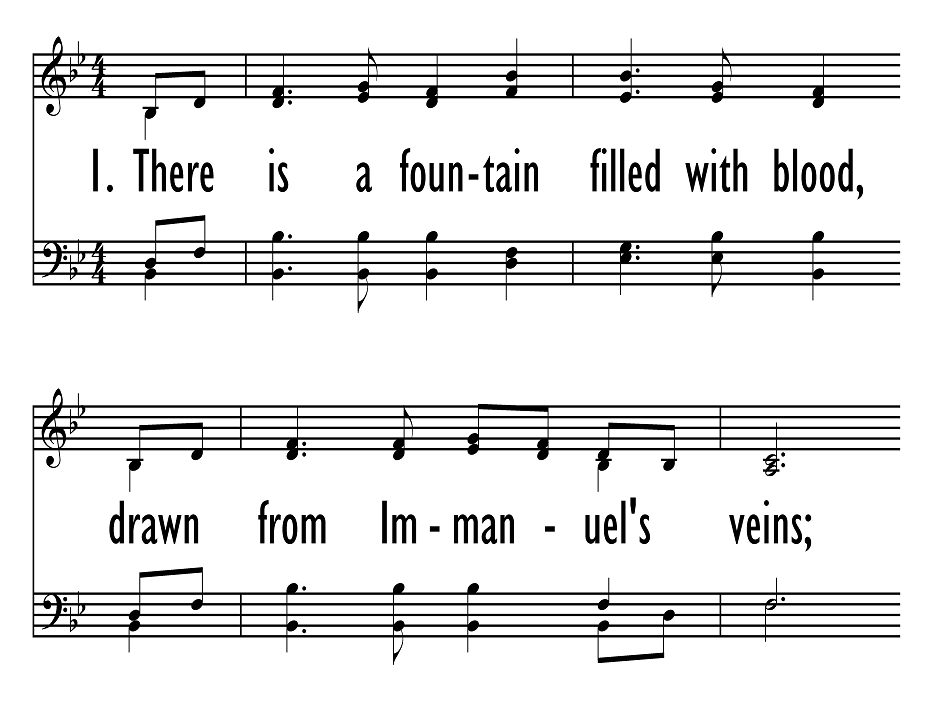
There is a Fountain filled with blood. W. Cowper. [Passiontide.] This hymn was probably written in 1771, as it is in Conyers's Collection of Psalms and Hymns, 1772, in 7 stanzas of 4 lines. It was republished in the Olney Hymns, 1779, Bk. i., No. 79, with the heading "Praise for the Fountain opened." It is based on Zech. xiii. 1, "In that day there shall be a Fountain opened to the house of David and to the inhabitants of Jerusalem for sin and for uncleanness." This hymn in full or abbreviated… Read More
There is a Fountain filled with blood. W. Cowper. [Passiontide.] This hymn was probably written in 1771, as it is in Conyers's Collection of Psalms and Hymns, 1772, in 7 stanzas of 4 lines. It was republished in the Olney Hymns, 1779, Bk. i., No. 79, with the heading "Praise for the Fountain opened." It is based on Zech. xiii. 1, "In that day there shall be a Fountain opened to the house of David and to the inhabitants of Jerusalem for sin and for uncleanness." This hymn in full or abbreviated is in extensive use in all English-speaking countries.
A well known form of this hymn is "From Calvary's Cross a Fountain flows." This appeared in Cotterill's Selection, 8th ed., 1819, No. 43, in 5 stanzas of 4 lines, and consists of stanzas i.-v. very much altered. In Bickersteth's Christian Psalmody, 1833, No. 49, that same opening stanza is given, with a return, in most of the remaining six stanzas, to the original text. The question as to by whom these alterations were made, first in Cotterill's Selection off 1819, and then in Bickersteth's Christian Psalmody, 1833, is answered by R. W. Dibdin, in the Christian Annotator, vol. iii., No. 76, for July 5, 1856, p. 278, where he writes concerning this hymn:—
"About 18 years ago, I was regretting to the late James Montgomery, the poet, of Sheffield, that hymns were so frequently printed differently from the originals as written by their authors. I pointed out the very hymn mentioned in the Rev. Edward Bickersteth's Collection as an example. He smiled, and said,'I altered it as you see it there; Bickersteth asked me to alter it.'"
We know from Montgomery's Memoirs that he altered hymns for Cotterill's 1819 edition of his Selection and here by his own confession we have one of those alterations. Previously to this, however, he had acknowledged having rewritten the 1819 text as in Cotterill's Selection in these words:—
”I entirely rewrote the first verse of that favourite hymn, commencing ‘There is a Fountain filled with blood.' The words are objectionable as representing a fountain being filled, instead of springing up; I think my version is unexceptional."
In these alterations of the text the sustained confidence and rapture of Cowper are entirely lost. This may suit public taste, but it gives an entirely false view of the state of Cowper's mind when he wrote this hymn. Our positive knowledge of the poet's frequent depression of spirits and despair is painful enough without this gratuitous and false addition thereto. Five stanzas of this hymn, taken from the commonly received text, are rendered into Latin in R. Bingham's Hymnologia Christiana Latina, 1871, as: "Fons est sanguine redundans." Dr. H. M. Macgill has however taken the original text for his rendering into Latin in his Songs of the Christian Creed and Life, 1876, where it reads:—"Sanguis en Emmanuelis." In addition to Latin, various forms of the text have been translated into many other languages.
--Excerpts from John Julian, Dictionary of Hymnology (1907)
Read Less

 My Starred Hymns
 My FlexScores
 My Hymnals
 My Purchased Files