My Starred Hymns
 My Hymnals
 My Purchased Files

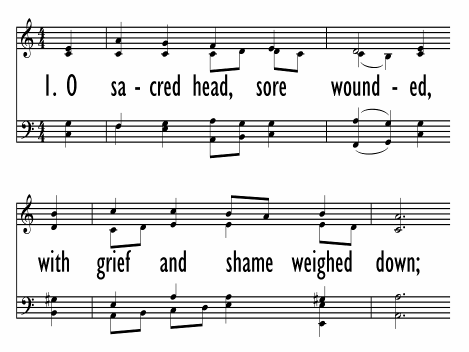
A Teaching Hymnal #38
Display Title: O Sacred Head, Now Wounded First Line: O sacred head, now wounded Tune Title: PASSION CHORALE Author: Anon. Date: 2018 Subject: Lent and Holy Week | Source: Latin
A Teaching Hymnal #38

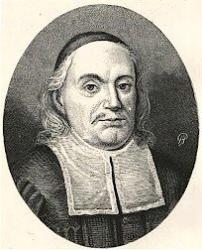 Paul Gerhardt (b. Gräfenheinichen, Saxony, Germany, 1607; d. Lubben, Germany, 1676), famous author of Lutheran evangelical hymns, studied theology and hymnody at the University of Wittenberg and then was a tutor in Berlin, where he became friends with Johann Crüger. He served the Lutheran parish of Mittenwalde near Berlin (1651-1657) and the great St. Nicholas' Church in Berlin (1657-1666). Friederich William, the Calvinist elector, had issued an edict that forbade the various Protestant groups to fight each other. Although Gerhardt did not want strife between the churches, he refused to comply with the edict because he thought it opposed the Lutheran "Formula of Concord," which condemned some Calvinist doctrines. Consequently, he was r… Go to person page >
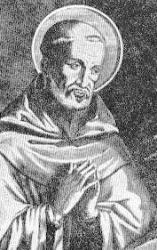 Bernard of Clairvaux, saint, abbot, and doctor, fills one of the most conspicuous positions in the history of the middle ages. His father, Tecelin, or Tesselin, a knight of great bravery, was the friend and vassal of the Duke of Burgundy. Bernard was born at his father's castle on the eminence of Les Fontaines, near Dijon, in Burgundy, in 1091. He was educated at Chatillon, where he was distinguished for his studious and meditative habits. The world, it would be thought, would have had overpowering attractions for a youth who, like Bernard, had all the advantages that high birth, great personal beauty, graceful manners, and irresistible influence could give, but, strengthened in the resolve by night visions of his mother (who had died in 1… Go to person page >
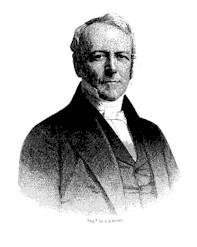 James W. Alexander (b. Hopewell, Louisa County, VA, 1804; d. Sweetsprings, VA, 1859) was often overshadowed by his father, the renowned Archibald Alexander, first professor at Princeton Theological Seminary. But James Alexander was also a fine preacher, teacher, and writer. He studied at New Jersey College (now Princeton University) and Princeton Seminary. Ordained in the Presbyterian Church, he alternated his career between teaching and pastoring; for two years (1849-1851) he was professor of ecclesiastical history and church government at Princeton Seminary. Alexander translated a number of hymns from Greek, Latin, and German but is mainly known today for his translation of "O Sacred Head."
Bert Polman… Go to person page >
James W. Alexander (b. Hopewell, Louisa County, VA, 1804; d. Sweetsprings, VA, 1859) was often overshadowed by his father, the renowned Archibald Alexander, first professor at Princeton Theological Seminary. But James Alexander was also a fine preacher, teacher, and writer. He studied at New Jersey College (now Princeton University) and Princeton Seminary. Ordained in the Presbyterian Church, he alternated his career between teaching and pastoring; for two years (1849-1851) he was professor of ecclesiastical history and church government at Princeton Seminary. Alexander translated a number of hymns from Greek, Latin, and German but is mainly known today for his translation of "O Sacred Head."
Bert Polman… Go to person page >