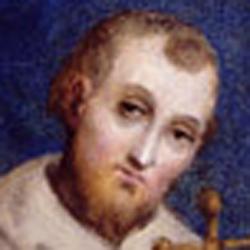
1182 - 1226 Person Name: Francis of Assisi Topics: God as Creator Author of "All Creatures of Our God and King" in Lift Up Your Hearts St. Francis of Assisi (Italian: San Francesco d'Assisi, born Giovanni di Pietro di Bernardone, but nicknamed Francesco ("the Frenchman") by his father, 1181/1182 – October 3, 1226) was an Italian Catholic friar and preacher. He founded the men's Order of Friars Minor, the women’s Order of St. Clare, and the Third Order of Saint Francis for men and women not able to live the lives of itinerant preachers followed by the early members of the Order of Friars Minor or the monastic lives of the Poor Clares. Though he was never ordained to the Catholic priesthood, Francis is one of the most venerated religious figures in history.
Francis' father was Pietro di Bernardone, a prosperous silk merchant. Francis lived the high-spirited life typical of a wealthy young man, even fighting as a soldier for Assisi. While going off to war in 1204, Francis had a vision that directed him back to Assisi, where he lost his taste for his worldly life. On a pilgrimage to Rome, he joined the poor in begging at St. Peter's Basilica. The experience moved him to live in poverty. Francis returned home, began preaching on the streets, and soon amassed a following. His Order was authorized by Pope Innocent III in 1210. He then founded the Order of Poor Clares, which became an enclosed religious order for women, as well as the Order of Brothers and Sisters of Penance (commonly called the Third Order).
In 1219, he went to Egypt in an attempt to convert the Sultan to put an end to the conflict of the Crusades. By this point, the Franciscan Order had grown to such an extent that its primitive organizational structure was no longer sufficient. He returned to Italy to organize the Order. Once his community was authorized by the Pope, he withdrew increasingly from external affairs. In 1223, Francis arranged for the first Christmas manger scene. In 1224, he received the stigmata, making him the first recorded person to bear the wounds of Christ's Passion.He died during the evening hours of October 3, 1226, while listening to a reading he had requested of Psalm 140.
On July 16, 1228, he was pronounced a saint by Pope Gregory IX. He is known as the patron saint of animals, the environment, and is one of the two patron saints of Italy (with Catherine of Siena). It is customary for Catholic and Anglican churches to hold ceremonies blessing animals on his feast day of October 4. He is also known for his love of the Eucharist, his sorrow during the Stations of the Cross, and for the creation of the Christmas creche or Nativity Scene.
Francis of Assisi was one of seven children born to Pietro, and his wife Pica de Bourlemont, about whom little is known except that she was a noblewoman originally from Provence, France. Pietro was in France on business while Francis was born in Assisi, and Pica had him baptized as Giovanni. When his father returned to Assisi, he took to calling him Francesco ("the Frenchman"), possibly in honour of his commercial success and enthusiasm for all things French. Since the child was renamed in infancy, the change can hardly have had anything to do with his aptitude for learning French, as some have thought.
As a youth, Francesco became a devotee of troubadours and was fascinated with all things Transalpine. Although many hagiographers remark about his bright clothing, rich friends, and love of pleasures, his displays of disillusionment toward the world that surrounded him came fairly early in his life, as is shown in the "story of the beggar." In this account, he was selling cloth and velvet in the marketplace on behalf of his father when a beggar came to him and asked for alms. At the conclusion of his business deal, Francis abandoned his wares and ran after the beggar. When he found him, Francis gave the man everything he had in his pockets. His friends quickly chided and mocked him for his act of charity. When he got home, his father scolded him in rage.
In 1201, he joined a military expedition against Perugia and was taken as a prisoner at Collestrada, spending a year as a captive. It is possible that his spiritual conversion was a gradual process rooted in this experience. Upon his return to Assisi in 1203, Francis returned to his carefree life and in 1204, a serious illness led to a spiritual crisis. In 1205, Francis left for Puglia to enlist in the army of the Count of Brienne. A strange vision made him return to Assisi, deepening his ecclesiastical awakening.
According to the hagiographic legend, thereafter he began to avoid the sports and the feasts of his former companions. In response, they asked him laughingly whether he was thinking of marrying, to which he answered, "yes, a fairer bride than any of you have ever seen," meaning his "Lady Poverty". He spent much time in lonely places, asking God for enlightenment. By degrees he took to nursing lepers, the most repulsive victims in the lazar houses near Assisi. After a pilgrimage to Rome, where he joined the poor in begging at the doors of the churches, he said he had a mystical vision of Jesus Christ in the country chapel of San Damiano, just outside of Assisi, in which the Icon of Christ Crucified said to him, "Francis, Francis, go and repair My house which, as you can see, is falling into ruins." He took this to mean the ruined church in which he was presently praying, and so he sold some cloth from his father's store to assist the priest there for this purpose.
His father, Pietro, highly indignant, attempted to change his mind, first with threats and then with beatings. In the midst of legal proceedings before the Bishop of Assisi, Francis renounced his father and his patrimony, laying aside even the garments he had received from him in front of the public. For the next couple of months he lived as a beggar in the region of Assisi. Returning to the countryside around the town for two years, he embraced the life of a penitent, during which he restored several ruined chapels in the countryside around Assisi, among them the Porziuncola, the little chapel of St. Mary of the Angels just outside the town, which later became his favorite abode.
At the end of this period (on February 24, 1209, according to Jordan of Giano), Francis heard a sermon that changed his life forever. The sermon was about Matthew 10:9, in which Christ tells his followers they should go forth and proclaim that the Kingdom of Heaven was upon them, that they should take no money with them, nor even a walking stick or shoes for the road. Francis was inspired to devote himself to a life of poverty.
Clad in a rough garment, barefoot, and, after the Gospel precept, without staff or scrip, he began to preach repentance. He was soon joined by his first follower, a prominent fellow townsman, the jurist Bernardo di Quintavalle, who contributed all that he had to the work. Within a year Francis had eleven followers. Francis chose never to be ordained a priest and the community lived as "lesser brothers," fratres minores in Latin. The brothers lived a simple life in the deserted lazar house of Rivo Torto near Assisi; but they spent much of their time wandering through the mountainous districts of Umbria, always cheerful and full of songs, yet making a deep impression upon their hearers by their earnest exhortations.
Francis' preaching to ordinary people was unusual since he had no license to do so. In 1209 he composed a simple rule for his followers ("friars"), (the Regula primitiva or “Primitive Rule”) which came from verses in the Bible. The rule was “To follow the teachings of our Lord Jesus Christ and to walk in his footsteps.” In 1209, Francis led his first eleven followers to Rome to seek permission from Pope Innocent III to found a new religious Order. Upon entry to Rome, the brothers encountered Bishop Guido of Assisi, who had in his company Giovanni di San Paolo, the Cardinal Bishop of Sabina. The Cardinal, who was the confessor of Pope Innocent III, was immediately sympathetic to Francis and agreed to represent Francis to the pope. Reluctantly, Pope Innocent agreed to meet with Francis and the brothers the next day. After several days, the pope agreed to admit the group informally, adding that when God increased the group in grace and number, they could return for an official admittance. The group was tonsured. This was important in part because it recognized Church authority and prevented his following from possible accusations of heresy, as had happened to the Waldensians decades earlier. Though Pope Innocent initially had his doubts, following a dream in which he saw Francis holding up the Basilica of St. John Lateran (the cathedral of Rome, thus the 'home church' of all Christendom), he decided to endorse Francis' Order. This occurred, according to tradition, on April 16, 1210, and constituted the official founding of the Franciscan Order. The group, then the "Lesser Brothers" (Order of Friars Minor also known as the Franciscan Order), preached on the streets and had no possessions. They were centered in Porziuncola, and preached first in Umbria, before expanding throughout Italy.
From then on, his new Order grew quickly with new vocations. When hearing Francis preaching in the church of San Rufino in Assisi in 1209, Clare of Assisi became deeply touched by his message and she realized her calling. Her cousin Rufino, the only male member of the family in their generation, also joined the new Order.
On the night of Palm Sunday, March 28, 1211, Clare sneaked out of her family's palace. Francis received Clare at the Porziuncola and hereby established the Order of Poor Ladies, later called Poor Clares. This was an Order for women, and he gave a religious habit, or dress, similar to his own to the noblewoman later known as St. Clare of Assisi, before he then lodged her and a few companions in a nearby monastery of Benedictine nuns. Later he transferred them to San Damiano. There they were joined by many other women of Assisi. For those who could not leave their homes, he later formed the Third Order of Brothers and Sisters of Penance. This was a fraternity composed of either laity or clergy whose members neither withdrew from the world nor took religious vows. Instead, they carried out the principles of Franciscan life in their daily lives. Before long this Order grew beyond Italy.
Determined to bring the Gospel to all God's creatures, Francis sought on several occasions to take his message out of Italy. In the late spring of 1212, he set out for Jerusalem, but he was shipwrecked by a storm on the Dalmatian coast, forcing him to return to Italy. On May 8, 1213, he was given the use of the mountain of La Verna (Alverna) as a gift from Count Orlando di Chiusi, who described it as “eminently suitable for whoever wishes to do penance in a place remote from mankind.”[21][22] The mountain would become one of his favourite retreats for prayer. In the same year, Francis sailed for Morocco, but this time an illness forced him to break off his journey in Spain. Back in Assisi, several noblemen (among them Tommaso da Celano, who would later write the biography of St. Francis) and some well-educated men joined his Order. In 1215, Francis went again to Rome for the Fourth Lateran Council. During this time, he probably met a canon, Dominic de Guzman (later to be Saint Dominic, the founder of the Friars Preachers, another Catholic religious order). In 1217, he offered to go to France. Cardinal Ugolino of Segni (the future Pope Gregory IX), an early and important supporter of Francis, advised him against this and said that he was still needed in Italy.
In 1219, accompanied by another friar and hoping to convert the Sultan of Egypt or win martyrdom in the attempt, Francis went to Egypt where a Crusader army had been encamped for over a year besieging the walled city of Damietta two miles (3.2 km) upstream from the mouth of one of the main channels of the Nile. The Sultan, al-Kamil, a nephew of Saladin, had succeeded his father as Sultan of Egypt in 1218 and was encamped upstream of Damietta, unable to relieve it. A bloody and futile attack on the city was launched by the Christians on August 29, 1219, following which both sides agreed to a ceasefire which lasted four weeks.It was most probably during this interlude that Francis and his companion crossed the Saracen lines and were brought before the Sultan, remaining in his camp for a few days. The visit is reported in contemporary Crusader sources and in the earliest biographies of Francis, but they give no information about what transpired during the encounter beyond noting that the Sultan received Francis graciously and that Francis preached to the Saracens without effect, returning unharmed to the Crusader camp. No contemporary Arab source mentions the visit. One detail, added by Bonaventure in the official life of Francis (written forty years after the event), concerns an alleged challenge by Francis offering trial-by-fire in order to prove the veracity of the Christian Gospel.Although Bonaventure does not suggest as much, subsequent biographies went further, claiming that a fire was kindled which Francis unhesitatingly entered without suffering burns. Such an incident is depicted in the late 13th-century fresco cycle, attributed to Giotto, in the upper basilica at Assisi (see accompanying illustration). According to some late sources, the Sultan gave Francis permission to visit the sacred places in the Holy Land and even to preach there. All that can safely be asserted is that Francis and his companion left the Crusader camp for Acre, from where they embarked for Italy in the latter half of 1220. Drawing on a 1267 sermon by Bonaventure, later sources report that the Sultan secretly converted or accepted a death-bed baptism as a result of the encounter with Francis. The Franciscan Order has been present in the Holy Land almost uninterruptedly since 1217 when Brother Elias arrived at Acre. It received concessions from the Mameluke Sultan in 1333 with regard to certain Holy Places in Jerusalem and Bethlehem, and (so far as concerns the Catholic Church) jurisdictional privileges from Pope Clement VI in 1342.
At Greccio near Assisi, around 1220, Francis celebrated Christmas by setting up the first known presepio or crèche (Nativity scene). His nativity imagery reflected the scene in traditional paintings. He used real animals to create a living scene so that the worshipers could contemplate the birth of the child Jesus in a direct way, making use of the senses, especially sight. Thomas of Celano, a biographer of Francis and Saint Bonaventure both, tell how he only used a straw-filled manger (feeding trough) set between a real ox and donkey. According to Thomas, it was beautiful in its simplicity with the manger acting as the altar for the Christmas Mass.
By this time, the growing Order of friars was divided into provinces and groups were sent to France, Germany, Hungary, Spain and to the East. When receiving a report of the martyrdom of five brothers in Morocco, Francis returned to Italy via Venice. Cardinal Ugolino di Conti was then nominated by the Pope as the protector of the Order. The friars in Italy at this time were causing problems, and as such, Francis had to return in order to correct these problems. The Franciscan Order had grown at an unprecedented rate, when compared to prior religious orders, but its organizational sophistication had not kept up with this growth and had little more to govern it than Francis' example and simple rule. To address this problem, Francis prepared a new and more detailed Rule, the "First Rule" or "Rule Without a Papal Bull" (Regula prima Regula non bullata) which again asserted devotion to poverty and the apostolic life. However, it introduced greater institutional structure, although this was never officially endorsed by the pope.
On September 29, 1220, Francis handed over the governance of the Order to Brother Peter Catani at the Porziuncola. However, Brother Peter died only five months later, on March 10, 1221, and was buried in the Porziuncola. When numerous miracles were attributed to the deceased brother, people started to flock to the Porziuncola, disturbing the daily life of the Franciscans. Francis then prayed, asking Peter to stop the miracles and to obey in death as he had obeyed during his life. The reports of miracles ceased. Brother Peter was succeeded by Brother Elias as Vicar of Francis. Two years later, Francis modified the "First Rule" (creating the "Second Rule" or "Rule With a Bull"), and Pope Honorius III approved it on November 29, 1223. As the official Rule of the order, it called on the friars "to observe the Holy Gospel of our Lord Jesus Christ, living in obedience without anything of our own and in chastity." In addition, it set regulations for discipline, preaching, and entry into the order. Once the Rule was endorsed by the Pope, Francis withdrew increasingly from external affairs. During 1221 and 1222, Francis crossed Italy, first as far south as Catania in Sicily and afterwards as far north as Bologna.
While he was praying on the mountain of Verna, during a forty-day fast in preparation for Michaelmas (September 29), Francis is said to have had a vision on or about September 14, 1224, the Feast of the Exaltation of the Cross, as a result of which he received the stigmata. Brother Leo, who had been with Francis at the time, left a clear and simple account of the event, the first definite account of the phenomenon of stigmata. "Suddenly he saw a vision of a seraph, a six-winged angel on a cross. This angel gave him the gift of the five wounds of Christ." Suffering from these stigmata and from trachoma, Francis received care in several cities (Siena, Cortona, Nocera) to no avail. In the end, he was brought back to a hut next to the Porziuncola. Here, in the place where it all began, feeling the end approaching, he spent the last days of his life dictating his spiritual testament. He died on the evening of October 3, 1226, singing Psalm 142(141) – "Voce mea ad Dominum".
--en.wikipedia.org/wiki/Francis_of_Assisi (excerpts)
St. Francis of Assisi


 My Starred Hymns
 My FlexScores
 My Hymnals
 My Purchased Files