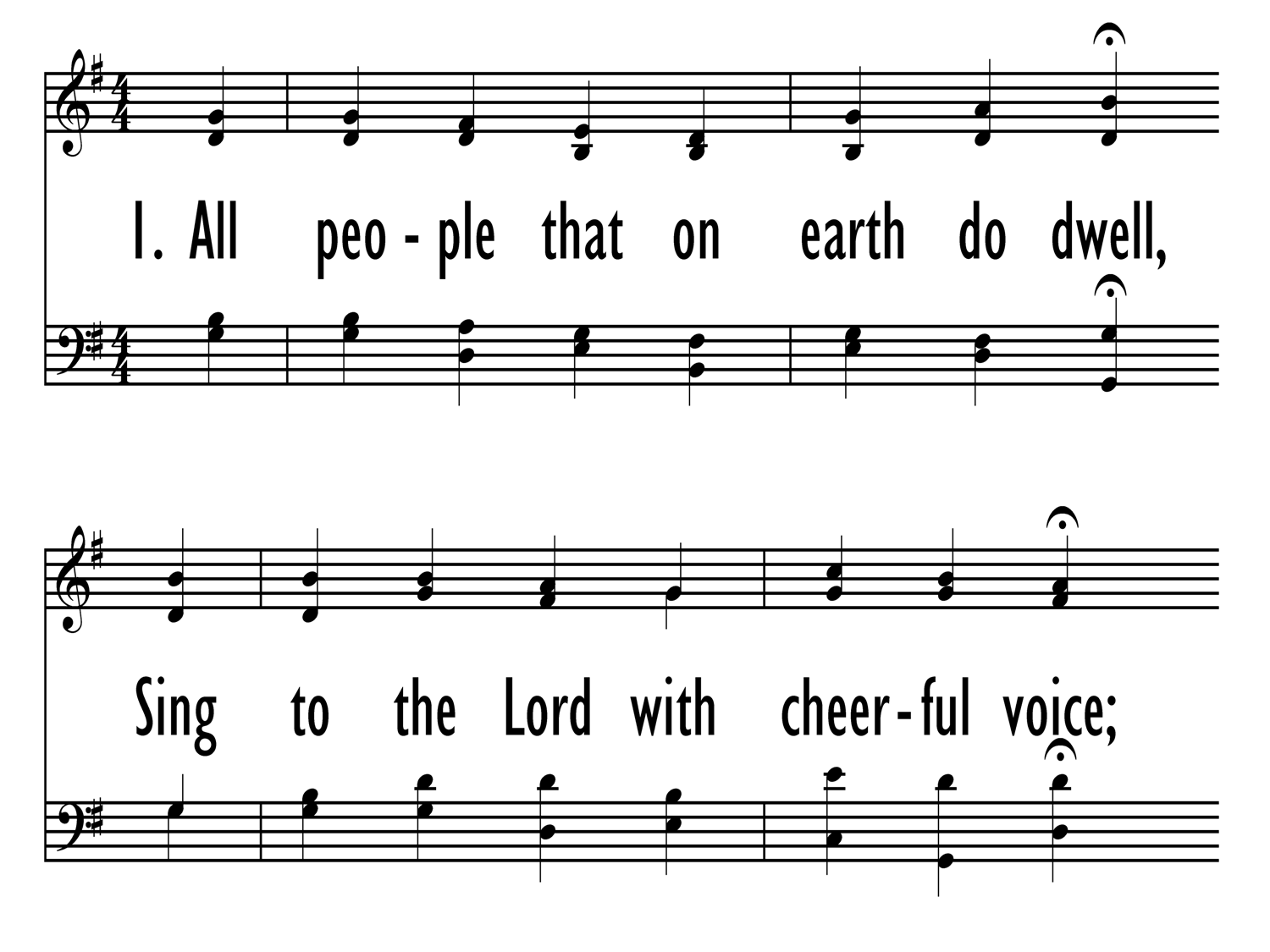
A call to praise the LORD for showing grace and faithfulness toward "the sheep of his pasture" (v.3).
Scripture References:
st. 1 = vv. 1-2
st. 2 = v. 3
st. 3 = v. 4
st. 4 = v. 5
Psalm 100 brings to a close a collection of psalms that celebrate the LORD's righteous rule over all creation (93, 95-99). Like the others, it was composed to be sung by the Levites at a high religious festival that annually celebrated the LORD's kingship over the entire world (perhaps the Feast of Tabernacles). Psalm 100 is the Hebrew equivalent of a cheerleader's shout–a strong call to worship the LORD with joyful song (st. 1, 3): the LORD is the one true God who made us to be "the sheep of his pasture" (st. 2), and God's love and faithfulness never fail (st. 4).
The Psalter Hymnal includes both an English and a French versification. The English text by William Kethe (b. Scotland [?], date unknown; d. Dorset, England, c. 1594) is the oldest metrical psalm text in the Psalter Hymnal It first appeared in the Anglo-Genevan Psalter of l561 and in John Day's Psalmes of David in English Metre (PHH 69), also of 1561. Since then it has been published in virtually all English-language psalters and hymnals. The French text (opposite 101 in the Psalter Hymnal) is taken from the French hymnal Psaumes et Cantiques (1891); it is included as a tribute to the original language of the Calvinist Psalter.
Both the time and place of Kethe's birth and death are unknown, although scholars think he was a Scotsman. A Protestant, he fled to the continent during Queen Mary's persecution in the late 1550s. He lived in Geneva for some time but traveled to Basel and Strasbourg to maintain contact with other English refugees. Kethe is thought to be one of the scholars who translated and published the English-language Geneva Bible (1560), a version favored over the King James Bible by the Pilgrim fathers. The twenty-five psalm versifications Kethe prepared for the Anglo-Genevan Psalter of 1561 were also adopted into the Scottish Psalter of 1565. His versification of Psalm 100 is the only one that found its way into modern psalmody.
Liturgical Use:
Many uses beyond its traditional role at the beginning of worship.
--Psalter Hymnal Handbook
===========================
All people that on earth do dwell. [Ps. c.] The memories which have gathered round this rendering of the 100th Psalm, together with the uncertainty of its authorship, require us to trace its history, to note its true text, and to determine, if possible, its author,
I.History.—It appeared for the first time in the Psalter, published in London by John Daye, in 1560-1, and in the Anglo-Genevan Psalter, printed at Geneva, in 1561. In the full English Psalter of 1562 it is not found, but in an Appendix to the edition of 1564 (British Museum) it is given, and again in the body of the work in 1565 (Brit. Mus.). It was also included in the Scottish Psalter of 1564. From 1564 it reappeared in all editions of the English and Scottish Psalters, and is also found in most hymnbooks published during the past 150 years.
II. Text.—The original text from the only copy of Daye's Psalter, 1560-1, known, and in which it is printed in the old black-letter text of the period, is as follows:—
"Psalme C.
Al people yt on earth do dwel,
sing to yc lord, with chereful voice
Him serve wt fear, his praise forth tel,
come ye before him and reioyce.
The Lord ye know is God in dede,
with out our aide, he did us make:
We are his folck, he doth us fede,
and for his Shepe, he doth us take.
Oh enter then his gates with prayse
approche with ioye, his courtes unto:
Praise, laude, and blesse his name alwayes,
for it is semely so to doe.
For why? the Lord our God is good,
his mercy is for euer sure:
His trueth at all tymes firmely stood
and shall from age to age indure."
[Orig. ed. 1560-1, London, J. Daye.]
In what form this text reached Geneva, whether in manuscript or in a copy of Daye's edition, cannot be determined.
III. Authorship.—This is somewhat difficult to determine. The evidence is this:—
1. Daye's Psalter, 1560-1. No signature.
2. Anglo-Genevan Psalter, 1561. "Tho. Ster."
3. Britwell Psalter, 1561. "W. Ke."
4. Scottish Psalter, 1564. " W. Ke."
5. Daye's Appendix, 1564. No signature.
6. Daye's Psalter, 1565. No signature.
7. Daye's Psalter, 1566. No signature.
8. Crespin's Psalter (Geneva), 1561). No signature.
9. Daye's Psalter, 1579. No signature.
10. Daye's Psalter, 1587. "J. H."
These are all the Psalters known which have any value in determining the question. This evidence is certainly in favour of W. Kethe, and this is the more conclusive when we remember that the Britwell Psalter, 1561, and the Scottish Psalter of 1564, are reprints of the Anglo-Genevan Psalter, with
such corrections in spelling as an English work printed on the Continent would call for, and constitute together a distinct family from the Daye Psalters. The metre is also in Kethe's favour, and decisive against both Sternhold and Hopkins. Its correct subscription is therefore "W. Kethe, 1560-1."
Although the history of tunes forms no part of our work, a few facts concerning "The Old Hundredth " may not be unacceptable. It first appeared in the enlarged edition of the French Genevan Psalter, published in 1551, as the tune to Ps. cxxxiv. The first half of the tune is a musical phrase which is found in various combinations both before and after that time; but the latter part of the tune, and the form of the whole of it, is the work of Louis Bourgeois, who, and not Guillaume Franc, is now known to be the editor of this edition of the French Genevan Psalter. Kethe's version of Ps. c. was doubtless written for this tune.
-- Excerpts from John Julian, Dictionary of Hymnology (1907)


 My Starred Hymns
 My FlexScores
 My Hymnals
 My Purchased Files